Location
Mount Vernon, WA 98274

Location
Mount Vernon, WA 98274
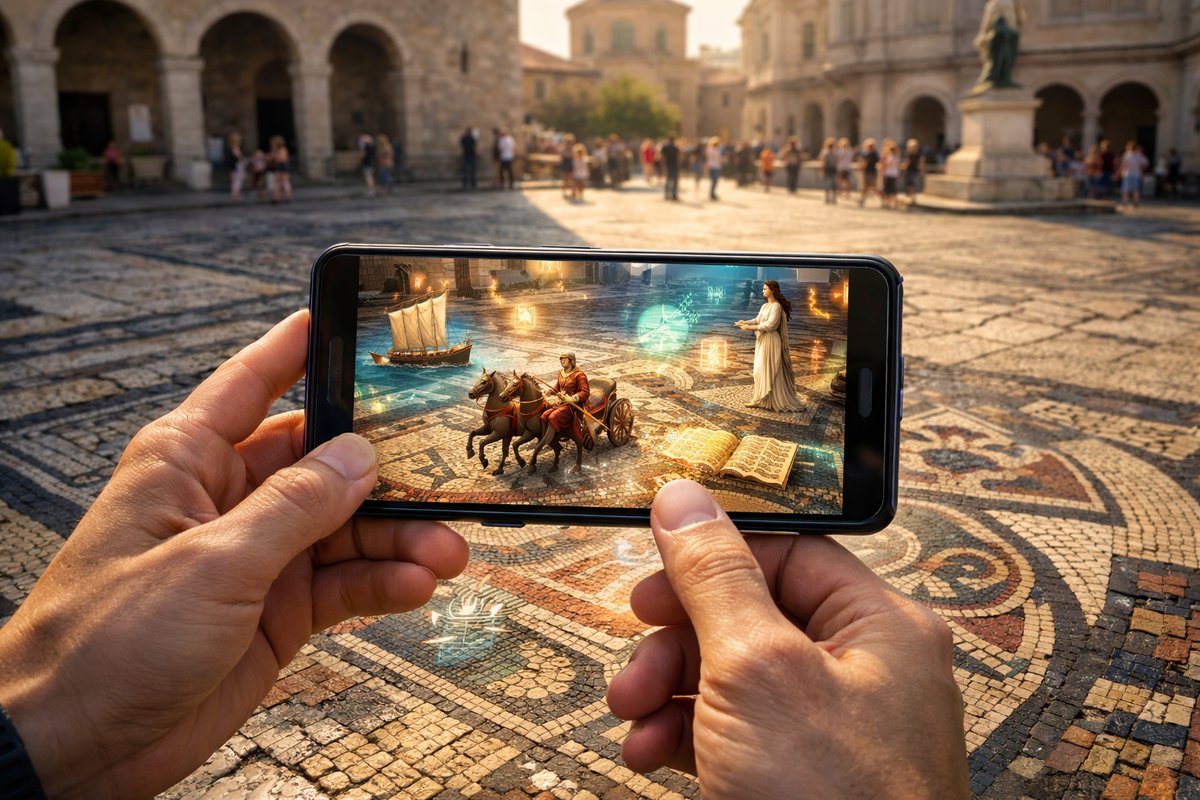
A sunlit plaza's mosaic floor transforms beneath the lens of a smartphone, revealing hidden animations and archival tales layered atop centuries-old stones. This fusion of ancient tesserae and custom AR technology invites visitors to explore public art that lives between tectonic permanence and digital flux.
On a sun-drenched plaza in the heart of a European capital, onlookers now pause not just to admire centuries-old architecture but to peer through the lens of a smartphone, where tile meets technology. A sprawling mosaic floor-rendered in cool marbles, deep jades, and flecks of recycled glass-comes alive with living patterns, animated shapes, and hidden narratives once dormant in stone. When viewed through a custom-built augmented reality app, the installation transforms, revealing swirling constellations and archival photographs that hover just above the tiled surface, inviting passersby to explore art in motion.
In many ways, this AR-enhanced mosaic follows a lineage stretching back to Roman peristyles and Byzantine basilicas, where tesserae of glass and stone were woven into complex stories of faith, power, and myth. Traditional mosaic artists hand select each piece of material-marble, ceramic, smalt-to create images that endure for millennia. Yet the same desire to capture epic tales, to arrest the viewer’s imagination, now finds a digital echo in ephemeral animations calibrated to live within the cracks and seams of ancient craft.
Behind this fusion of old and new stands a multidisciplinary design collective that spent nearly a year deducing how to anchor digital layers to irregular surfaces. Their process began with 3D scans of the plaza’s contours, followed by the design of animation loops that respond to the viewer’s angle, distance, and even time of day. Code and stone became collaborators: as sunlight shifts, so does the opacity of layers, and as a pedestrian moves, hidden glyphs emerge, spawning a choreography of light that defies the mosaic’s static origin.
Technically, the project relies on markerless tracking algorithms and light-field mapping. Instead of gluing QR codes to polished marble, developers used real-time surface recognition to identify geometric patterns within the tiles themselves. When a device’s camera locks onto a cluster of tesserae, it triggers bursts of pixel-precise animations-fragmenting the boundary between digital and physical space. The result is a minimal interface: no menus to navigate, no buttons to press, just a gesture of pointing and a breath-held instant when the past and future converge in the tile-laced earth.
Material choices reflect a deep respect for place. Artisans harvested recycled bottle glass from local repurposing centers, blending it with salvaged stone quarried from nearby ruins. Natural pigments derived from ochre and lapis were applied to accentuate contrast zones where digital effects would take hold. The physical mosaic covers nearly three hundred square meters, each tessera cut to fit an invisible raster grid that aligns with an underlying mesh of AR coordinates. The marriage of material science and digital mapping underscores a broader design ethos: marry sustainability with sensory wonder.
Every weekend since the unveiling, open studios adjacent to the plaza host collaborative workshops. Under the guidance of master mosaicists, participants learn how to place tile, polish edges, and dream up visual motifs. In parallel sessions led by software engineers, newcomers sketch simple animations in node-based tools and see them mapped onto 3D models of the plaza in real time. By the end, amateur artisans walk away with both a sample tile to inset into a collective wall and a custom AR filter they can share on social platforms, bridging hands-on craft with code.
Local students have become avid explorers, scanning hidden patterns that unlock audio narratives recorded by elderly residents who helped build the city after a major storm decades ago. As each layer is revealed, memories encoded in stone, paint, and voice overlap, giving visitors a layered sense of history. Parents hover behind their children, smartphones aloft, watching 3D butterflies emerge from sinuous mosaics, while elders nod at familiar designs now animated in ways they never imagined. The piece becomes communal: a living repository of collective memory.
Sustainability lies at the heart of the operation. Servers hosting the AR content are powered by nearby solar canopies, and a minimal-wattage LED projector system provides docking stations where those without compatible devices can experience the animation in place. Event lighting uses low-energy protocols, and all printed workshop materials are on post-consumer paper. Even the app’s code base is open source, inviting optimizations that reduce data usage and extend battery life. An uneasy question-digital art often consumes vast resources-finds an answer in mindful design choices.
Yet the road to seamless integration was not without hurdles. Strong midday sun can flood sensor arrays, confusing the surface recognition system, while colder conditions shift the stone’s microstructure, demanding recalibration. Early prototypes relied on off-the-shelf AR toolkits that struggled with irregular geometry, prompting a shift to custom scripts tuned to the tile dimensions. Engineers wrestled with latency spikes when dozens of devices pinged the server simultaneously, leading to the deployment of a decentralized peer-to-peer caching system that keeps animations responsive, even in crowded crowds.
At its core, this fusion of mosaic and code raises philosophical questions about permanence and ephemerality. Stone tesserae, laid by human hands, endure in place; code, by contrast, is slippery, updateable, and invisible until summoned. Viewers must reconcile a form of art that is physically present yet only fully legible through an electronic intermediary. The installation challenges our assumptions: is the primary artwork the colored tile underfoot, or the flickering digital constellation above it? The tension becomes the point of meditation.
Feedback from visitors has been overwhelmingly emotional. One passerby described standing motionless as a silent chorus of petal-like shapes swirled around her ankles, likening the moment to a personal heartbeat made visible. Another confessed to tears when archival photographs of long-lost public gardens rose from the pavement, trailing vines that skirted faded inscriptions. Instagram stories exploded with slow-motion captures of pixel rains and kaleidoscopic tile shifts, yet many insisted they experienced far more than a mere filter-they felt glimpses of a shared past, refracted through a digital lens.
Designers behind the project are already sketching new iterations. Sound triggers set to emerging birdcalls could layer ambient audio atop existing visuals. Haptic elements embedded in handrails flanking the mosaic might vibrate in sync with pattern changes. Nighttime projections onto surrounding façades-mapped to hidden markers in the stone-could expand the installation into three dimensions. And as cities explore networked public art, similar AR-augmented mosaics may form a constellation of interactive floor panels that guide pedestrians through thematic urban trails.
For design teams aspiring to create their own blended installations, certain tools prove indispensable. A high-resolution AR-ready tablet with robust cameras helps test alignment and track prototypes on site. Portable mini projectors, charged by external battery packs, enable demos after hours, projecting animations onto flat surfaces. And a precision digital stylus aids in sketching both pattern motifs and motion paths, seamlessly translating drawing gestures into timeline-based animation frames. Together, these tools shrink the gap between imagination and installation.
On the materials side, seek out recycled glass packets graded for color consistency, and partner with stone fabricators experienced in patchwork tiling. Open-source AR frameworks simplify early-stage development, while lightweight peer-to-peer networking libraries keep content flowing without overloading local networks. Invite local craft guilds into the process: their knowledge of historical techniques can inform the placement of every marble square. And don’t underestimate the value of user testing-guerrilla deploy prototypes with thick paper prints to gauge foot traffic and interaction points before cutting a single tile.
In the end, the marriage of ancient mosaic traditions and interactive code exemplifies the boundless possibilities when creativity meets curiosity. It reminds us that art need not dwell solely in galleries or on walls but can unfold beneath our feet, layered in stone and light. By honoring materials, inviting participation, and harnessing digital alchemy, designers forge experiences that resonate on both tactile and transcendent levels. For those who believe in the power of hybrid expression, the plaza stands as an open invitation to step forward, point a phone, and discover hidden worlds.