Location
Mount Vernon, WA 98274

Location
Mount Vernon, WA 98274
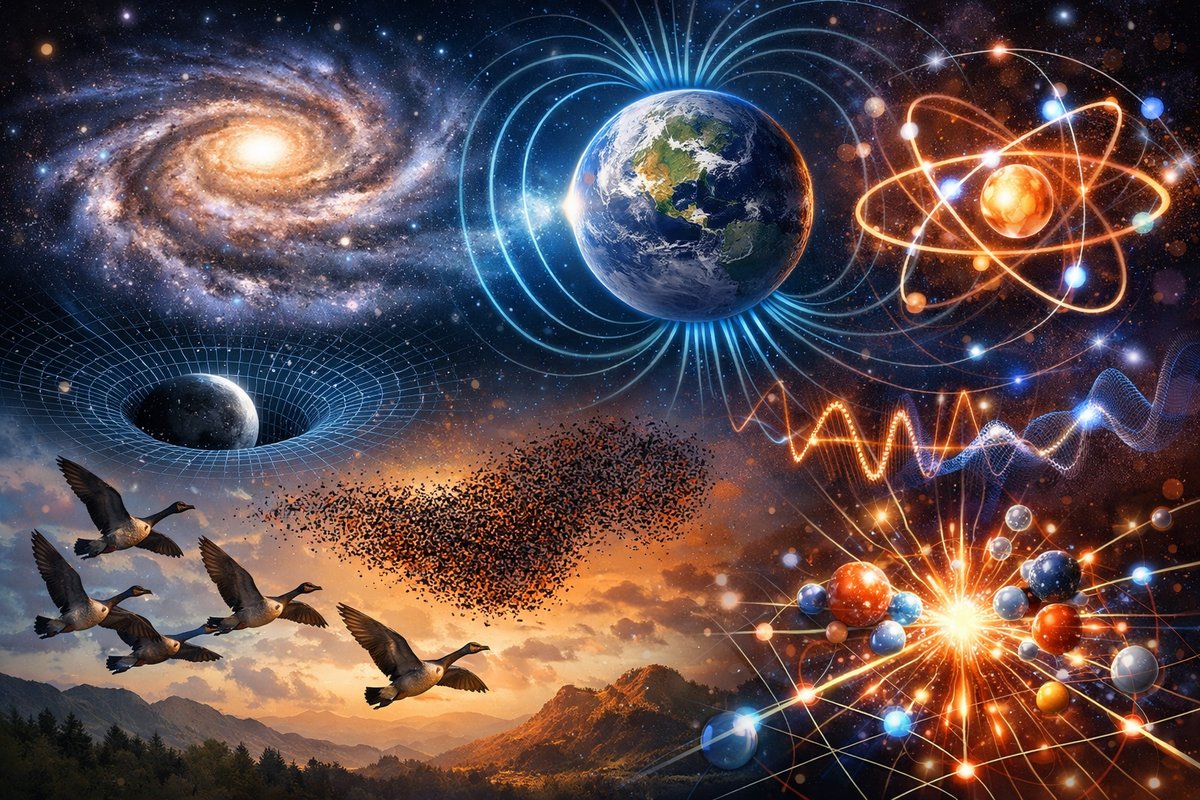
Explore how gravity's tug, magnetic fields, emergent patterns and quantum oddities reveal a coherent tapestry of natural forces. This article traces the invisible threads that bind galaxies, guide migrating birds, choreograph swarms and unlock subatomic secrets.
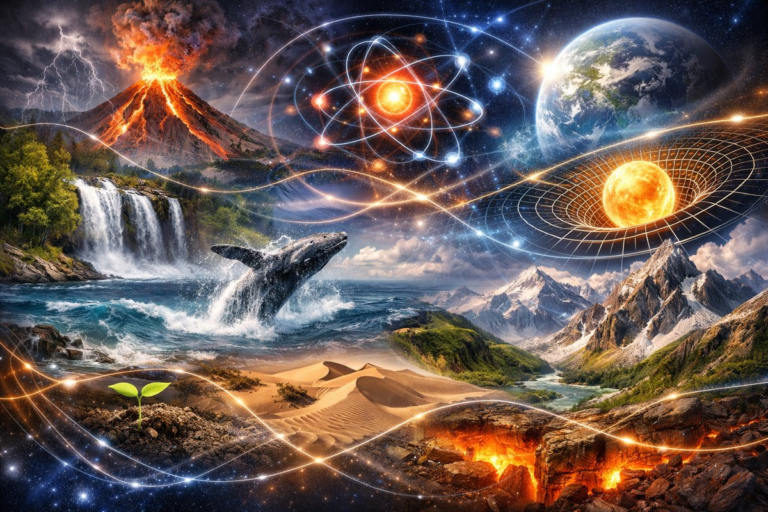
Nature weaves an intricate tapestry of forces and patterns that transcend scale, from the motion of planets to the flicker of subatomic particles. By decoding these phenomena, scientists and curious minds alike open a window onto the elegant principles that shape our world. Gravity, magnetism, emergent systems and quantum quirks each offer a unique lens, yet they share a surprising kinship in how simple rules can generate breathtaking complexity. As we embark on this journey of discovery, we meet ripples in spacetime, invisible compass lines, self organized swarms and entangled particles that challenge our intuitions and spark wonder.
Gravity is the silent architect of cosmic structure, guiding planets in orbits and sculpting galaxies over billions of years. While we feel its pull every day, recent advances have revealed far more subtle ripples in the fabric of spacetime. Gravitational wave detectors now catch faint tremors from colliding black holes and merging neutron stars, translating cosmic cataclysms into audible signals. These discoveries confirm predictions made a century ago and usher in an era of multi messenger astronomy, where light, gravity and particles combine to tell a richer story of the universe.
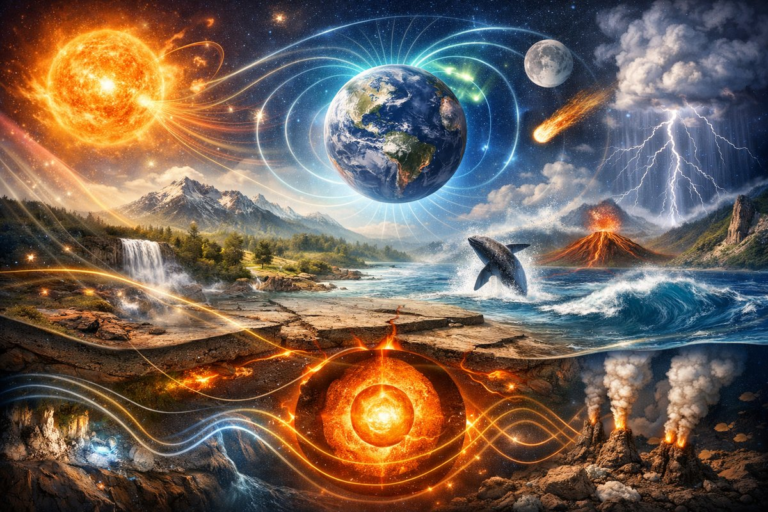
On the scale of our own planet, gravity continues to surprise. Ultra sensitive torsion pendulums detect minute variations in Earth’s density, mapping subterranean structures and ancient geological faults. Desktop Foucault pendulums dramatize Earth’s rotation with hypnotic arcs, reminding us that even in a quiet room we share a dance with our spinning globe. From precision gravimeters used to monitor volcanic swelling to weightless experiments aboard parabolic flights, gravity remains central to both exploration and innovation.
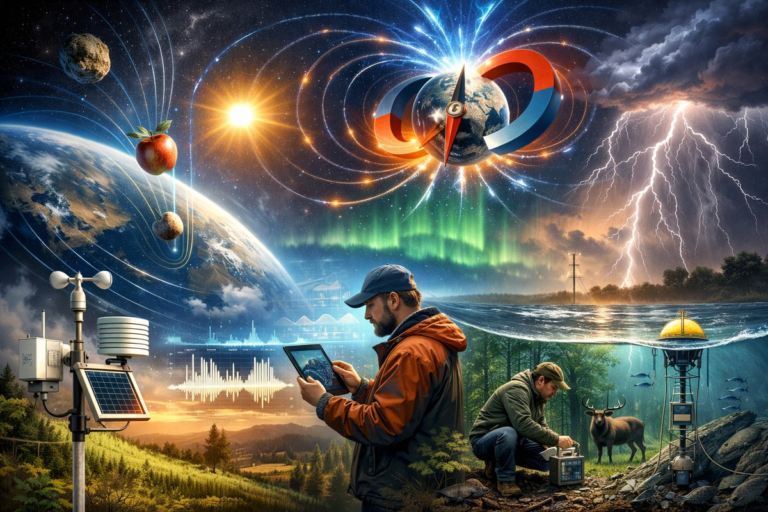
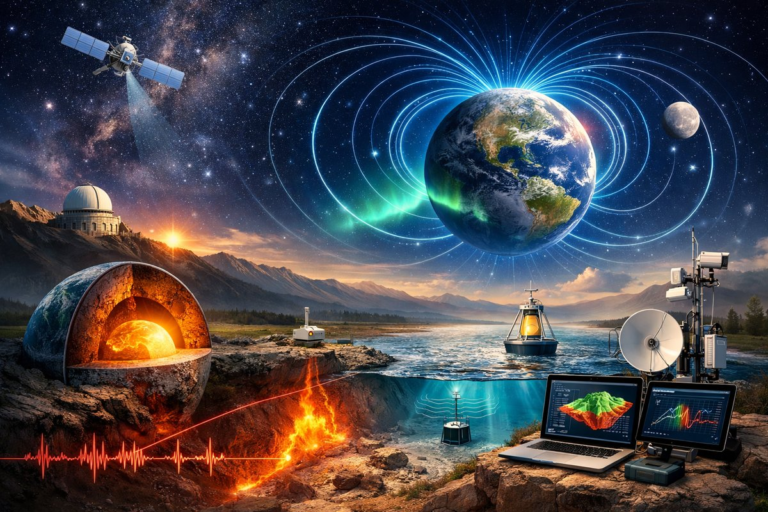
Electromagnetism binds electrons into atoms and fuels the lights and motors of our civilization, yet its subtleties extend far beyond. Migratory birds and sea turtles navigate thousands of miles by sensing Earth’s magnetic field, tapping into invisible compass lines etched across the planet. Researchers are unraveling the proteins and minerals in animal tissues that function as natural magnetometers, potentially revolutionizing navigation technology with bio inspired sensors.
Back in the laboratory, magnetic domains dance within metal crystals and ceramics, flipping orientation in response to tiny field changes. Ferrofluid displays shift into fluid sculptures under external magnets, revealing patterns that evoke alien landscapes. Magnetic resonance imaging exploits spin alignment to peer inside the human body, while magnetohydrodynamic experiments in plasmas shed light on solar flares and fusion prospects. Whether in living creatures or molten matter, magnetism bridges the living and the cosmic.
When individuals follow simple rules, astonishing collective behaviors often emerge. A single ant knows little of its colony’s grand design, yet an ant trail unfurls like a living highway. Flocks of starlings twist and turn in unison, generating fluid shapes that defy prediction. Even waves crashing on a shore carry within them a hidden choreography of vortices and eddies, governed by the interplay of momentum and fluid viscosity.
Mathematical models of reaction diffusion spawn the spots and stripes of animal coats, while cellular automata illustrate how local interactions yield global order. Swarming robots use analogous algorithms to coordinate search and rescue missions, inspired directly by insects. In chemical reactors, oscillating reactions pulse in time, demonstrating that static ingredients can give rise to rhythmic patterns. Emergence reminds us that complexity need not require complexity at its roots.
Venture deep into the microscopic realm and you enter a theater of paradox. Particles behave like waves, position and momentum trade places in uncertainty, and entangled pairs communicate correlations instantaneously across distance. Quantum sensors harness these quirks to detect minute fields and frequencies, improving timekeeping, navigation and medical imaging.
Cold atom experiments trap clouds of ultracold gas in magnetic fields, forming Bose Einstein condensates that flow without friction. Such states offer a glimpse of matter acting as a single quantum entity on a macroscopic scale. Quantum optics labs parse light into individual photons, using them to test the foundations of reality and to secure communications through unhackable cryptographic schemes. Each new experiment deepens the mystery and suggests applications once confined to speculation.
Across these domains, common themes emerge. Scale invariance appears in fractal coastlines, turbulent cascades and even in the distribution of certain quantum energy levels. Feedback loops give rise to self amplification in gravitational lenses, magnetic dynamos and ecosystem networks. The interplay of symmetry and symmetry breaking guides phase transitions in superfluids, ferromagnets and the early universe alike.
Decoding these natural algorithms does more than satisfy curiosity. It inspires new materials that self assemble, sensors that detect the faintest signals, and robotics that coordinate like living creatures. It refines climate models by integrating emergent feedbacks and helps us anticipate seismic or volcanic threats through gravitational monitoring. Quantum research lays the groundwork for computers that could solve intractable problems overnight. In every case, nature’s blueprint offers elegant strategies for technology and conservation.
Our journey through gravity, magnetism, emergence and quantum phenomena shows that the laws governing the cosmos are simultaneously simple and wondrously intricate. By studying nature’s hidden patterns, we not only unveil the mechanics of reality but also cultivate a profound sense of interconnectedness. Whether listening to the faint hum of spacetime or tracing magnetic lines over a piece of iron filings paper, we wield science as a lens of awe and stewardship. As we refine our understanding, we open new frontiers of exploration-guided by the very forces that shaped us.
The tapestry of natural forces and phenomena is far from fully unraveled. Future gravitational observatories will peer deeper into cosmic history, while novel magnetic materials could transform energy storage. Advances in complexity science promise smarter cities and resilient ecosystems, and quantum technologies edge ever closer to practical breakthroughs. Curiosity remains our compass, leading us toward discoveries that will reshape how we live, learn and commune with the living galaxy we inhabit.