Location
Mount Vernon, WA 98274

Location
Mount Vernon, WA 98274
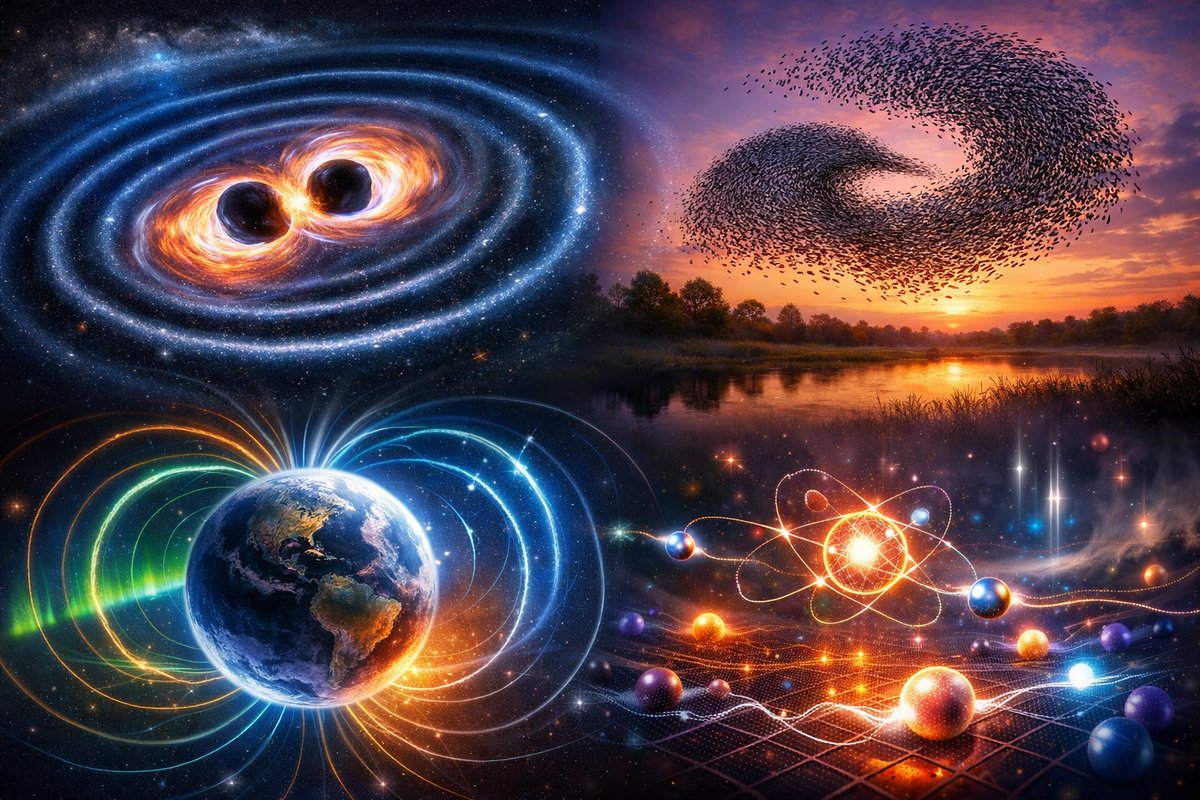
From the tremor of colliding black holes to the swirls of starlings at dusk, nature speaks in patterns. Scientists are decoding gravity's ripple, Earth's magnetic tapestry, collective behaviors in living systems, and the strangest rules of the quantum realm.
In a quiet lab deep beneath a mountain, a team of physicists listens for the faintest tremor in spacetime. Thousands of kilometers away, satellites chart shifts in Earth’s magnetic shield. At the same time, biologists track waves of movement in an ant colony, and chemists watch electrons tunnel through barriers smaller than a grain of sand. These efforts share a common purpose: to decode nature’s hidden metrics, the forces and phenomena that shape our world and invite wonder.
Gravity, the first force woven into human consciousness, still harbors mysteries. Since the groundbreaking detection of gravitational waves by a network of precision interferometers more than half a decade ago, dozens of cosmic collisions have been cataloged, each event offering a glimpse of black holes merging or neutron stars coalescing. Instruments planned for launch in the years ahead promise to extend that range, tuning into low-frequency ripples from supermassive black holes millions of light-years away. Meanwhile, tabletop experiments using cryogenic torsion balances and atom interferometry are probing gravity at submillimeter scales, searching for deviations that could hint at extra dimensions.
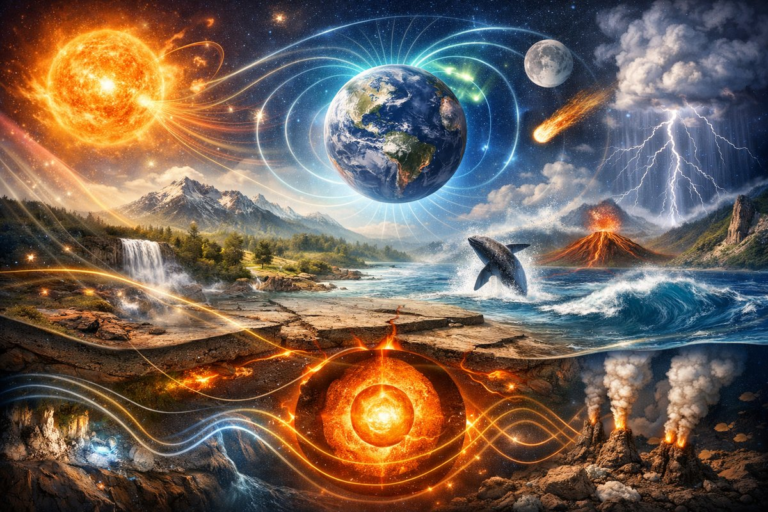
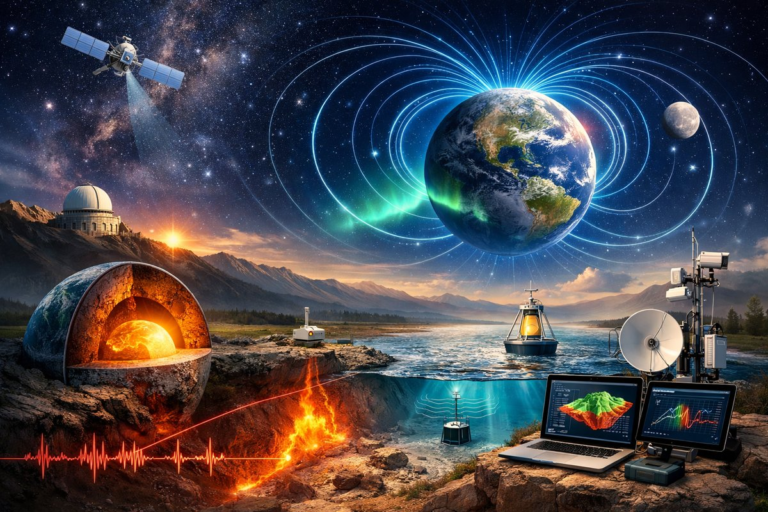
On Earth, magnetism masquerades as a simple compass needle pointing north. Yet the field that guides migratory birds and shields our atmosphere is a turbulent tapestry. A trio of Earth-observing satellites currently map the shifting currents of molten iron deep beneath the core. Recent data revealed a dramatic weakening of the magnetic field over the South Atlantic, prompting new models of core dynamics. Closer to home, engineers use magnetoresistive sensors to track minute changes in magnetic lines, improving navigation systems in environments where GPS fails. Meanwhile, magnetotactic bacteria, which orient using biomineralized magnets, inspire research into biohybrid robots capable of precise movement in fluid environments.
Emergent phenomena show us that complex patterns can arise from simple rules. As dusk falls in certain wetlands, thousands of starlings wheel overhead in dazzling murmurations that ripple like liquid metal. Researchers using high-speed cameras and agent-based simulations have distilled these displays into just three local rules-alignment, cohesion, and separation-yet the group behavior remains breathtakingly intricate. Similar principles govern the growth of snowflakes, the formation of sand dunes, and even traffic flow in urban centers. In a recent study, reactive chemical gels exhibited Turing-like stripe patterns under controlled conditions, hinting at universal principles that underlie pattern formation across chemistry and biology.
Venture into the microscopic realm, and quantum quirks take center stage. Semiconductor chips rely on electrons tunneling across potential barriers just nanometers thick, a phenomenon that classical physics cannot explain. More surprisingly, evidence has emerged that some biological processes exploit quantum coherence. Photosynthetic complexes in certain algae maintain coherent electron states for fleeting instants, boosting energy transfer efficiency. Meanwhile, experimental physicists have built sensors capable of detecting minute changes in magnetic fields by leveraging nitrogen vacancy centers in diamond-artificial defects in a crystal lattice that act as exquisitely sensitive quantum probes.
While these domains-gravity, magnetism, emergence, quantum-might seem remote, they converge in surprising ways. Gravitational wave detectors must contend with magnetic noise from nearby cables and geophysical tremors. Emergent swarm-intelligence algorithms draw inspiration from both macroscopic physics and neural networks, which in turn operate on quantum-level interactions. Even the study of phase transitions in condensed matter echoes cosmic events like the cooling of the early universe.
In recent months, an international consortium published an analysis showing statistical correlations between gravitational wave event rates and galaxy cluster distributions mapped via magnetic polarization surveys. By overlaying these datasets, researchers hope to identify cosmic filaments that act as highways for matter and radiation. Meanwhile, tabletop experiments are beginning to emulate these conditions using superfluid helium, which flows without resistance and hosts quantized vortices-tiny tornadoes governed by quantum rules.
Such cross-disciplinary work is more than academic exploration. Technologies born from quantum sensing promise to revolutionize medical imaging, mineral exploration, and underground mapping. Advances in understanding geomagnetic fluctuations could improve power-grid resilience and early warning systems for solar storms. Insights into emergent behavior are already guiding development of distributed robotics for environmental monitoring and disaster response. Even our grasp of gravity influences satellite navigation, timekeeping, and fundamental limits on machine precision.
For enthusiasts and educators, these discoveries open doors to hands-on exploration. DIY cloud chambers let curious minds visualize particle tracks in real time. Low-cost magnetometer modules connect to single-board computers, enabling homemade geomagnetic observatories. Laser interferometer kits illustrate the principles behind gravitational-wave detection at tabletop scale. Observing pattern formation in reaction-diffusion gels or setting up automated ant-farm cameras demonstrates emergence with playful immediacy. Even a simple falling-weight experiment can spark questions about how gravity unites mass, motion, and geometry.
The story of natural forces is far from complete. Each detection, each simulation, each classroom experiment adds a piece to an unfolding puzzle. As new instruments come online and computational tools grow more powerful, patterns that once seemed inscrutable become clear. Yet nature retains the capacity to surprise, challenging us to refine our theories and expand our curiosity.
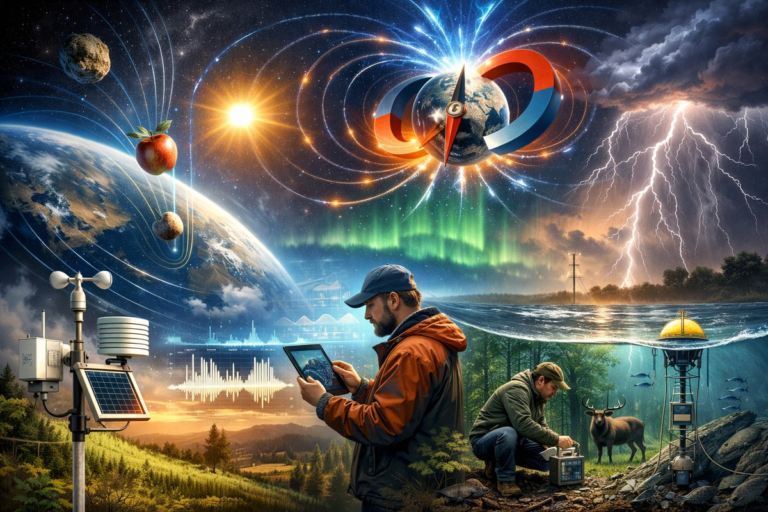
In the centuries since Newton gazed at an apple’s fall and Faraday played with magnets, our view of the universe has grown richer and more complex. Today, we stand at the nexus of macroscopic waves and microscopic quirks, emergent marvels and timeless forces. By mapping these hidden metrics, we not only unlock practical innovations but also reaffirm a sense of wonder: that beneath every ripple and swirl lies a story waiting to be told.