Location
Mount Vernon, WA 98274

Location
Mount Vernon, WA 98274
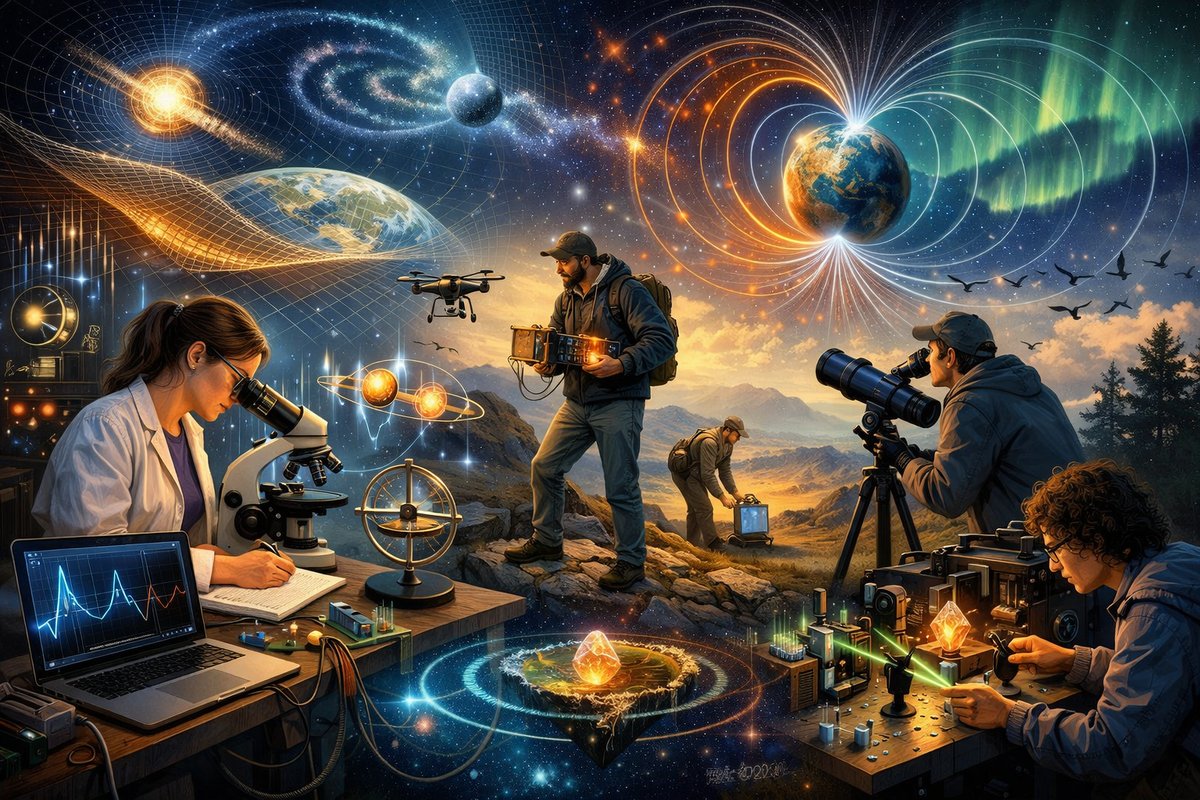
Scientists and citizen explorers are decoding the invisible patterns that govern our world, from subtle gravitational anomalies to the fluid dance of magnetic fields. This deep dive reveals the tools, experiments, and DIY spirit bringing emergent systems and quantum oddities into everyday discovery.
Every moment, unseen forces shape the world around us. A bird banking on a thermal updraft, metal filings dancing around a magnet, or the faint tremor rippling beneath our feet-these phenomena weave a tapestry of hidden rules. In labs and backyards alike, researchers and curious minds are crafting experiments to make the invisible visible. This article navigates breakthroughs in gravity mapping, magnetic fluid art, emergent robotics, and quantum detection, showing how a blend of high-precision instruments and do-it-yourself kits is transforming the way we experience nature’s subtle scripts.
The pull of gravity is so familiar that its nuances often escape notice. Yet in recent field studies, geophysicists have turned to smartphone accelerometers to detect minute variations in gravitational pull over old volcanic sites and abandoned mines. By mounting an off-the-shelf digital gravity sensor aboard a hiking backpack, teams have charted anomalies as small as a few microgals (millionths of a meter per second squared), revealing subterranean cavities and tracking groundwater flow. These portable gravity monitors, once the exclusive domain of specialized surveyors, now fit in a pocket, democratizing a method long reserved for large-scale projects.
Back on the lab bench, pendulum arrays offer a low-tech yet dramatic window into gravity’s reach. A desktop pendulum wave toy-comprising dozens of identically weighted bobs suspended at graduated lengths-unfolds a mesmerizing sequence of synchronized oscillations and apparent chaos. Designed for physics classrooms decades ago, this kinetic sculpture now inspires public art installations, inviting passersby to witness gravity in motion. Artists and educators are customizing pendulum lengths and pivot points, mixing materials like bamboo and recycled steel, to craft sustainable displays that resonate both visually and mechanically.
While gravity captivates through its pull, magnetism seduces with fluid patterns. In urban plazas, ferrofluid installations react to concealed arrays of rare‐earth magnets, birthing rippling black sculptures that shift shape under invisible magnetic pressure. Engineers program magnet arrays to pulse in specific sequences, guiding the ferrofluid into ephemeral spires and valleys. Spectators can place their hands or specially designed magnetic wands near a transparent reservoir, watching the ferrofluid respond in real time. These interactive exhibits underscore how magnetic fields channel energy without contact, sparking wonder at an unseen force that governs compass needles, electric motors, and the very nucleus of atoms.
Researchers have extended magnetic exploration skyward. Drone-mounted magnetometer sensor kits are mapping geomagnetic anomalies over glacial valleys and coastal bluffs. By flying a grid pattern just above the tree line, each drone collects millions of data points, pinpointing mineral deposits and archaeological sites. In one recent survey, a team discovered an iron-rich meteorite strewn field spanning several acres, its magnetic signature undetectable to the naked eye. Processing and visualizing the data harness open-source geospatial software, ensuring that results remain transparent and accessible while respecting landowner privacy and local cultural sensitivities.
Beyond single-force experiments, emergent systems remind us that complexity can arise from simple rules. Inspired by the murmuration of starlings, engineers deploy swarms of mini drones programmed with basic collision avoidance and cohesion algorithms. As each unit reacts only to its nearest neighbors, the group self-organizes into fluid, shape-shifting formations. Observers report an uncanny emotional resonance-witnessing machines mimic a natural ballet prompts both awe and reflection on how unassuming interactions yield grand patterns. Educators are now using programmable robotics kits to introduce middle school students to concepts of emergence, sustainability, and cooperative behavior.
Digital simulations complement physical swarms. Open-source emergent behavior software allows anyone with a notebook computer to adjust parameters-separation distance, alignment strength, cohesion factor-and watch agents flock, scatter, or spiral. These virtual laboratories underscore the universality of emergent phenomena, from ant colonies forging trails to neurons firing in synchronized waves. In makerspaces, pairing a microcontroller board with a set of infrared proximity sensors transforms a tabletop into a living petri dish of algorithmic life, reinforcing sustainable design through reusable circuits and 3D-printed components.
At the extreme scale of the infinitesimal, quantum quirks challenge our classical intuitions. Portable cloud chamber kits-assembled from aluminum plates, dry ice or cooling elements, and a fine-grain alcohol vapor-capture fleeting particle tracks as streaks of mist. Amateur physicists set these chambers atop sturdy wooden stands, darkening the interior with recycled black felt and illuminating trails with low-power LED strips. Each speck of cosmic radiation or decay product leaves a ghostly line, reminding us that our atmosphere is bathed in subatomic shower currents. Workshops in public libraries now teach patrons how to build and maintain their own cloud chambers, fostering a community of experimenters bound by a commitment to privacy and open-source schematics.
Quantum sensors are taking on challenges from secure communication to ultraprecise timing. Compact quantum gravimeters, cooled by compact cryocoolers and leveraging atom interferometry, measure gravitational acceleration with unrivaled sensitivity. Although still expensive, these instruments hint at a future where quantum-enhanced devices fit on a field table, monitoring volcanic inflation or coastal subsidence. Alongside them, quantum random number generators-pensize devices tapping into vacuum fluctuations-promise unbreakable encryption keys. Hobbyist kits for building simple quantum optical setups are emerging, complete with fiber-coupled lasers, beam splitters, and single-photon detectors, inviting tinkerers to test quantum superposition in their own homes.
In all these ventures, sustainability and privacy have emerged as guiding principles. Researchers choose recycled materials or low-power electronics to minimize environmental impact. Data collection protocols ensure that sensitive geolocation information-whether mapping archaeological sites or recording residential seismic activity-remains anonymized and encrypted. Collaborative platforms host code and design files under permissive licenses, inviting others to adapt experiments, remix designs, and contribute improvements without fear of proprietary lock-in.
These hands-on explorations aren’t confined to research institutions. Teachers are weaving gravity, magnetism, and emergence into interdisciplinary modules that blend art, history, and social studies. Students journal their observations in recycled-paper lab notebooks and share results on local mesh networks, sidestepping concerns about cloud storage privacy. Weekend maker fairs showcase solar-powered pendulums, ferrofluid sculptures lit by reclaimed LEDs, and swarm robotics demos built from salvaged drone parts. This grassroots movement underscores that understanding nature’s forces need not hinge on multimillion-dollar facilities.
Perhaps the most profound impact of these initiatives lies in the emotional resonance they foster. Watching a cascade of metal balls swing in patterned harmony, feeling a sudden tug at a magnetometer wand, or seeing twinkling tracks of cosmic rays for the first time-each moment sparks a deep sense of connection to the universe’s subtle choreography. In an age of digital saturation, these tactile encounters offer a form of mindful engagement, grounding us in the physical realities that underpin our virtual lives.
Looking ahead, the frontier of natural forces is expanding beyond Earth’s surface. Citizen scientists are already eyeing small-satellite missions to carry magnetometers, cloud chambers, and quantum sensors into low Earth orbit. By collaborating with university teams, they hope to monitor geomagnetic storms that threaten satellites, study emergent plasma wave phenomena, and capture high-energy cosmic particles above most of the atmosphere.
From gravity’s gentle tug to the quantum jitter of a single atom, the forces that shape our world can be probed by anyone with curiosity, ingenuity, and a modest toolkit. As laboratories shrink to the size of backpacks and experiments move to public squares, the boundary between professional scientists and citizen explorers blurs. In this era of open hardware and collective intelligence, every tinkerer becomes a witness to the grand patterns that underpin reality, and each new vantage point deepens our shared wonder.