Location
Mount Vernon, WA 98274

Location
Mount Vernon, WA 98274
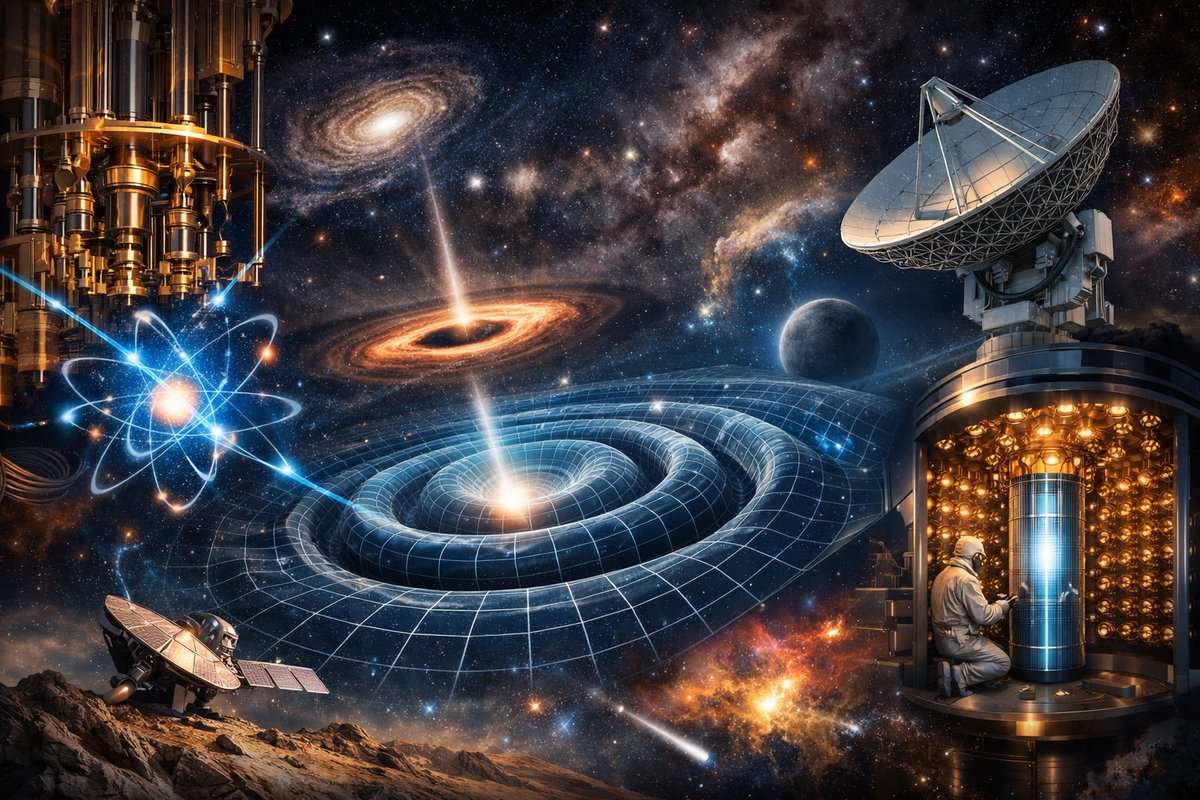
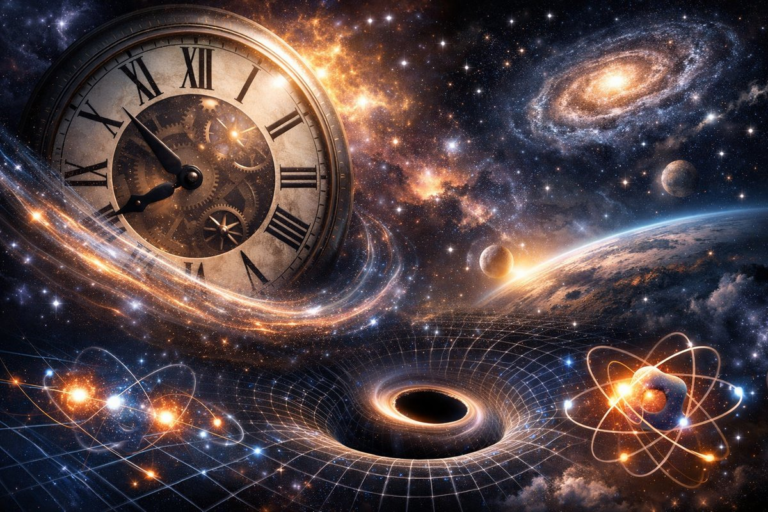
From precision atomic clocks that sense time's gentle flow to deep-space detectors chasing whispers of dark matter, scientists are stitching together a richer tapestry of reality. A wave of recent experiments and observations is not only probing the fabric of spacetime but also inviting us to rethink our place within its boundless expanse.
On a quiet night last autumn, a team of physicists watched in wonder as a network of optical clocks, spread across three laboratories, detected a fractional shift in time-one so subtle that it corresponded to a height difference of just a few centimeters. This breakthrough, achieved by researchers using next-generation optical lattice clocks, brought Einstein’s theory of gravitational time dilation into everyday reach. It wasn’t the dramatic warping of spacetime near a black hole, but rather a gentle reminder that time flows at different rates depending on our position in Earth’s gravitational well.
At nearly the same moment, deep beneath a mountain in Italy, an array of xenon detectors recorded a handful of events that tease at the nature of dark matter. Projects like XENONnT and LUX-ZEPLIN have pushed sensitivity to record lows, searching for collisions with hypothetical particles that make up roughly 85 percent of the universe’s mass. Although a definitive detection remains elusive, each non-event tightens the constraints on theoretical models, guiding physicists toward new frameworks for understanding matter’s hidden side.
Together, these developments highlight a dual frontier. On one hand, we’re refining our grasp of time itself-circumscribed by relativity yet now measurable with unprecedented precision. On the other, we’re probing the invisible scaffolding of matter that shapes galaxies and stars. Both ventures carry an undercurrent of mystery, demanding tools that push technological limits and philosophies that challenge our intuitions.
The saga of time’s measurement stretches back centuries: pendulums, mechanical escapements, quartz oscillators and then atomic clocks. The latest optical lattice clocks trap thousands of strontium atoms in a grid of laser light, each atom oscillating billions of times per second. Observing them in unison yields an accuracy that loses or gains less than a second over the age of the universe. In a recent field test, scientists deployed portable versions to compare time at sea level with time atop a plateau. The results confirmed predictions of general relativity once reserved for high-energy astrophysics.
These instruments are more than laboratory curiosities. Ultra-precise timekeeping underpins global navigation systems, synchronizes data centers around the world and even offers new probes of Earth’s interior mass distribution. Minute shifts in the clock rates can reveal subterranean water flows or magma movements, effectively turning timepieces into geological sensors. In this way, the pursuit of cosmic understanding ripples into the realm of practical human needs.
Meanwhile, the hunt for dark matter has embraced both underground sanctuaries and high-altitude observatories. Particle accelerators search for dark matter’s possible production, while satellite missions look for its astrophysical signatures. Yet it’s within lead-lined tanks the size of small auditoriums that the quietest whispers might be caught. At the heart of these detectors is a pool of liquid xenon chilled to minus 100 degrees Celsius. When a dark matter particle collides with a xenon nucleus, it produces a tiny flash of light and a handful of electrons. Reading out those signals without drowning in background noise requires shielding, cryogenics and new data-analysis techniques powered by machine learning.
Despite decades of null results, each successive experiment narrows the field. Recent updates from XENONnT have ruled out dark matter particles with interaction strengths once considered plausible, while LUX-ZEPLIN is gearing up for its first science run with even greater sensitivity. The exclusion of popular candidates like WIMPs (weakly interacting massive particles) has spurred theoretical creativity, giving rise to concepts such as ultralight axions or hidden-sector dark photons that interact with regular matter in more elusive ways.
Yet the story doesn’t stop at detection or nondetection. Alongside empirical campaigns, theorists are weaving fresh narratives that link the cosmos’s largest structures to quantum phenomena. Ideas like emergent gravity propose that spacetime itself arises from entangled quantum bits in a deeper, information-theoretic substrate. In such a view, time and space are secondary concepts-emergent properties of a more fundamental realm. While these frameworks remain speculative, they offer a unifying vision that entangles time’s arrow, quantum uncertainty and cosmic expansion in a single mathematical tapestry.
In one recent study, a collaboration of physicists simulated cosmic inflation-the rapid expansion of the universe in its infancy-using programmable arrays of superconducting qubits. By tuning couplings between qubits, they recreated analogues of quantum fields undergoing inflationary dynamics. The experiment revealed patterns consistent with theories that link primordial gravitational waves to fluctuations in spacetime geometry. Though still in its infancy, quantum simulation promises a sandbox for testing ideas that lie beyond the reach of telescopes or particle colliders.
Observationally, the James Webb Space Telescope continues to push back the cosmic horizon, capturing supernovae and galaxy mergers from epochs when the universe was only a few hundred million years old. Those distant cataclysms act as cosmic lighthouses, their light stretched and reddened by expanding space. Measuring subtle time delays between different wavelengths provides a cosmic clock, a way to cross-check terrestrial measurements of time dilation. The interplay between laboratory clocks and cosmic clocks embodies the meeting point of experiment and observation-a dialogue across scales from the microscopic to the intergalactic.
Amid these grand experiments, a humbler pursuit quietly unfolds in university basements and home workshops. Amateur astronomers peer through backyard telescopes, hunting for variable stars or tracking asteroids. Citizen-science platforms encourage volunteers to classify galaxy shapes or search for exoplanet transits. By democratizing data and analysis tools, these initiatives stitch together a collective human effort, reminding us that curiosity about time, matter and mystery isn’t reserved for large collaborations alone.
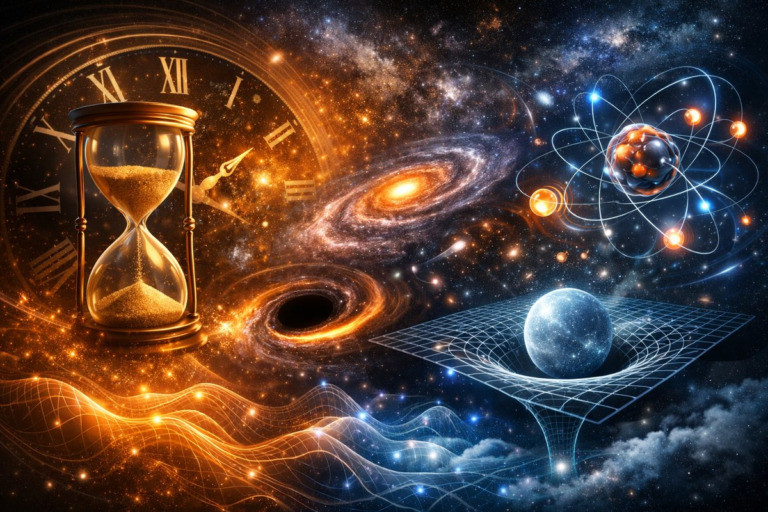
All these strands-optical clocks, xenon detectors, quantum simulators, space telescopes and citizen scientists-converge on a shared question: how does reality assemble itself from the building blocks of time and matter? It’s a question with practical stakes. Our understanding of fundamental physics shapes tomorrow’s technologies, from quantum computers to precision navigation to new materials. It also nourishes our sense of wonder, inviting us to see ourselves not as incidental actors but as participants in a vast cosmic drama.
Yet for every answer these tools deliver, new puzzles emerge. Why does time flow in one direction? What is the true nature of dark matter, and might it consist of multiple particle species? Could spacetime itself be quantized, and under what conditions would that discretization become evident? Such mysteries persist at the edges of theory and experiment, beckoning us to explore further.
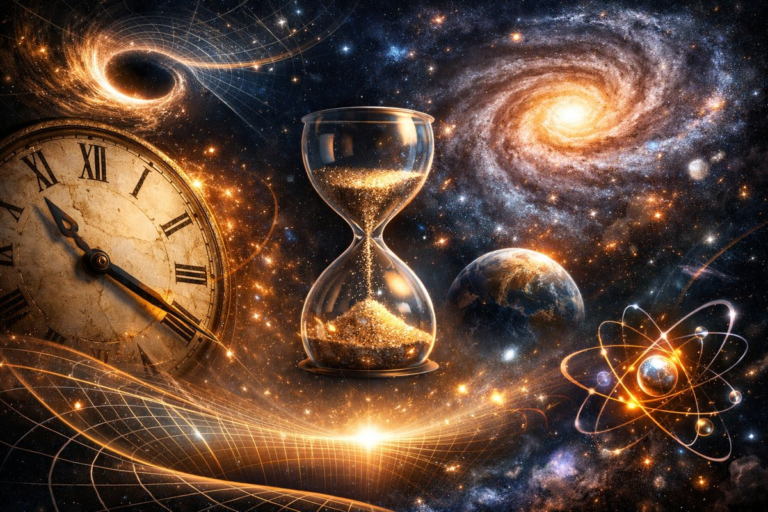
As next-generation observatories come online-from gravitational wave detectors sensitive to mergers of black holes across billions of light-years to neutrino telescopes peering into the heart of exploding stars-the tapestry of discovery will grow more intricate. Each thread, whether a blip on a digital readout or a spectral line from a distant quasar, enriches our understanding of existence. And as we refine our clocks and detectors, we become more attuned to the subtle rhythms of the universe: the heartbeat of time itself and the silent pulse of dark matter coursing through the cosmic web.
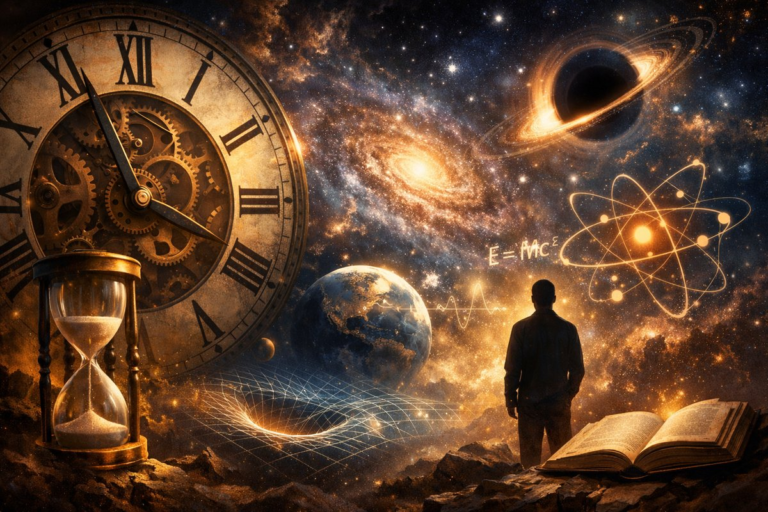
In weaving these insights together, we find a deeper appreciation for the unity of the scientific endeavor. The quest to measure time with atomic precision and the pursuit of matter’s darkest secrets are not separate dramas but chapters in one unfolding story. That story reminds us that our tools-physical and intellectual-can reveal hidden harmonies in the universe. And as long as we carry forward with curiosity and imagination, the echoes in the cosmic web will continue to guide us beyond the boundaries of the known.