Location
Mount Vernon, WA 98274

Location
Mount Vernon, WA 98274
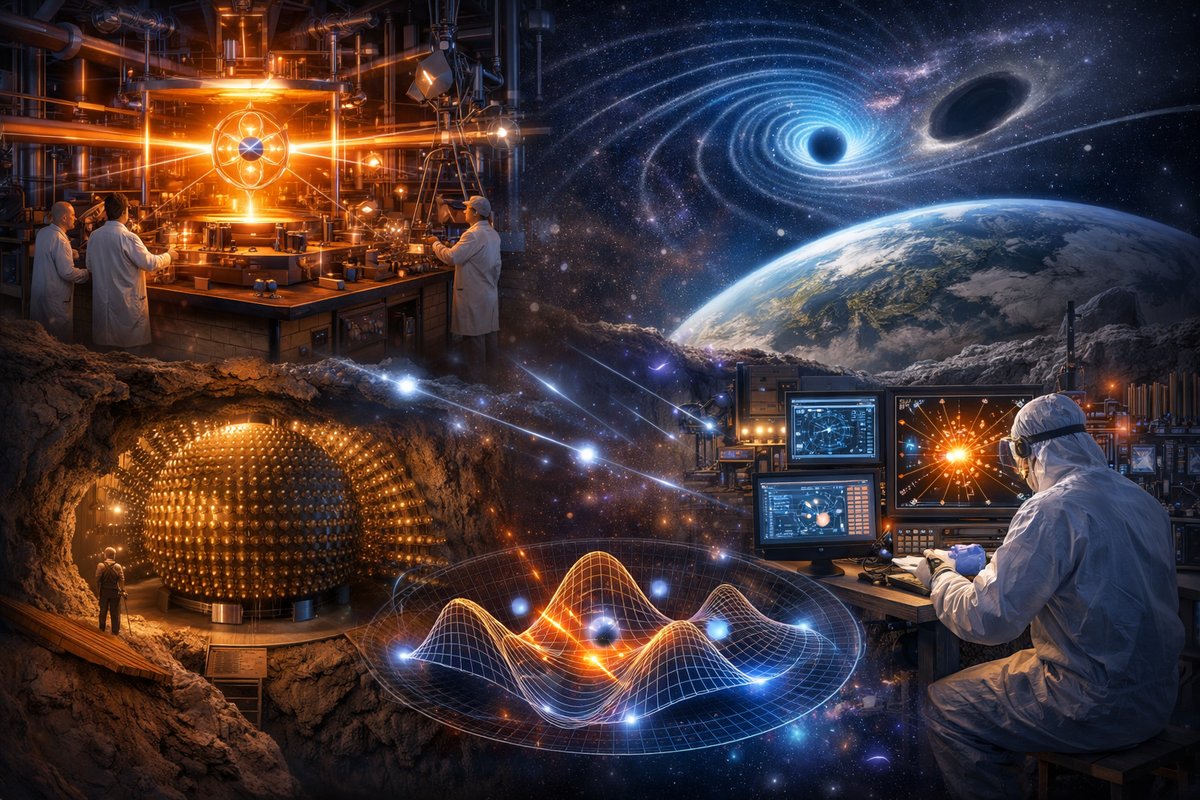
A new wave of experiments is pushing the boundaries of precision timekeeping and particle detection, revealing subtle effects of gravity and quantum mechanics that challenge our understanding of reality. From subterranean neutrino detectors to ultrastable optical lattice clocks, scientists are unraveling mysteries at the nexus of time, matter, and the cosmos.
In a softly lit laboratory far from the bustle of city streets, a team of physicists huddles around an array of ultrastable lasers and vacuum chambers. Each device pulses with carefully calibrated precision, its optical frequency locked to the vibrations of atoms held motionless in an electromagnetic trap. This is not science fiction but the heart of a new generation of optical lattice clocks-timekeepers so accurate that they lose less than a second over the age of the universe. By measuring infinitesimal shifts in frequency caused by gravity’s pull at different heights, researchers are probing Einstein’s predictions of gravitational redshift with unprecedented resolution.
Simultaneously, hundreds of meters below the surface in a cavernous underground facility, another team monitors streams of ghostly particles known as neutrinos. Encased in massive tanks of ultrapure water and lined with light sensors, the detector quietly records the rare flashes produced when a neutrino interacts with an atomic nucleus. Recent data show slight anomalies in oscillation patterns that hint at a possible “sterile” neutrino species-one that does not interact via the weak force. If confirmed, such a discovery would rewrite the Standard Model of particle physics and provide new clues about dark matter, the invisible substance that dominates the mass of galaxies.
Above ground, gravitational wave observatories have entered a new era of sensitivity. Beyond detecting the cataclysmic mergers of black holes and neutron stars, these facilities are beginning to search for the so-called gravitational wave memory effect-a permanent distortion in spacetime left behind by passing waves. The memory effect, predicted decades ago by general relativity, would offer a direct glimpse into the nonlinear dynamics of gravity itself and open a window onto processes that occurred in the early universe.
Meanwhile, quantum optics labs around the world are exploring time symmetry by creating entangled photon pairs and then sending them through carefully timed delays. By comparing correlations between photons separated by microseconds, scientists test whether the familiar arrow of time holds firm at the quantum scale or whether subtle violations of temporal symmetry might emerge. Early results show astonishing agreement with theory, but a handful of unexplained deviations have prompted fresh theoretical work on the relationship between quantum measurement, entropy, and the flow of time.
Together, these experiments form a tapestry of inquiry that spans scales from the subatomic to the cosmic. Optical lattice clocks refine the definition of the second and underpin practical technologies such as global navigation satellite systems and high-frequency trading networks. Neutrino observatories and dark matter detectors deepen our understanding of the universe’s hidden mass and energetic history. Gravitational wave facilities extend our senses to cosmic vibrations that carry information from the dawn of time. Each advance raises new questions: Are fundamental constants truly constant? Could time itself emerge from a more primitive quantum substrate? And what role do matter-antimatter asymmetries play in shaping the observable universe?
The cosmic context of these experiments is as profound as it is humbling. Observations of the cosmic microwave background map temperature fluctuations to one part in 100,000, offering a snapshot of the universe when it was less than 400,000 years old. The subtle imprint of primordial neutrinos-relics from the Big Bang-may soon be teased out by cross-correlating data from large radio telescopes and deep-sea neutrino arrays. Detecting those relic neutrinos would reveal conditions at energies unreachable by any human-made accelerator and provide a direct link between laboratory experiments and the earliest moments of cosmic history.
Yet the quest to understand time and matter is not purely an abstract pursuit. It shapes our everyday experience. Ultra-precise clocks improve synchronization in communication networks and sensor arrays used in earthquake monitoring and geophysical surveys. Advances in particle detection have led to novel imaging techniques in medicine and materials science. Even the quest for gravitational wave memory has inspired refinements in vibration isolation and mirror coatings, innovations that benefit optical instrumentation across many fields.
Philosophers and artists have long pondered the nature of time as a river, a circle, or an illusion. Today, physicists add rigorous nuance to these debates. By controlling atomic interactions with lasers, they create conditions where time dilation can be observed over mere centimeters of height. By studying entangled states, they see how the act of measurement influences the very existence of events. And by listening for gravitational echoes, they seek evidence of cosmic phenomena that lie beyond the range of telescopes.
Leading researchers emphasize the modular nature of these investigations. “Each experiment is a piece of a larger puzzle,” says one senior scientist who collaborates across laboratories on three continents. “Optical clocks tell us how fast time flows at different altitudes. Neutrino detectors reveal hidden forms of matter. Gravitational wave observatories let us hear the universe’s most violent outbursts. By combining these insights, we hope to construct a coherent narrative of reality that spans from quantum scales to cosmic expanses.”
Despite the heady excitement, challenges loom large. Achieving even greater clock stability requires pushing lasers to new power levels without introducing thermal noise. Increasing neutrino detection rates demands larger detectors and even purer target fluids. Gravitational wave memory searches call for enhanced data analysis algorithms to distinguish faint memory signals from terrestrial disturbances. Each hurdle requires sustained investment, collaborative ingenuity, and a willingness to rethink long-held assumptions.
Looking ahead, the convergence of precision timekeeping, particle detection, and gravitational astronomy promises deeper revelations about the fabric of reality. Proposals for space-based optical lattice clocks aim to map Earth’s gravitational field with centimeter-scale resolution. Plans for next-generation neutrino telescopes under Antarctic ice could double detection sensitivity and explore neutrino interactions at energies never before seen. Future gravitational wave networks may include mid-frequency detectors that bridge the gap between ground-based and space-borne observatories, unlocking new astrophysical sources.
Above all, the interplay of time, matter, and mystery underscores a fundamental truth: understanding the universe requires a union of measurement and imagination. As scientists refine their instruments and expand their reach, they also refine the questions they ask about existence, causality, and the origins of everything we observe. In their laboratories and observatories, humanity inches closer to answering questions that have resonated through millennia-and in doing so, opens doors to technologies and insights that will shape our collective future.
Whether you’re captivated by the ticking of an atomic clock, the faint flash of a neutrino interaction, or the tremor of a passing gravitational wave, the story of time and matter is one of perpetual discovery. It reminds us that the universe remains a vast mystery, waiting to be measured with ever greater precision-and experienced with ever greater wonder.