Location
Mount Vernon, WA 98274
Location
Mount Vernon, WA 98274

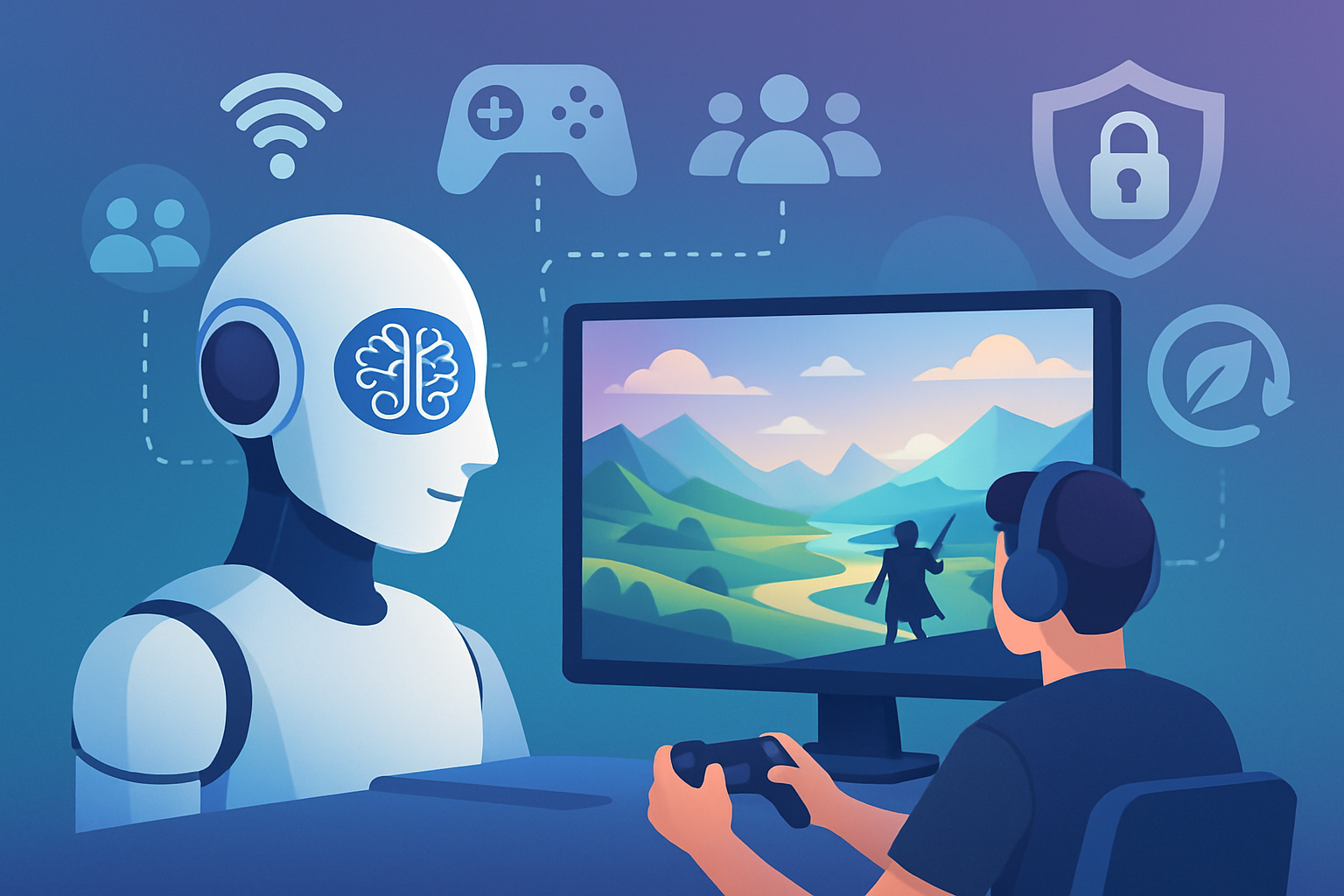
Artificial intelligence is transforming games and digital experiences, enabling dynamic characters, endless procedural landscapes, and personalized community events. From ethical challenges around data privacy to sustainable practices in development, this article explores the evolving landscape and practical steps for developers and enthusiasts to join the revolution.
Gaming and virtual entertainment are on the brink of a seismic shift as artificial intelligence moves from background calculations to center stage. Once confined to simple rule-based opponents or randomized loot tables, AI now powers characters that learn player habits, worlds that grow beyond predesigned limits, and content creation tools that blur the line between developer and player. This article examines the most exciting developments, the ethical dimensions they introduce, and how both seasoned creators and curious newcomers can participate in this new phase of interactive media.
Next-Level NPC Evolution
Nonplayer characters (NPCs) have historically followed preset scripts or state machines, but recent breakthroughs in machine learning allow them to adapt in real time. Advanced behavior trees combined with reinforcement learning techniques produce opponents that study tactics and alter their strategy session by session. Social NPCs can remember past conversations, develop allegiances, and even exhibit emergent personalities shaped by player interactions. This level of responsiveness creates deeper emotional engagement and replay value. Developers are now exploring hybrid models that balance scripted narrative beats with AI-driven improvisation, ensuring key story moments remain intact while side encounters feel fresh and unpredictable.
Boundless Procedural Worlds
Procedural generation has long been used to populate levels with random terrain features or item drops. Today, AI accelerates this process with generative models trained on vast corpora of environmental data and architectural designs. Instead of simple noise functions, these systems employ neural networks that can learn stylistic patterns from concept art or real-world photography and apply them at scale. The result: ecosystems with coherent biomes, cities that follow logical road networks, and landscapes teeming with emergent details. Players wander through digital realms that can adapt to their preferred pace and themes, whether they enjoy cinematic vistas or tight maze-like catacombs.
Content Creation Unleashed
AI-driven content tools are empowering both professional studios and hobbyist communities to produce high-quality assets more quickly. Text-to-image models generate concept art or textures on demand, while code-assistant agents draft boilerplate scripts and AI scripting hooks. Even audio production benefits from synthetic soundscapes and adaptive music generators that tailor tracks to gameplay intensity. These innovations democratize game creation, lowering technical barriers and allowing smaller teams to compete on quality. Modders and community developers can integrate AI plugins into existing engines to prototype levels within minutes, iterate on player feedback, and deploy updates at unprecedented speed.
Community and Virtual Social Spaces
Beyond single-player adventures, AI is transforming multiplayer lobbies and virtual gatherings. Intelligent matchmaking systems analyze skill levels, play styles, and social preferences to form balanced teams or recommend friends. Virtual event platforms powered by generative avatars host concerts, film screenings, or live Q A sessions inside game engines. Smart moderation bots monitor chat in real time, detect harmful behavior, and apply context-aware filters. These community tools foster safer, more engaging social experiences while preserving the spontaneity of user-driven moments. Spectators can even shape events by voting on environmental changes or narrative branches, creating a feedback loop that redefines live entertainment.
Ethical AI and Data Privacy in Games
The rise of AI raises important questions around the data it consumes and the decisions it makes. Training behavioral models may involve collecting extensive player telemetry, including movement patterns, chat logs, and biometric signals from eye tracking. Transparent data practices and opt-in consent frameworks become crucial to maintaining trust. Developers face the challenge of preventing bias in AI-driven characters or matchmaking algorithms, ensuring that diverse playstyles and cultural contexts are respected. A growing number of studios are adopting ethics guidelines that outline acceptable data handling, model auditing procedures, and mechanisms for players to review and delete their personal information.
Environmental Impact and Sustainable Practices
As AI computation demands grow, so does the energy footprint of training and inference tasks. High-performance GPUs and specialized accelerators draw significant power, prompting calls for greener infrastructure. Some developers are turning to edge computing or hybrid cloud models that shift processing to on-device units, reducing latency and carbon emissions. Others support carbon offset initiatives or partner with renewable energy providers. Incremental refinements to AI models, such as compressing neural networks or quantizing weights, help lower resource requirements without sacrificing performance. These sustainable practices are increasingly woven into project roadmaps to ensure that entertainment innovations do not compromise planetary health.
Practical Steps for Developers and Enthusiasts
For those eager to dive into AI-enabled game creation, a wealth of resources is available. Open-source frameworks offer pretrained models for character behavior, procedural generation, and voice synthesis. Cloud-based development environments provide scalable training clusters accessible via simple APIs. Online communities host tutorials on integrating generative art with popular engines and share performance optimization tips. Even nontechnical content creators can experiment with AI tools to design levels, craft music, or write branching narratives. By starting with modular AI plugins and gradually expanding custom pipelines, teams can manage complexity and iterate rapidly without a steep learning curve.
Tools and Platforms Leading the Charge
Several emerging platforms have become hubs for AI-driven innovation in the gaming space. Some engines now bundle AI modules for dialogue generation, pathfinding enhancements, and dynamic storytelling out of the box. Independent tools offer drag-and-drop interfaces for adjusting procedural world parameters or training custom character models on user-supplied datasets. Cross-platform middleware solutions integrate seamlessly with console, PC, and mobile targets, enabling unified workflows across devices. Developers weigh factors such as licensing costs, community support, and extensibility when selecting the right combination of tools to achieve their creative vision.
Case Studies and Early Adopters
A handful of studios have showcased the potential of AI-powered entertainment through experimental titles and public demos. In one example, an open-world role-playing game features a cast of AI personas that remember player decisions and adapt their story arcs over dozens of hours. Another indie project leverages generative architecture to deliver a never-ending roguelike dungeon that evolves based on collective player data from global servers. Virtual concert platforms have already hosted live performances with dynamic stage design rendered in real time, responding to audience engagement metrics. These case studies illustrate how AI can deepen immersion and enable experiences that would be impractical or impossible with traditional production pipelines.
The Road Ahead: Predictions for the Next Decade
As AI research continues to advance, gaming and virtual entertainment may become more personalized, responsive, and socially interconnected than ever before. We can expect interactive narratives that reshape themselves around player psychology, multiplayer ecosystems where AI-powered moderators foster healthy competition, and virtual worlds that adapt their physics and aesthetics to individual play histories. Crossovers between gaming, education, and enterprise training could flourish, using gamified AI tutors to teach complex skills. While challenges around ethics, sustainability, and equitable access remain, a collaborative approach involving developers, players, and policymakers will guide this transformation toward inclusive, imaginative, and responsible outcomes.
Into the Future
The integration of AI into gaming and virtual entertainment marks one of the most exciting frontiers in digital culture. From intelligent NPCs and procedurally generated realms to community-driven events and ethical data frameworks, every facet of interactive media is evolving. Whether you are a developer seeking to harness these capabilities or a player curious about the next wave of immersive experiences, the tools and techniques are at your fingertips. Embracing AI responsibly promises not only richer gameplay and storytelling but also new opportunities for collaboration, creativity, and shared discovery in the worlds we build together.