Location
Mount Vernon, WA 98274
Location
Mount Vernon, WA 98274


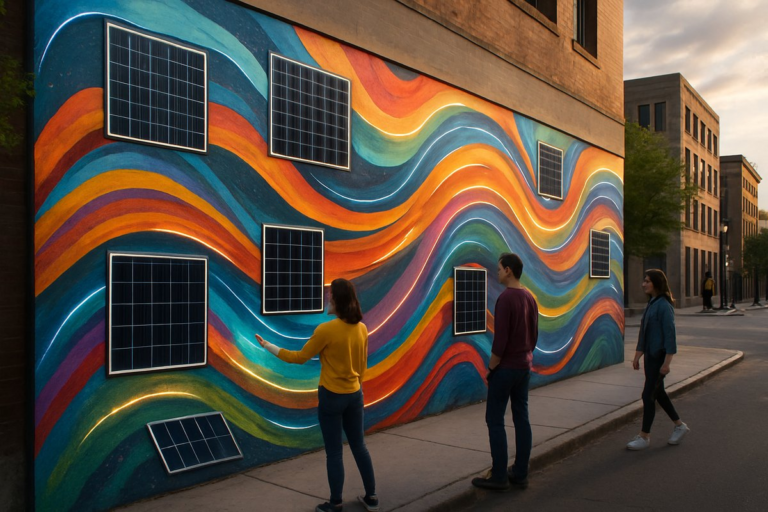
A new wave of artists is harnessing solar technology to illuminate public spaces after dark. By pairing portable solar arrays with LED projectors, these creators transform heritage facades and community walls into canvases of light-without drawing power from the grid. This sustainable approach is sparking fresh dialogues about ephemerality, access, and environmental responsibility in urban storytelling.
As night falls over an ancient plaza, columns and archways flicker to life in hues of gold and violet. What might at first glance seem an elaborate light festival is, in fact, a fully off-grid projection mapping installation powered entirely by the sun. Over the past year, a growing roster of artists and collectives has adopted solar-charged LED projectors to illuminate historic structures, community landmarks, and even temporary shelters, signaling a shift toward sustainable, accessible public art.
Against a backdrop of intensifying discussions around climate change and energy consumption, these initiatives foreground a simple yet radical idea: art need not draw on fossil-fuel-derived electricity to spark wonder. Instead, photovoltaic cells collect sunlight by day, storing energy in lightweight battery banks. When darkness arrives, projection mapping rigs-typically mounted on tripods or mobile platforms-bring digital imagery to life. This combination of renewable energy and digital design has begun to transform how audiences engage with urban form, history, and collective imagination.
At last autumn’s Riverside Light Biennial, a local collective unveiled “Harvest of Light,” an evening-long spectacle on the façade of a 19th-century grain mill. Over the course of thirty minutes, animated fields of wheat swayed across brick and mortar, coalescing into constellations of seeds before dissolving into streaks of light. Spectators were invited to scan QR codes that linked to seed-saving co-ops and community gardens, bridging digital art with on-the-ground action. The entire show ran on power stored in portable battery packs charged by a compact solar array mounted on nearby scaffolding.
Meanwhile, in a makeshift community center on the outskirts of a small coastal town, a visiting art collective repurposed discarded shipping containers into solar power hubs. Each container houses enough panels to charge two battery-driven projectors. By night, these projectors restore a sense of agency to residents through a collaborative mapping workshop. Participants are encouraged to paint their own imagery onto physical panels and then see those images animated on the walls of the center once the sun has set.
Behind these installations lies a growing ecosystem of off-the-shelf hardware and open-source software. Portable LED projectors with high lumen output have become lightweight enough to mount on bicycle trailers or rooftop racks. Solar recharge stations, once the province of remote research camps and disaster relief teams, are now accessible to artists at community-driven price points. Even DIY enthusiasts can integrate commercially available charge controllers, lithium-iron-phosphate batteries, and compact microcomputers to drive projection sequences-some of which react in real time to ambient sound, motion, or environmental data.
“The real breakthrough,” says a project coordinator for a nomadic art caravan, “is realizing that off-grid projection doesn’t have to look like a science experiment. We can curate poetic experiences that speak to local history while relying entirely on renewable energy. That’s both a creative and ethical achievement.” While the idea of solar-based projection mapping circulated among technologists for years, it is only recently that artists have sought to dismantle the barriers of technical complexity and cost.
Community response has been enthusiastic. At the coastal center, dozens of residents lined up to sketch scenes of daily life-fishing nets, schoolchildren, local wildlife-knowing their drawings would soon appear larger than life. For many, this marked the first time they had participated in a digital art process, let alone one that carried a clear environmental message. Similarly, attendees at the Riverside festival noted how the absence of loud diesel generators or noisy backup systems made gatherings feel more intimate, even sacred.
On a theoretical plane, these interventions signal a growing interest in art that is ephemeral yet resonant. Projection mapping, by its very nature, leaves no physical residue: after tonight’s show, the images vanish, leaving only memory and a faint glow in participants’ minds. Unlike murals or sculptures, which stake a claim on public space for decades, light installations invite a different kind of ownership-one rooted in shared experience and fleeting wonder.
That ephemerality also invites critical reflection on energy use and environmental responsibility. In urban centers where nightfall brings rising electricity demand, a festival powered by portable solar rigs shifts the narrative. It says, “We can tell stories, provoke emotions, and build community without overwhelming local grids.” And in an era of frequent power shortages and rising energy costs, this model offers a roadmap for cultural events that leave a minimal carbon footprint.
Challenges remain. Weather unpredictability can curtail charging cycles. Rain and high humidity test the durability of electronics. Shadows cast by passing pedestrians or vehicles can disrupt projection layers. To address these issues, some teams are experimenting with hybrid setups that combine solar with small wind turbines or micro-hydro generators when sites near waterways. Others are building modular, pop-up shelters to keep sensitive gear dry during dusk and dawn.
The ripple effects extend beyond festivals. Urban planners in several mid-sized cities are exploring solar-powered art kiosks as part of nighttime wayfinding systems. Civic organizations are commissioning community-led mapping projects to raise awareness of local biodiversity and historic landmarks. Even park rangers are testing lightweight projection units during off-hours to project educational documentaries onto natural rock faces, giving nocturnal visitors a unique way to learn about ecology under the stars.
From a practical standpoint, the cost curve continues to bend in favor of wider adoption. Portable lithium battery packs that once cost thousands of dollars have seen price declines of nearly 40 percent in two years. High-efficiency monocrystalline solar panels, previously reserved for rooftop installations, are now available in rollable and frameless formats that fit inside standard backpacks. Software frameworks for projection mapping have embraced modular plugins, letting non-programmers compose intricate sequences through visual interfaces.
At the philosophical core, these projects challenge long-held assumptions about where and how art belongs in public life. No longer confined to indoor galleries or permanent monuments, digital installations can roam streets, parks, and forgotten courtyards with minimal environmental impact. They champion sustainability not only in energy sourcing but in the concept of impermanence-reminding us that beauty can be both powerful and transient.
As dawn breaks on the last night of the festival, volunteers begin packing up panels and projectors, guided only by the soft glow of residual battery LEDs. The plaza, once animated with dynamic patterns, stands quietly in early morning light. A handful of onlookers wander through empty scaffolding, recalling where golden grains of light once danced. Their memories will linger, long after cables and cells have been stowed.
Looking ahead, collaboration between technologists, environmental scientists, and artists will likely enrich the toolkit for off-grid projection. Research into biodegradable circuit boards, low-impact casing materials, and zero-waste assembly methods promises to tighten the bond between creative expression and ecological stewardship. The day may soon come when solar-charged projection mapping is as common as street art stencils-accessible, responsible, and bound to spark curiosity in every corner of the world.
In reclaiming the night sky as a canvas powered by sunlight, artists and communities alike are crafting a narrative that connects past and future, technology and nature. Through flickering images on brick, metal, and concrete, they remind us that innovation need not come at the earth’s expense. Instead, it can grow out of the very light that nurtures life.