Location
Mount Vernon, WA 98274
Location
Mount Vernon, WA 98274

High above the city streets, a collective of former refugees tends to rooftop beehives that symbolize more than honey-they stand for healing, purpose, and a shared journey toward renewal. Confronting the ache of displacement and the shadow of failure, these beekeepers discover that caring for bees can awaken resilience and unconditional trust in both themselves and each other.
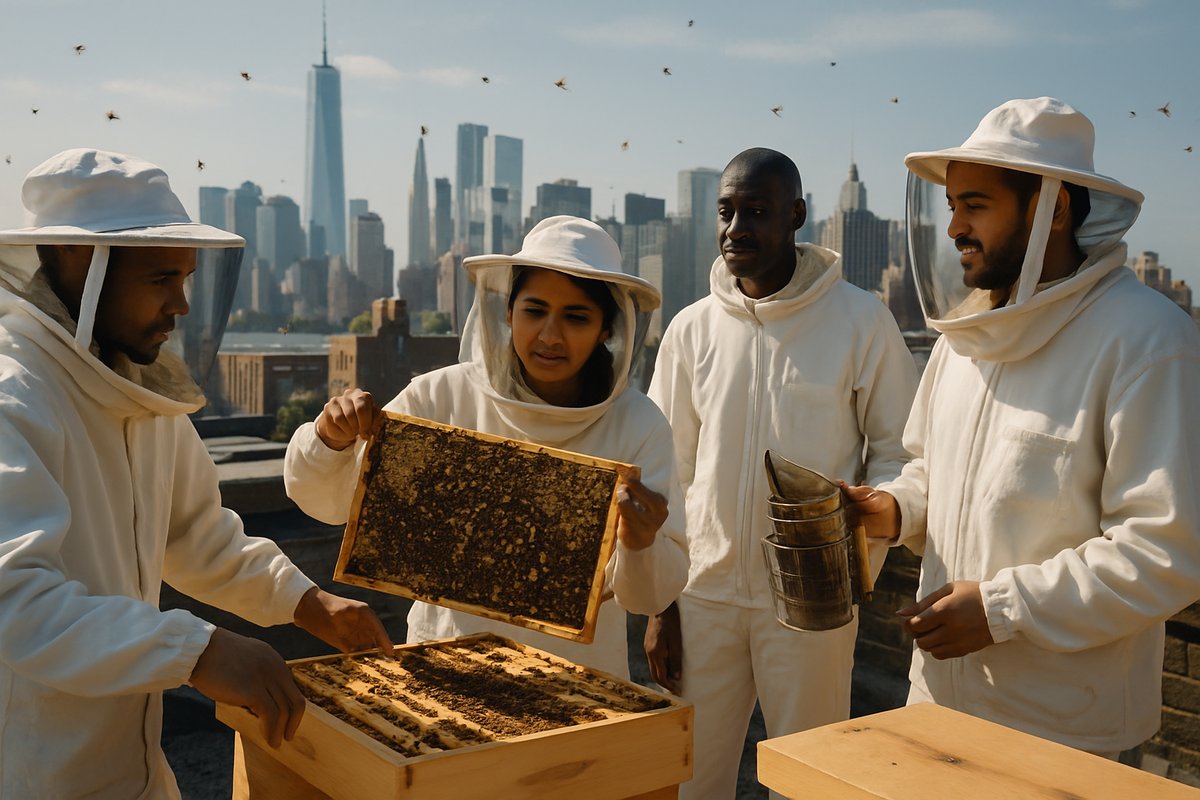
On a weathered rooftop once forgotten by the passersby below, a line of wooden beehives glints in the morning light. Inside each box, tens of thousands of honeybees hum in measured choreography, carving out the space where nature and humanity meet. This unlikely apiary is run by a group of former refugees who, just a few years ago, walked into the city with nothing but a duffel bag and a fading dream. Now they suit up in white jackets and mesh veils to tend to the hives that have become a living testament to their capacity for renewal.
For many of these urban beekeepers, life before displacement was defined by stability-family meals around a central table, the familiar hum of community celebrations, the comfort of everyday routines. When conflict forced them from home, they felt unmoored and lost. Language barriers and cultural isolation compounded the ache of failure they carried in their hearts. In the wreckage of what they once knew, hope felt like a distant memory.
But in a chance meeting at a community workshop on mental health, a volunteer beekeeper suggested an idea some found strange: working with bees to rebuild trust and purpose. The thought of donning a protective suit and handling a swarm felt daunting, even terrifying, but the chance to reconnect with life’s rhythms resonated deeply. In their first session, participants learned the basics of hive structure, how to light a smoker, and the gentle art of lifting a frame from the colony. The bees, it turned out, responded not just to smoke but to the calm energy of their caretakers.
Amina, who fled with her two children after losing her husband, admits she was skeptical. “I had never handled anything so delicate and alive,” she recalls, voice steady as she examines a comb. “It was strange to think that these tiny creatures could teach me so much about patience.” Her trembling at first gave way to a newfound confidence. As she witnessed the queen leading worker bees to build honeycomb, she saw a mirror of her own potential to guide and rebuild her family’s future.
In this hive, the concept of unconditional cooperation comes to life. Bees communicate through dances and pheromones, each individual contributing to the survival of the whole. The refugees-turned-beekeepers learned to mirror that unity. They share tasks from cleaning frames to monitoring hive health, and they offer a listening ear when someone is overwhelmed. In one memorable winter, a colony nearly collapsed under a sudden cold snap. Working late into the night, the team insulated the boxes, provided emergency feeding, and kept vigil through subzero temperatures. When spring arrived and the hive buzzed back to life, there was a collective sigh of relief and a sense of triumph that few experiences can match.
Yet the journey hasn’t been without setbacks. Early in the project, an outbreak of hive beetles threatened several colonies. Inspecting the damage was heartbreaking-frames half-devoured, brood chambers in disarray. But as with every challenge, the group found strength in solidarity. Workshops on integrated pest management taught them natural methods to protect their bees, from trap boxes to beneficial fungi. They experimented with essential oils and new hive designs. Each failure became a lesson in resilience rather than defeat.
Beyond the rooftop, the group has reached out to schools, community centers, and local markets. Children press their noses against Plexiglas observation hives, wide-eyed as they watch bees tend to brood cells. At weekend markets, jars of raw honey, labeled by harvest date and hive location, sell out within hours. The proceeds fund a counseling program tailored to the emotional scars of displacement. For many participants, selling honey for the first time was a pivotal moment: handing over a jar to a stranger felt like offering a piece of their own story, sweet and resilient.
This enterprise has also become a living classroom in sustainability. Bees are pollinators essential to urban ecology, and the group has planted rooftop wildflower patches and potted herbs to attract foragers. They’ve held seed-swapping events to teach other residents how to green their balconies and courtyards. The project underscores the fragile interdependence between humans and the environment, and how tending to one’s community can ripple outward into the broader city.
What emerges from this story is more than an agricultural venture; it is a testament to purpose reclaimed. These beekeepers have learned to face failure with curiosity-inspecting a collapsed hive not as an endpoint but as the start of a new experiment. They have discovered courage in vulnerability, recognizing that opening a hive parallels opening the self to communal care. In the quiet hum of thousands of bees, they have found a soundtrack for healing.
When honey drips off a wooden spoon during the first harvest, tears flow freely. The sweetness on the tongue carries the weight of every challenge-the loss that preceded flight, the fear of starting anew, and the unwavering hope that brought them this far. Each jar becomes a small monument to the ache of failure and the triumph of rising again.
In a city defined by concrete and noise, these rooftop hives offer a sanctuary where purpose takes wing. The group’s story reminds us that resilience is born in motion-in the steady beat of wings, the shared labor of hands, and the unspoken bond between human and hive. As they suit up each morning to begin their work, there is an unspoken understanding: love can be cultivated, trust can be rebuilt, and hope can blossom in the most unexpected places.
Their journey is far from over. Plans are underway to expand to other rooftops, to offer advanced training in queen rearing, and to create an apprenticeship program for young adults seeking direction. The lessons learned here-about community, loss, and renewal-will continue to flourish as long as there are people willing to listen to the bees and to each other.
In the end, it’s not just about honey. It’s about the courage to face a swarm, the patience to wait for new growth, and the empathy to recognize that every worker, whether human or insect, plays a vital role. On that rooftop, against the backdrop of glass towers, a small collective hum stands as proof that even in the aftermath of trauma, when we come together in purpose and compassion, we can truly buzz back to life.