Location
Mount Vernon, WA 98274
Location
Mount Vernon, WA 98274


Explore the hidden patterns that shape our universe, from the subtle tug of gravity anomalies beneath our feet to the quantum fluctuations that ripple across reality. This article unpacks the science behind gravitational waves, magnetospheres, emergent fluid patterns and the quantum quirks that challenge our understanding.
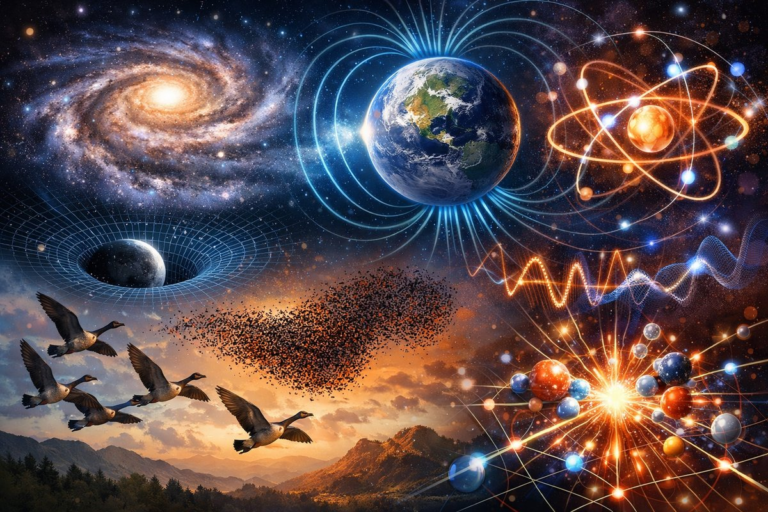
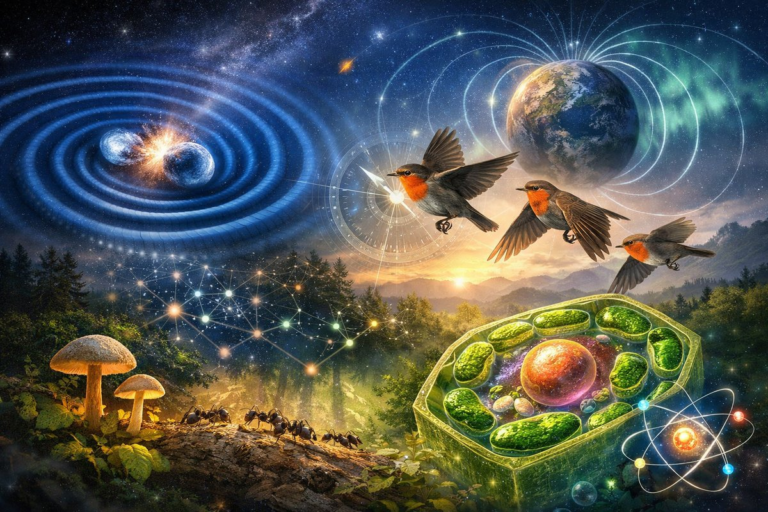
From the gentle pull we feel beneath our feet to the dazzling ribbons of auroras overhead, nature speaks in a language of forces and patterns that both guides and mystifies us. Gravity may seem mundane when we drop a coin, but follow its reach into the cosmos and it becomes a storyteller of colliding black holes and warping space. Magnetism, too, shapes landscapes unseen, forging protective shields around planets and stirring charged particles into cosmic light shows. Beyond these familiar interactions lie emergent systems-complex behaviors that arise without a central conductor-and quantum quirks that reveal a world governed by probabilities, entanglements and the vacuum’s restless energy.
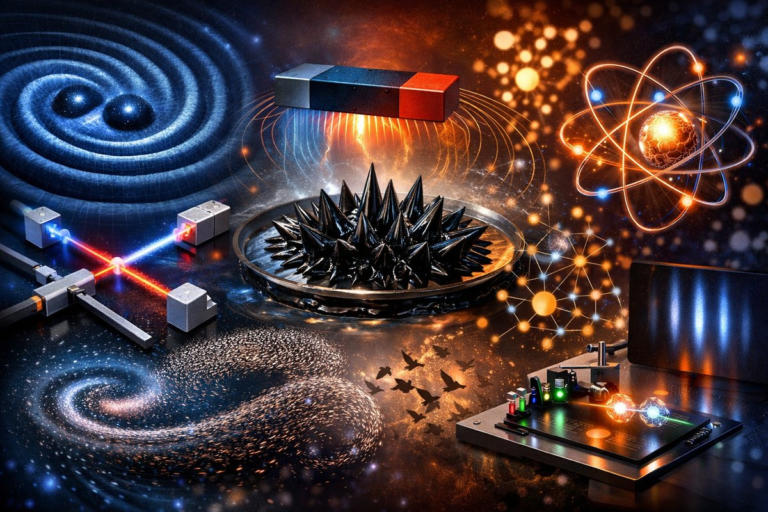
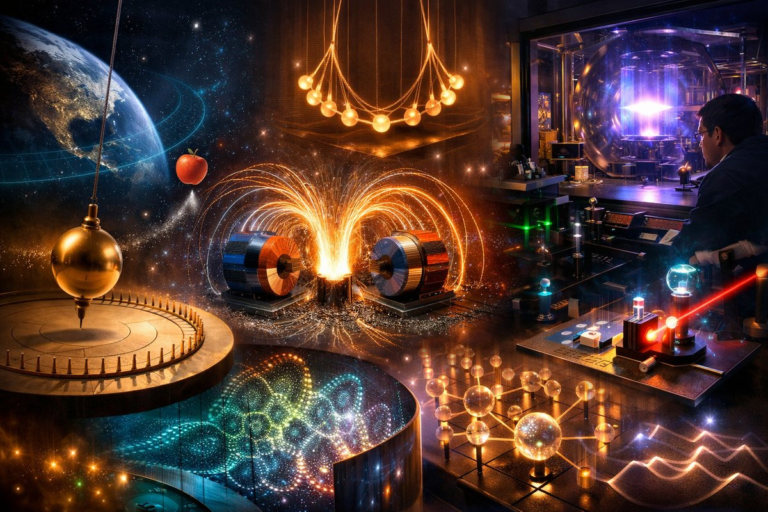
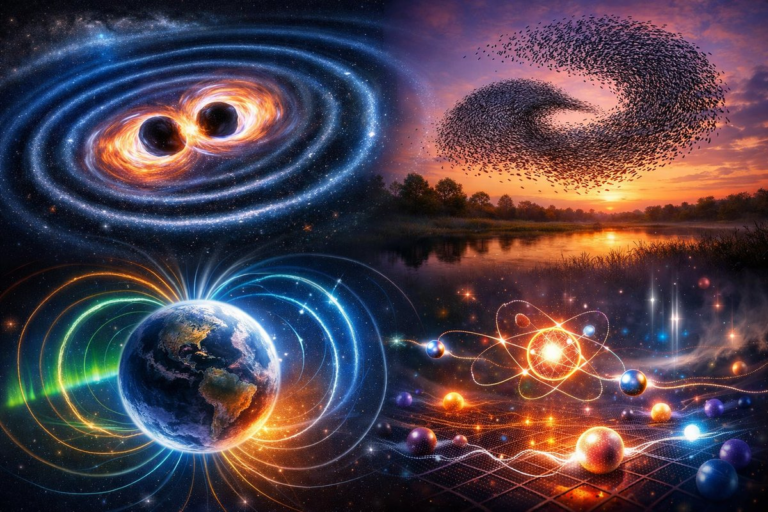
Recent advances in detecting gravitational waves have shifted our understanding of gravity from static attraction to dynamic conversation. When two massive objects like neutron stars spiral together, they send ripples through spacetime at the speed of light. Sensitive observatories pick up these faint tremors, allowing scientists to reconstruct astrophysical events billions of light-years away. Each detection refines our grasp of how gravity operates under extreme conditions, offering clues to the nature of dark matter and the fabric of the universe itself. Meanwhile, tabletop experiments with torsion pendulums and laser interferometry are testing gravity at submillimeter scales, searching for unexpected anomalies that could hint at new forces.
Closer to home, geophysicists map subtle variations in Earth’s gravitational field to reveal hidden structures below ground. Mountains, ocean trenches and dense ore bodies each leave a signature in local gravity measurements. Modern satellites equipped with accelerometers fly repeated orbits, measuring minute changes and building high-resolution gravity maps. These datasets inform everything from groundwater studies to volcanic monitoring. In the polar regions, shifts in ice mass have been tracked through gravitational changes, delivering direct evidence of melting glaciers. Such observations underscore how gravity can serve as a remote sensor, tracing mass movements without ever touching the surface.
Magnetism paints its own portrait of planetary behavior. Our planet’s magnetic field originates deep within Earth’s molten core and extends into space, forming the magnetosphere-a dynamic shield that deflects harmful solar wind. When charged particles funnel toward the poles, they collide with atmospheric gases and ignite auroras in curtains of green, pink and purple. Spacecraft fly into this electric ballet to sample plasma flows and study how magnetic reconnection powers substorms. On other worlds, magnetospheres vary wildly: Jupiter’s immense field traps radiation belts far stronger than Earth’s, while Mars bears only patchy remnants, offering clues to its lost atmosphere.
In the lab, magnetism emerges in materials through the alignment of tiny atomic magnets. Certain compounds exhibit ferromagnetism, strengthening into permanent magnets, while others display exotic states like spin ices or skyrmions-whirlpools of magnetization that can move like particles. Researchers probe these emergent behaviors using neutron scattering, magnetic resonance and scanning probe microscopes. Insights from emergent magnetism promise breakthroughs in energy-efficient memory, advanced sensors and even quantum computing elements where control of individual spins becomes paramount.
Emergent systems appear whenever simple interactions cascade into complex patterns. Watch a shallow pan of liquid heated from below and you’ll see convection cells form a hexagonal lattice, each cell rising with warm fluid and descending with cooler currents. In nature, similar principles govern atmospheric circulation, ocean currents and weather patterns. Flocks of birds, schools of fish and swarms of insects self-organize using local rules-avoid collisions, align with neighbors and move toward goals-without any central command. Scientists employ agent-based models and network theory to decode these phenomena, revealing universal principles that apply in social dynamics, traffic flow and even financial markets.
Quantum mechanics, the theory of the very small, introduces a fresh set of curiosities. Particles exist as waves of probability, and properties like position and momentum gain a fuzziness dictated by Heisenberg’s uncertainty principle. Entanglement binds particles so that a change in one instantly affects its partner, regardless of distance. In vacuum itself, transient particles flicker into existence and annihilate on impossibly brief timescales. Laboratory experiments with ultracold atoms, superconducting circuits and photonic systems recreate these effects in controlled settings, testing the limits of quantum theory and opening doors to technologies like ultra-precise clocks and quantum cryptography.
Strikingly, quantum quirks play a role in macroscopic devices. Gravitational wave detectors squeeze laser light’s quantum noise to improve sensitivity and unlock subtler signals. Quantum sensors now measure minute magnetic fields from neural firing in the brain or map underground infrastructure without excavation. Even everyday electronics owe much to quantum tunneling in semiconductors. As quantum technologies mature, they promise to revolutionize navigation, communication and measurement, blurring the boundary between fundamental research and practical application.
The interplay between gravity, magnetism, emergent behavior and quantum phenomena hints at a grander unity. The quest for a theory of quantum gravity-where quantum rules merge with spacetime’s curvature-drives experiments at the world’s largest colliders and most sensitive detectors. Some cosmologists propose that space and time themselves emerge from entangled quantum bits, suggesting that the fabric of reality is woven from information. While these ideas remain speculative, they illustrate how curiosity propels scientists to seek connections across scales and forces.
Understanding these natural patterns isn’t mere academic exercise. Climate modeling depends on accurate fluid dynamics and convection principles. Satellite positioning and navigation rely on corrections for both gravitational anomalies and relativistic effects. Materials engineered with emergent magnetic or electronic properties could lead to zero-loss power transmission. And quantum sensors may soon probe underground water reservoirs, detect structural weaknesses in infrastructure or offer navigation where GPS can’t reach. Each advance carries practical implications for energy, health and environmental stewardship.
To join this exploration, curious minds can turn to citizen science projects and hands-on kits. Open databases of gravitational and magnetism measurements invite anyone with programming skills to uncover new anomalies. DIY cloud chamber kits visualize cosmic rays at home. Portable magnetometers reveal local magnetic variations in parks and city streets. Amateur astronomers track auroras and meteors with telescopes mounted on smartphone adapters. Through simple experiments and data analysis, we not only learn about nature’s hidden currents but also cultivate a deeper sense of wonder and responsibility toward the planet.
Nature’s forces are both familiar and profound. From the coin that drops at our fingertips to the gravitational tremors of distant mergers, from the spark of auroras to the dance of quantum particles, patterns of physics and emergence surround us. Decoding these phenomena enriches our understanding, fuels new technologies and stirs a quiet awe in the heart of every observer. As we probe ever deeper, we’re reminded that each answer reveals new questions, and nature’s grand design remains an open invitation to wonder.