Location
Mount Vernon, WA 98274
Location
Mount Vernon, WA 98274

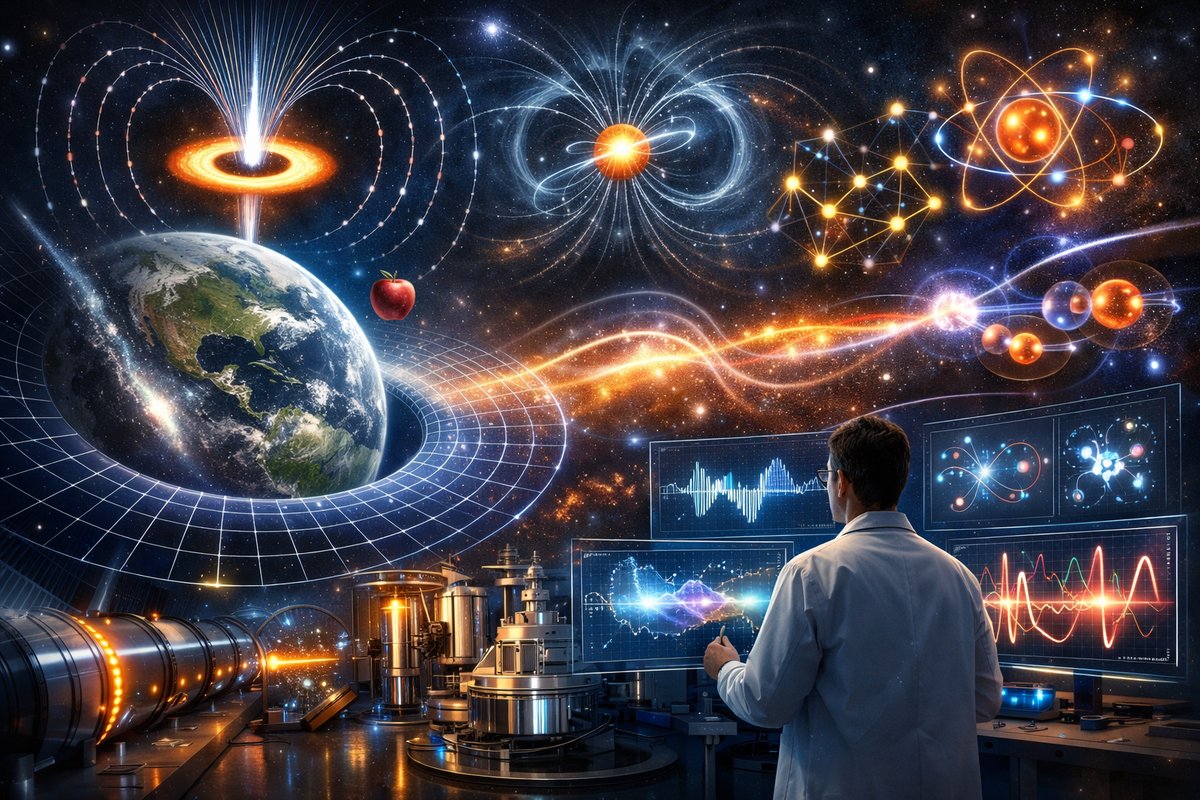
Scientists are uncovering the intricate patterns that underlie gravity, magnetism, emergent systems, and quantum phenomena, revealing a unified tapestry of natural forces. New experiments and instruments are translating whispers of the cosmos into vivid data streams, inviting us to witness nature's hidden algorithms.
In research laboratories and backyard workshops around the world, a new wave of inquiry is turning nature’s subtle signals into vivid stories. Gravity, once understood as nothing more than the pull that keeps our feet on the ground, is now being read like a code. Magnetism, long harnessed by compasses and motors, is revealing dynamic patterns that shape life from bird migrations to neural networks. Emergent systems-from murmuration of starlings to chemical reaction-diffusion waves-are teaching us how complexity arises from simple rules. And deep within the atom, quantum quirks continue to defy our intuition, teasing out superpositions and entanglement that could power the next generation of technology.
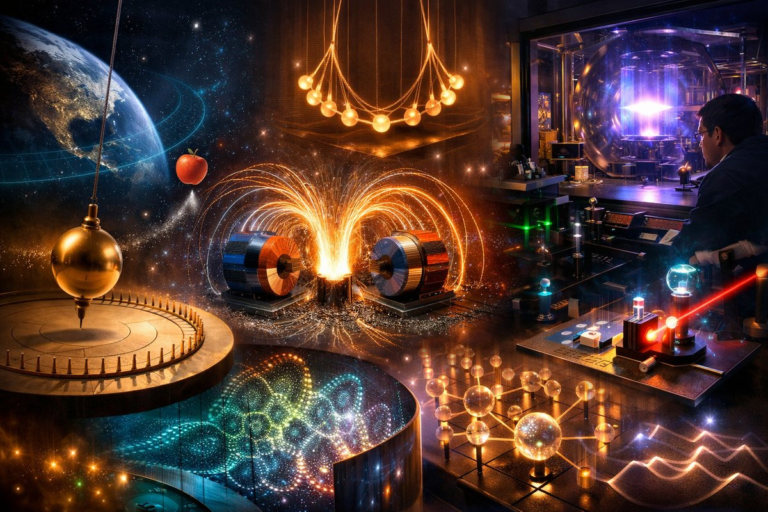
At the heart of these discoveries are sensitive instruments and creative experiments. In a high-altitude observatory, scientists have deployed ultra-precise gravimeters to detect minuscule shifts in Earth’s gravitational field. These devices track subterranean water flows, volcanic inflation, and even glacial melting by measuring variations of gravitational acceleration at the parts-per-billion level. The data is then fed into machine-learning models that compare temporal gravimetric signatures with environmental changes, revealing a predictive map of natural hazards.
Magnetism, once the domain of simple bar magnets and lodestones, now benefits from miniaturized sensors with nanotesla sensitivity. Hobbyists and professionals alike use 3-axis digital magnetometer modules attached to compact microcontrollers to map local field anomalies. These pocket-sized explorers can plot the hidden magnetic fingerprints of metallic objects, archaeological sites, and underground power lines. By combining crowdsourced readings via smartphone attachments, geomagnetic researchers are building open-access field maps that evolve in real time.
Meanwhile, emergent patterns in biology and chemistry are being studied with a blend of time-lapse imaging and computational simulation. Researchers film colonies of bacteria that form intricate swirling patterns on agar plates, then reconstruct their motion to test how individual cells follow chemical gradients. Physicists studying reaction-diffusion systems replicate Turing patterns in petri dishes, generating spots, stripes, and waves by tuning the concentrations of interacting chemicals. These tabletop experiments offer a window into developmental biology, helping explain how animal coats get their stripes or spots.
But it is at the quantum frontier where nature’s enigma deepens. In laboratories cooled to near absolute zero, atoms are coaxed into Bose-Einstein condensates, a state of matter in which quantum waves overlap and behave in unison. Laser pulses create atom interferometers that can sense gravitational waves and measure fundamental constants with unprecedented precision. Recent advances in superconducting qubits and trapped ions point toward quantum networks that could one day encrypt data with perfect secrecy or simulate complex materials at the atomic scale.
The allure of these discoveries lies not only in their scientific significance but in their aesthetic beauty. A gravimetric map becomes a topographic painting of concealed aquifers. A magnetogram exposes the ghostly arcs of magnetic field lines curling around iron artifacts. Reaction-diffusion patterns evoke organic designs reminiscent of seashells and corals. Quantum wavefunctions, once abstract mathematical constructs, manifest as interference fringes in microscopic images.
These patterns also carry practical promise. Early-warning systems for earthquakes and volcanic eruptions could harness changes in gravity and magnetism to provide precious time for evacuation. Precision magnetometers are enhancing navigation where GPS cannot reach-deep indoors, underwater, or on other planets. Reaction-diffusion research informs new approaches to tissue engineering, guiding stem cells to self-assemble into functional organs. Quantum sensors are set to revolutionize timekeeping, navigation, and even medical imaging.
Across these fields, an ethos of open science and DIY exploration is emerging. Citizen scientists equipped with inexpensive sensors contribute to magnetic anomaly databases. Makers assemble cloud chambers to detect cosmic rays in their living rooms. Online platforms host interactive simulations of emergent systems, inviting anyone with an internet connection to tweak parameters and watch patterns unfold. This democratization of tools and data reflects a broader shift: science is no longer confined to ivory towers but is becoming a shared quest for wonder.
Of course, decoding nature’s patterns comes with challenges. Noise and interference can obscure the faintest signals. Gravitational measurements are disrupted by passing vehicles or even waves crashing on distant shores. Magnetic sensors must compensate for temperature drift and local ferrous materials. Reaction-diffusion experiments demand precise control of chemical concentrations, and quantum systems teeter on the brink of decoherence, where the mere act of observation collapses delicate superpositions.
To surmount these hurdles, interdisciplinary teams combine expertise from physics, engineering, computer science, and biology. Adaptive filtering algorithms learn to subtract predictable noise, isolating the true natural signals. Adaptive optics and vibration isolation systems protect laser-cooled atom setups from external disturbances. Biologists and chemists co-develop off-the-shelf kits that standardize reaction-diffusion experiments, increasing reproducibility across labs.
Looking ahead, the convergence of gravity, magnetism, emergence, and quantum research hints at a deeper unity. The same mathematical frameworks that describe turbulence in fluids reappear in quantum chromodynamics. Network theory unites flocking birds, power grids, and neural circuits under common patterns of node interactions. Topological methods borrowed from condensed matter physics are mapping protected states in photonic crystals, magnetic materials, and quantum Hall systems. By exploring these parallels, scientists hope to reveal nature’s universal algorithms-principles that transcend scale and complexity.
This pursuit of hidden order also carries a philosophical dimension. When we decode the whispers of gravity or the flickers of quantum waves, we confront the limits of human perception. Instruments extend our senses, translating invisible forces into digital readouts and colorful plots. Yet each breakthrough raises new questions: What is the nature of space and time at the smallest scales? How do emergent behaviors give rise to consciousness and life? Can we harness these insights responsibly to address climate change, resource scarcity, and global health?
In classrooms and community labs, educators leverage these stories of discovery to spark curiosity. Rogue pendulums swing in high-school physics demonstrations to visualize Earth’s rotation. DIY magnetometer workshops teach students about vector fields and data analysis. Cloud chamber kits let children see traces of cosmic rays from deep space. These hands-on experiences foster not only scientific literacy but an emotional connection to the living planet and the vast cosmos beyond.
The narrative of nature’s hidden algorithms is still unfolding. Every new generator of data-whether a hypersensitive gravimeter, a network of micro-magnetometers, or an automated reaction-diffusion rig-feeds a growing archive of patterns. Artificial intelligence tools are trained on this archive to tease out subtle correlations that human intuition might miss. In turn, those correlations guide the design of new experiments, creating a virtuous cycle of discovery.
As we refine our instruments and algorithms, we catch glimpses of a world more interconnected than ever. The flutter of a bird’s wings, the migration of whales guided by geomagnetic maps, the birth of galaxies seeded by quantum fluctuations-all follow the rules of natural forces and phenomena. By listening to gravity’s murmur, tracing magnetism’s invisible currents, mapping emergent complexity, and probing quantum strangeness, we deepen our understanding and appreciation of the universe.
In the end, decoding nature’s hidden algorithms is not just a scientific endeavor; it is an invitation to wonder. It asks us to look beyond surface appearances, to question the taken-for-granted, and to celebrate the delicate interplay of forces that shape life on Earth and beyond. With every data point and every pattern revealed, we weave a richer story of our place in the grand cosmic tapestry.