Location
Mount Vernon, WA 98274
Location
Mount Vernon, WA 98274

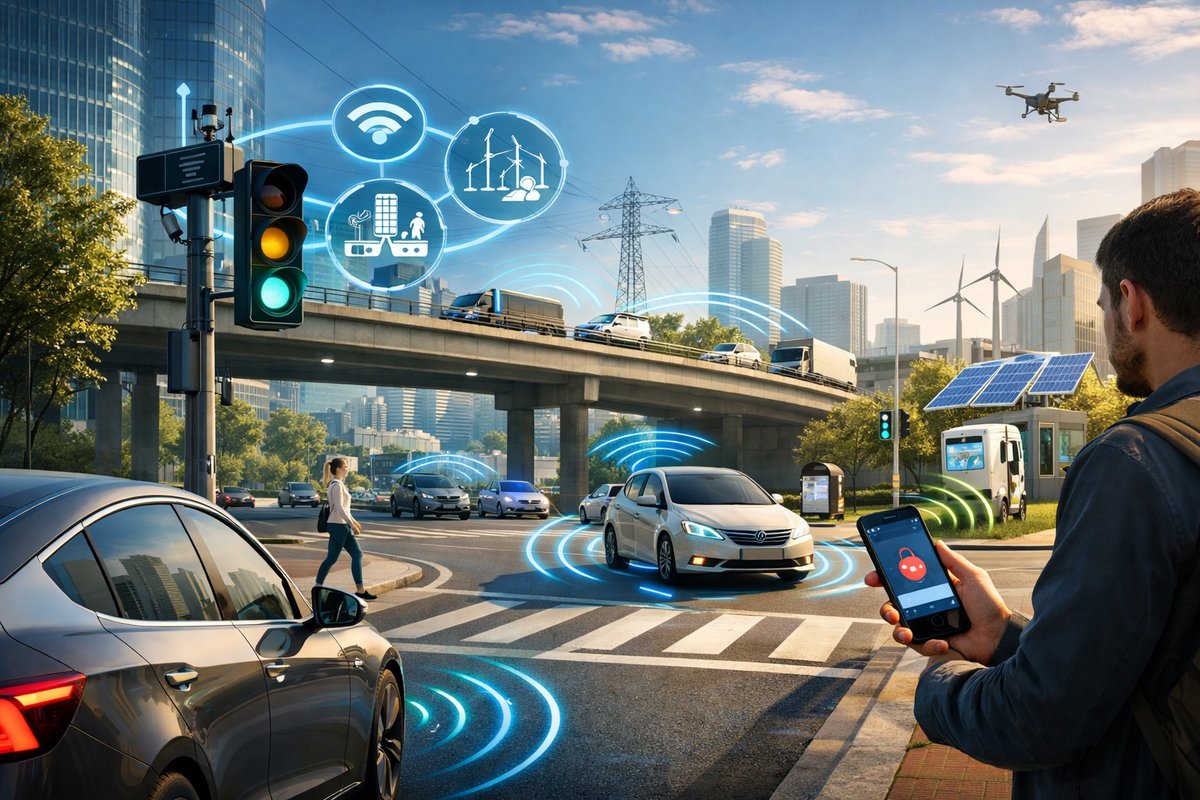
Connected vehicles now talk to traffic lights, power grids, and even pedestrians' smartphones, unlocking a new era of safer, greener transportation. By leveraging vehicle-to-everything communication and intelligent roadside units, cities and automakers are collaborating on pilot projects that promise fewer accidents, lower emissions, and more efficient highways.
Imagine driving through a city where every traffic light, crosswalk and roadside sensor is part of an invisible orchestra, guiding your car smoothly and safely toward its destination. That’s no futuristic daydream: vehicle-to-everything communication, or V2X, is seeding smart roads around the globe. Instead of simply relying on lines on the pavement, cars are harnessing real-time data streams from infrastructure and other road users to orchestrate speed, timing and energy use. Early pilot corridors in North America and Europe demonstrate collision warnings, green-wave speed advisories and coordinated electric-vehicle charging that reduce both traffic jams and tailpipe emissions. The familiar daily commute is evolving into an adaptive networked journey that remembers your habits, learns local traffic rhythms and even lends power back to the grid when demand spikes. The implications extend from safer streets and more efficient logistics to a circular electric ecosystem where cars interact as mobile batteries in a shared energy marketplace. Yet rolling out this promise requires bridging technology gaps, forging new industry partnerships and addressing privacy and cybersecurity concerns along the way.
Data from the U.S. Department of Transportation indicates that connected-vehicle applications could reduce crashes by as much as 80 percent. In one pilot project on Interstate 80 in Wyoming, equipped vehicles received warnings before entering curve zones at unsafe speeds, cutting run-off-road incidents by more than half. Meanwhile, in Northern Virginia, a 5G-enabled testbed streams low-latency alerts from smart traffic signals to vehicles, allowing drivers to maintain a constant pace through green lights while conserving fuel. In Germany, the C-Roads platform unites national road authorities with automakers on standardized protocols so cars can seamlessly interact with traffic management centers across borders. Each proof of concept reinforces the central tenet of V2X: when vehicles, infrastructure and pedestrians share a common language, the entire transportation ecosystem grows more harmonious.
Behind the scenes, two competing technologies power V2X communication: dedicated short-range communications (DSRC) and cellular V2X (C-V2X). DSRC operates over the 5.9 GHz band with sub-millisecond reaction times, ideal for urgent collision warnings between nearby vehicles. C-V2X, leveraging existing cellular networks and forthcoming 5G rollout, promises broader coverage and simpler integration for infrastructure-to-vehicle messages. Automakers and regulators worldwide are hashing out standards that allow both to coexist and evolve. A hybrid approach seems likely for the foreseeable future, pairing DSRC’s razor-sharp alerts for high-risk scenarios with C-V2X’s expansive reach to relay traffic signal timing, work-zone warnings and pedestrian proximity alerts.
Beyond instant safety benefits, V2X sets the stage for a more sustainable mobility paradigm. Imagine fleets of electric vehicles pulling into charging stations that automatically fine-tune their charge rate based on grid demand and renewable‐energy availability. During abundant midday solar production, roadside chargers ramp up to capture excess power. As the grid strain peaks at dusk, parked EVs fed power back to local transformers in a vehicle-to-grid (V2G) arrangement, smoothing load curves and reducing reliance on peaker plants. Early trials in Denmark and Japan show that bi-directional chargers and smart meters can deliver grid stability services while helping EV owners offset charging costs. In this reciprocal partnership, cars become mobile energy storage units, ameliorating one of the key hurdles of large-scale renewable adoption.
On the urban front, smart intersections equipped with lidar and radar sensors detect pedestrians and cyclists, broadcasting their positions to approaching vehicles. When a jogger steps off the curb against a red light, cameras and roadside radios collaborate to trigger in-car warnings and gently nudge braking systems. In a pilot in Barcelona, city planners discovered that adaptive signal timing informed by connected bike-lane counters reduced conflicts by 30 percent and improved traffic flow for all road users. Micro-mobility devices like e-scooters and cargo bikes are also integrating into this mesh, sharing anonymized location pings that help vehicles anticipate users popping out of blind corners.
In parallel, digital twins of highway segments are emerging in control centers, fed by fleets of connected cars streaming anonymized sensor data. Traffic engineers can visualize construction impacts in real time, predict congestion hot spots and adjust signal plans or lane assignments on demand. When a jackknifed truck is detected on a mountainous stretch, the system automatically reroutes connected commercial vehicles, dispatching roadside assistance before secondary pileups occur. These digital replicas foster proactive maintenance: potholes and roadside hazards are logged the moment they’re encountered, prompting repair crews to respond before the deterioration accelerates.
Of course, weaving this web of connectivity presents challenges. Ensuring robust cybersecurity at roadside units, cellular base stations and in practitioners’ vehicles is paramount. Malicious actors targeting a handful of traffic lights could unleash gridlock across a city, so encryption, authentication and intrusion-detection systems must be baked into every communication layer. Privacy advocates also raise important questions about how location data is collected, stored and shared. Industry alliances stress that only anonymized or aggregated data should traverse public networks, and that personal identifiers stay securely locked within individual vehicles or trusted service providers.
Deploying V2X infrastructure demands significant public-private collaboration and upfront investment. Governments must decide where to install roadside units, allocate spectrum licenses and craft regulations that balance innovation with safety. Automakers need to outfit millions of vehicles with transceivers, implement over-the-air firmware updates and build interfaces that inform drivers without causing distraction. Yet partnerships are already blossoming: toll agencies, electric utilities, software startups and OEMs are sharing cost and expertise to launch pilot corridors. Many see this cooperative model as essential to avoid patchwork rollouts that stymie interoperability.
For commercial fleets and logistics providers, the allure of V2X is even more tangible. Truck platooning, where groups of heavy vehicles cruise in close formation under automated speed controls, can cut aerodynamic drag and fuel consumption by up to 10 percent. In a European demonstration, three connected trucks maintained just 10 meters of spacing at highway speeds, reacting to the lead unit’s braking in milliseconds. Coordinating routes through smart freight corridors reduces idle time at toll booths and border crossings, while dynamic weight monitoring ensures axle loads remain within legal limits to prevent pavement damage.
Meanwhile, major city transit agencies are experimenting with connected buses that negotiate green extension at intersections to stay on schedule. Passengers benefit from more reliable arrival predictions, while schedulers gain granular insights into dwell-time patterns at stops. A bus that “speaks” to the road network can also optimize its own energy use, for example by coasting or regenerative braking in synchronization with signal phases.
Looking ahead, V2X will underpin ever more ambitious automation levels. Autonomous shuttle services already depend on high-definition maps fused with real-time traffic data to navigate complex urban corridors. As vehicles coordinate their actions through connected sensors, safe distances shrink and highway capacity swells, eventually easing congestion without the need to widen roads. In suburban and rural areas, networked freight drones and self-driving delivery vans will tap into the same roadside intelligence to chart safe, efficient routes off the beaten path.
Ultimately, the road reimagined is one where vehicles, infrastructure and energy networks merge into a cohesive living system. Everyday drivers will experience fewer unexpected bottlenecks, more timely warnings of hazards and smarter routes that adapt to weather, events or grid conditions. For commercial operators, the efficiency gains translate into lower operating costs and greener supply chains. And for city planners, the opportunity to reshape urban design around dynamic, data-driven flows offers a chance to reduce sprawl, cut carbon footprints and elevate quality of life.
This shift toward ubiquitous vehicle connectivity also rekindles a sense of wonder that once defined the automobile age. The hum of a well-tuned engine gave way to silent EV motors; today, the promise of a car that talks back, anticipates, and even lends power back to the grid restores the automobile’s role as both tool and companion. In this networked future, the road becomes more than a static ribbon of asphalt-it is a living corridor of memory, motion and meaning, shaped by human ingenuity and the shared pulse of millions of connected machines.