Location
Mount Vernon, WA 98274
Location
Mount Vernon, WA 98274

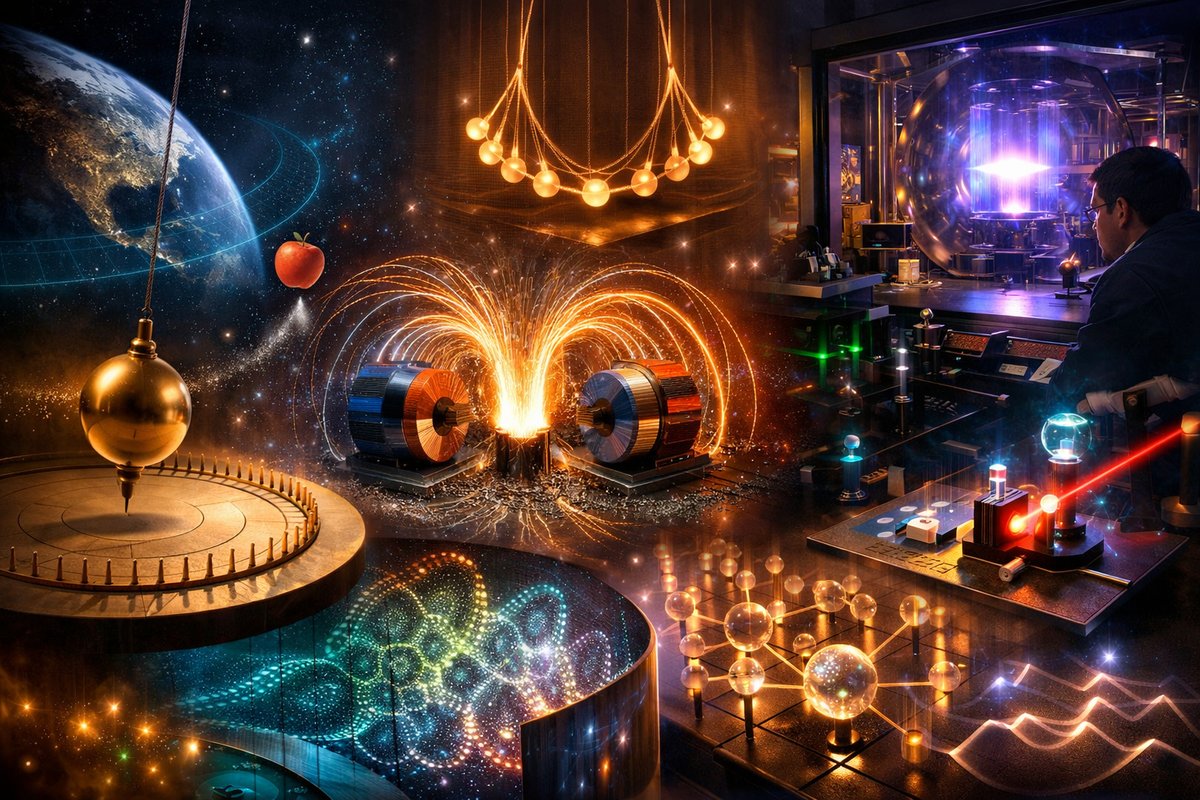
A new collaborative initiative invites readers to explore the fundamental forces shaping our world, from the quiet tug of gravity to the dance of magnetic fields, the surprising order emerging in complex systems, and the strange behavior of matter on quantum scales. This immersive report highlights experiments and installations that make these invisible patterns visible.
A wave of curiosity is sweeping through science centers and maker spaces worldwide as educators, researchers, and citizen scientists team up to bring the invisible forces of nature into focus. This effort spans gravity’s constant tug, magnetism’s subtle push and pull, emergent patterns born of simple rules, and the strange quirks of quantum phenomena. By combining hands-on demonstrations, interactive exhibits, and open-source experiment designs, the initiative aims to foster wonder and deepen public understanding.
Gravity’s Quiet Grip
Gravity, perhaps the most familiar of natural forces, often feels so constant that it fades into the background. Yet its effects are all around us-from the trajectory of a thrown ball to the tides that shape coastlines. In a recent traveling exhibit, participants can roll steel balls down adjustable ramps, altering incline angles to watch how acceleration changes. Simple timers record the speed, demonstrating in real time that steeper slopes lead to faster descents, echoing Galileo’s 17th-century observations.
Beyond ramps, another station features a high-precision balance platform that records minute weight shifts as volunteers rise and fall on an electronic scale. This platform traces tiny fluctuations in local gravitational intensity, revealing variations due to elevation changes and even nearby large structures. Such live data counters the notion of gravity as uniform and invites visitors to ponder how massive bodies-planets, moons, asteroids-shape cosmic orbits.
Magnetism: The Invisible Dance
If gravity draws objects together, magnetism orchestrates a push-and-pull ballet that lights up compasses, spins electric motors, and guides charged particles in star-forming clouds. A set of ring magnets glued around a cylinder lets attendees feel how magnetic repulsion can appear almost weightless, as two rings hover just above one another. Nearby, a coil wrapped around an iron core connects to a simple power supply, transforming into an electromagnet whose strength grows with current. Real-time sensors display the magnetic field lines in color, helping the audience visualize fields that are otherwise invisible.
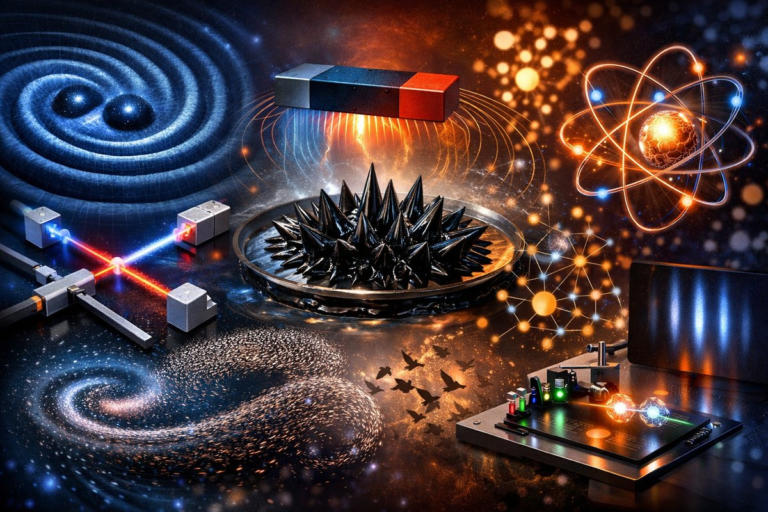
In a hands-on corner, volunteers play with a ferrofluid display tank. When a strong magnetic field is applied, the dark liquid erupts into spikes and patterns, a dynamic sculpture formed by the interplay of magnetism and fluid surface tension. The exhibit makes clear that magnetic forces at work on microscopic particles can drive stunning macroscopic effects-an emergent marvel in its own right.
Emergent Systems: When Simple Rules Spark Complexity
Perhaps most intriguing are emergent systems, where simple building blocks follow basic rules yet create patterns far more elaborate than any individual part. A classic example on display is a grid of smart pixels programmed as cells in a cellular automaton. Visitors tap cells to turn them “alive” or “dead,” then press play to watch patterns evolve. Some arrangements die out quickly; others expand, oscillate, or generate moving structures reminiscent of gliders. The exhibit underscores how natural processes-ants forming trails, flocking birds, chemical reaction-diffusion patterns in snail shells-arise without a central conductor.
Another table invites interaction with a crowd simulation projected onto a tiled floor. Motion sensors track footsteps as participants wander through the virtual crowd, revealing spontaneous lanes, jams, and waves. These models reflect real-world concerns-from optimizing pedestrian flow in event venues to understanding traffic patterns on busy highways. By directly engaging with simulation rules, visitors grasp how order and chaos can coexist and shift with small tweaks.
Quantum Quirks: Peeking at the Subatomic Stage
On the microscopic end, quantum phenomena challenge our intuition with superposition, entanglement, and wave-particle duality. A compact tabletop cloud chamber, filled with alcohol vapor cooled by dry ice, lets guests see trails of ionizing particles as they zip through the mist. Each streak marks a path of cosmic rays or background radiation, bridging everyday experience with subatomic processes. The chamber’s dancing vapor serves as a visual gateway into a realm usually hidden deep inside detectors or accelerators.
Nearby, a laser diffraction station employs a low-power laser pointer and a set of fine slits printed on transparent film. Shining the beam through single, double, and multiple slits projects interference patterns onto a white screen. These bands of light and dark make palpable the wave-like behavior of photons and electrons, reminding participants that matter itself can behave like a ripple in a pond.
Bridging Scales and Disciplines
What unites these diverse demonstrations is a spirit of exploration. Researchers from physics, mathematics, computer science, and design have co-authored open-source guides for constructing these stations from off-the-shelf components and recycled materials. Maker communities in Asia, Europe, and the Americas have already adapted the plans, customizing interactive features and translating instructions into local languages. This global patchwork of evolving DIY science exhibits showcases how emergent collaboration mirrors the very patterns the exhibits explore.
Educators are finding that students who engage with these hands-on tools gain a more intuitive grasp of concepts that often seem abstract when confined to textbooks. A teacher in a suburban middle school reported that after building a simple electromagnet and measuring its field, several students went on to create a science-fair project exploring magnetic levitation. In another city, a summer workshop on pendulum wave machines-collections of pendulums of varying lengths swinging in unison-sparked discussions about resonance, wave interference, and the rhythmic pulse found in heartbeats and traffic cycles.
Real-World Impacts
Beyond sparking wonder, these demonstrations have practical implications. Urban planners use emergent-system models to predict foot traffic in transit hubs. Engineers designing precision sensors lean on a deep understanding of magnetic fields to develop non-invasive medical imaging devices. And physicists studying particle tracks in cloud chambers contribute to environmental monitoring of background radiation, informing public health initiatives in regions affected by industrial activities or natural radon emissions.
At the same time, gratitude for the elegance of these forces is fueling calls to protect fragile ecosystems and promote sustainable technologies. Discussions around renewable energy links-the gravitational potential in hydropower, magnetic fields in wind turbine generators, and emergent patterns in energy grids-are heartening signs that scientific insight can guide responsible stewardship.
Looking Ahead: The Next Frontier
Organizers are already planning expansions of the core exhibit, exploring additional phenomena and deeper layers of complexity. Proposed modules include a tabletop plasma globe to illustrate electric fields and ionization, a resonance chamber for exploring the natural frequencies of materials, and low-temperature experiments to demonstrate superconductivity in everyday setups.
Teams are also piloting remote-access versions of the stations, streaming live data and video so that learners in remote or underserved regions can participate virtually. Paired with interactive web apps that let users tweak parameters and observe simulated outcomes, these hybrid experiences blur the line between physical and digital exploration.
By weaving together gravity, magnetism, emergence, and quantum mechanics into a cohesive narrative, this global collaboration offers a lens of wonder through which anyone can glimpse the hidden choreography of nature. It invites us to remember that beneath the surface of the everyday lies a coded tapestry of forces and patterns, waiting to be decoded by curious minds.
A New Dawn for Public Science
In an era marked by rapid technological change and complex global challenges, the initiative underscores the enduring power of hands-on discovery. Whether it’s a child adjusting the slit spacing in a diffraction experiment, a hobbyist crafting a ferrofluid sculpture, or a full classroom measuring gravitational variations, the common thread is active engagement. Through these shared experiences, participants not only learn scientific principles but also cultivate the emotional intelligence and collaborative spirit needed to tackle tomorrow’s problems.
This movement reminds us that science is not confined to labs or lecture halls. It is a universal language of patterns, a toolkit for unraveling mysteries, and above all, a source of wonder that connects us-to each other, and to the invisible forces that shape our lives.