Location
Mount Vernon, WA 98274

Location
Mount Vernon, WA 98274
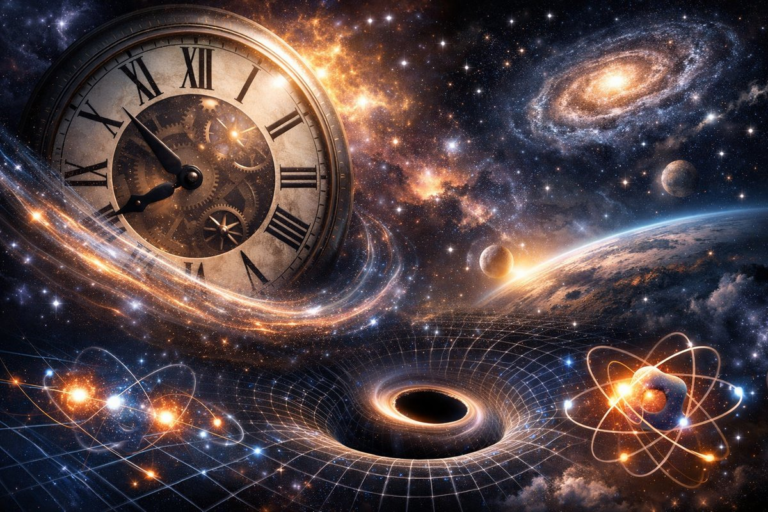
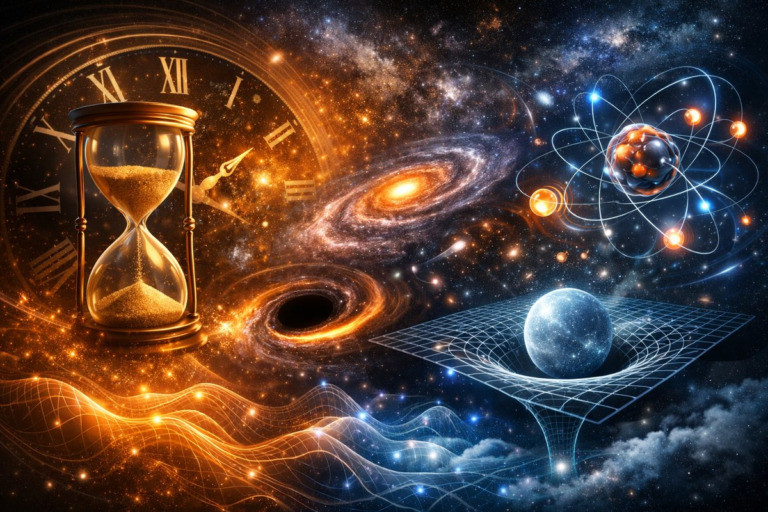
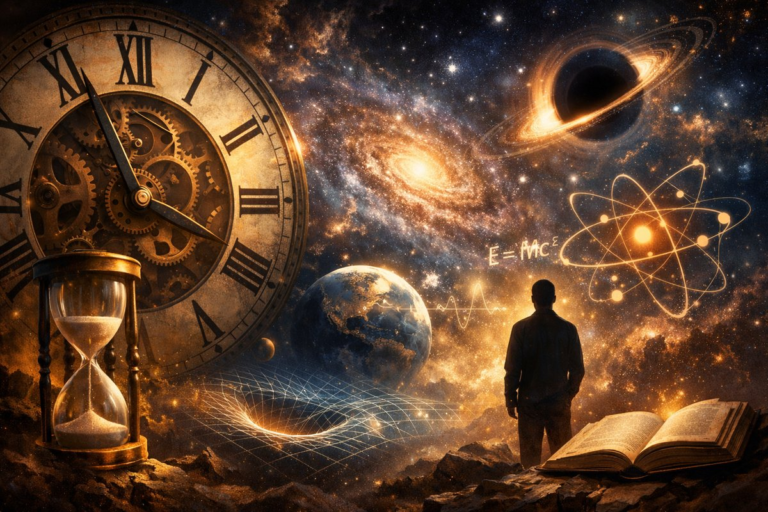
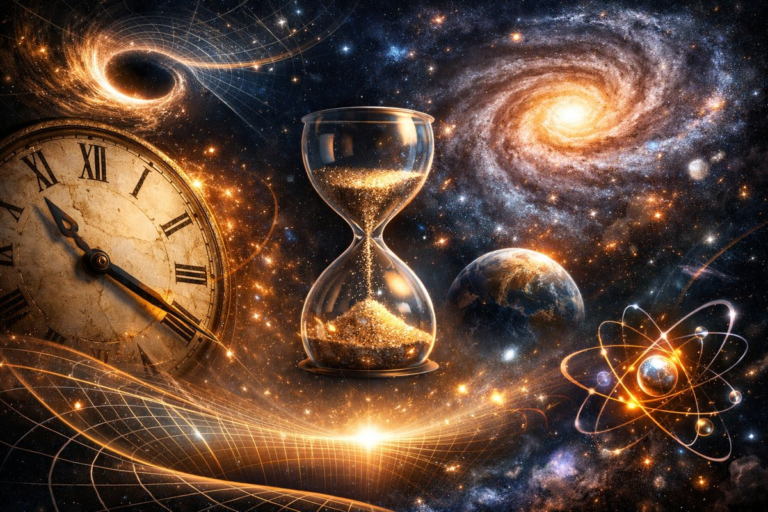
A groundbreaking series of experiments is shedding fresh light on the nature of time and the elusive properties of matter. From quantum time crystals to deep‐space atomic clocks, scientists are weaving disparate threads of observation into a new tapestry of cosmic understanding. This emerging narrative may reshape how we perceive our place in the universe.
A hush has fallen over the grand experimental halls and telescope domes that span the globe. Researchers at leading laboratories and observatories report tantalizing hints that time itself might exhibit properties once reserved for matter-and that matter may harbor secrets of hidden dimensions. From Europe’s high‐energy collisions to precision measurements in orbit, this unfolding story unites disciplines and challenges our most fundamental assumptions.
Deep beneath the Franco-Swiss border, a consortium of physicists at the European Organization for Nuclear Research is pushing particle collisions to unprecedented energies. Their goal is not merely the discovery of new particles but the study of time’s fabric at extremes. Recent analyses suggest fleeting fluctuations in the rate of atomic decays-tiny variations in half-lives that could point toward interactions with exotic fields or mirror universes. Although these anomalies lie at the edge of statistical significance, they beckon follow-up experiments designed to isolate environmental effects and decouple classical noise from genuine quantum signatures.
Thousands of kilometers away, another group of researchers is exploring time’s behavior from above. A prototype deep‐space atomic clock, mounted on a small satellite platform, has achieved unrivaled stability during extended operation. Its success paves the way for vast networks of synchronized timekeepers capable of probing gravitational time dilation across planetary scales. By comparing tick rates between ground stations and satellites in varying orbits, scientists can test Einstein’s predictions with precision that transcends past efforts. The emerging network will also support navigation systems and fundamental tests of general relativity.
Meanwhile, in rotary vacuum chambers and laser‐cooling traps, physicists are engineering so-called time crystals-quantum systems that oscillate in perpetuity without expending energy. Although purely theoretical for decades, time crystals have recently been realized in platforms ranging from trapped ions to diamond impurities. Each experimental setup exhibits its own quirks: one shows period-doubled oscillations, another reveals multi-frequency beats. Together they offer a laboratory playground for studying non-equilibrium phases of matter and the arrow of time itself. Insights gleaned from these miniature clocks may one day inform data processing in quantum computers or even reveal methods for stabilizing timekeeping in extreme environments.
At the same time, telescopes tuned to the cosmic microwave background are delivering fresh maps of primordial fluctuations. By measuring minute temperature and polarization patterns in the afterglow of the Big Bang, cosmologists trace the imprints of dark matter and the initial flow of time through the infant universe. Recent high-resolution surveys have uncovered subtle anomalies in the power spectrum-irregularities that some theorists interpret as evidence of interactions between dark matter particles and radiation during cosmic dawn. If confirmed, these findings could upend prevailing dark matter models and force a rethinking of how mass clumped to form galaxies.
Back in the lab, teams are refining their measurements of particle masses with ever-improving detectors. Time-of-flight chambers, complemented by ultrafast electronics, allow scientists to track subatomic fragments across microscopic distances in fractions of a nanosecond. These devices reveal how mass emerges from energy and how fleeting virtual particles flicker into existence within quantum fields. By comparing results across different collision energies and target materials, researchers aim to pin down the nature of heavy quark bound states and search for hints of beyond-standard-model physics.
Bridging these disparate threads is an emerging effort in computational cosmology. Ultra-scale simulations deploy millions of processing cores to evolve virtual universes from fractions of a second after the Big Bang through to galaxy formation. Advanced algorithms now incorporate time-dependent dark energy models, quantum field effects, and relativistic corrections in a single unified framework. These simulated universes provide theoretical playgrounds for interpreting observations-whether they originate from beamline spectrometers or cosmic observatories.
What unites these pursuits is a growing realization that time and matter are not passive backdrops to physical phenomena but dynamic participants. In deep-space experiments, atomic clocks demonstrate that when you change gravitational potential, time itself runs at a different pace. In quantum trials, matter arrays form structures that break temporal symmetry and hint at phases yet unseen. And in high-energy experiments, minute variations in decay rates whisper of hidden forces or dimensions waiting to be discovered.
Alongside pure research, educators and outreach teams are embracing this narrative to inspire a new generation of curious minds. Interactive exhibits at science centers now allow visitors to manipulate simulated atoms and experience time dilation firsthand in virtual reality. Open source toolkits grant students access to data from real-world atomic clocks and particle detectors. Amateur stargazers armed with affordable telescopes can contribute to dark matter searches by tracking microlensing events in distant galaxies. The frontier of discovery has never felt more accessible.
As these inquiries converge, they raise profound philosophical questions. If time can crystallize, oscillate, and vary with gravity, then what is its essence? Is the arrow of time an emergent phenomenon tied to entropy, or does it arise from deeper quantum correlations? And how does our conscious experience of flowing time relate to these underlying mechanisms? While experiments will continue to refine the details, the broader mystery remains enticingly intact.
For the curious observer, the journey is just beginning. Whether mapping fluctuations in the cosmic microwave background or stabilizing atomic clocks in lunar orbit, scientists are weaving a story that spans scales from the subatomic to the cosmological. Each new measurement adds a thread, revealing patterns that may eventually form a complete tapestry of reality.
In the coming years, expect collaborations between quantum laboratories and astronomical observatories to deepen. Imagine coordinated campaigns where time crystals oscillate in sync with pulsar timing arrays, or where satellite clocks and gravitational wave detectors jointly probe spacetime distortion. The blurring boundaries between disciplines promise breakthroughs-and with them, an ever-richer understanding of how time and matter dance together across the cosmic stage.
Still, amid the technical sophistication, the human dimension persists. Researchers recall awe-inspiring moments: the faint shimmer of a telescope’s eyepiece revealing a distant quasar, the exhilaration of a new calibration that refines our cosmic map, the quiet thrill of seeing theory and experiment converge. These emotional resonances keep the quest vibrant, reminding us that science is as much a human enterprise as an objective endeavor.
Today’s headlines may highlight incremental advances-another decimal place of precision, a new oscillation pattern detected-but together they comprise a saga of discovery. Over the coming decade, as instruments become more sensitive and simulations more realistic, we may find answers to age-old questions: What is time? Why does matter dominate antimatter? How did complexity emerge from the primordial chaos? Until then, every tick of an atomic clock, every photon captured by a telescope, and every collision in a particle accelerator will carry us closer to unveiling the ultimate tapestry of reality.