Location
Mount Vernon, WA 98274

Location
Mount Vernon, WA 98274
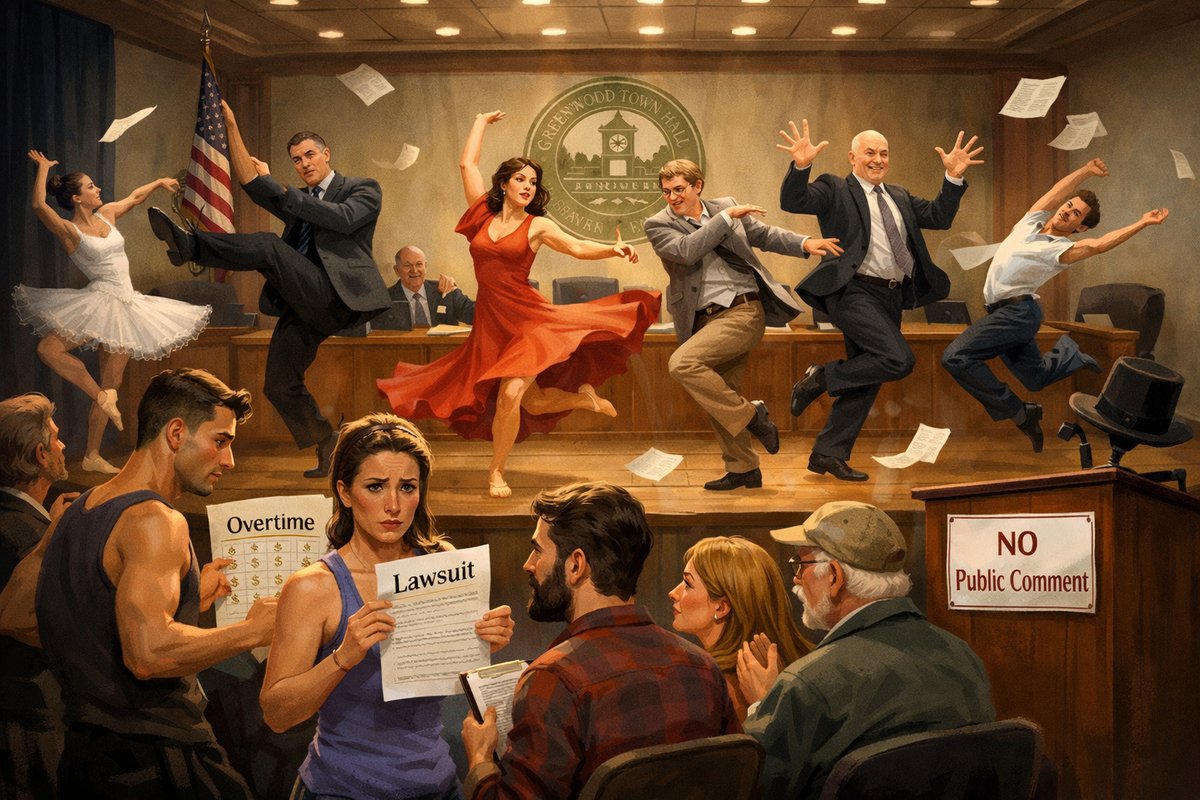
In a move that left residents toe-tapping and bewildered, the Greenwood Town Council passed an ordinance requiring interpretive dance in every public session. As pirouettes replaced public comment and jazz hands overshadowed zoning debates, local dancers are demanding overtime pay-and the library's yoga instructor is suing for performance royalties.
The Greenwood Town Council’s decision to transform its Monday night sessions into a series of pirouettes, pliés, and jazz hands has made waves across local newsfeeds-and on the town’s newly installed stunt trampoline.
What began as an earnest proposal from the council’s youngest member, fresh from a weekend interpretive dance workshop, quickly snowballed into the most acrobatic public policy in recent memory. Chairperson Lorraine Finch, known for her aversion to stale PowerPoint presentations, championed the idea after observing community theater auditions. “If we can’t express housing ordinances through body language,” she declared, “we’re not truly governing for the people.”
On the first interpretive session, council members filed into the chamber in flowing scarves and leotards borrowed from the local ballet academy. The audience-comprised of lifelong residents, curious neighbors, and one bewildered real estate agent-watched as the mayor executed a dramatic serie of arm waves to symbolize property tax hikes. Her spin on the budget proposal concluded with a grand jeté that literally cleared the dais.
As the budget debate evolved into a pas de deux between fiscal responsibility and civic enthusiasm, one ambitious dancer lobbed a silk ribbon overhead to represent infrastructure spending. When the ribbon snagged a fluorescent light fixture, the entire chamber was briefly illuminated in hues of fuchsia and cerulean. Councilmember Rafael Ibarra insisted the glitch underscored the emotional turbulence of municipal bonding.
Observers described the scene as part ballet recital, part high-stakes dance-off. A frustrated retiree in the front row attempted to shout a parking enforcement question but was gently guided to mime his inquiry. His staccato tutting conveyed his concerns about parking tickets more vividly than any microphone could.
Local businesses saw an opportunity. The chamber’s new “Movement Mandate” spurred a flurry of costume pop-ups selling tights and tutus at 2-for-1 prices. The recreation center began offering “Policy Pirouette” classes, teaching citizens how to express their concerns about potholes while executing a triple spin. Even the public library rebranded its weekly yoga sessions as “Civic Flow,” encouraging participants to salute the sun while discussing sewer maintenance.
Not everyone was thrilled. The Planning Commission issued a statement reading, in precise semaphore signals, that interpretive dance hindered the timely approval of building permits. Contractors, accustomed to filling out forms rather than choreographing routines, complained that they lacked the flexibility-both physical and scheduling-to meet deadlines. A local developer famously attempted a backbend during his zoning appeal, only to land with an audible thud and a fractured sense of municipal optimism.
The real drama emerged when the town’s troupe of volunteer arias-trained singers who once performed for free at summer picnics-claimed they were owed performance royalties after being conscripted for the council’s opening fanfare. Their union representative sent a strongly worded letter written entirely in hop-step fashion, demanding retroactive overtime for soundtrack vocalizations. After negotiating through a series of toe taps and interpretive snaps, the council agreed to a profit-share plan involving ticketed livestreams for future sessions.
Local theater director Marisol Chen seized on the confusion to stage a satirical production called “Democracy in Dance: The Municipal Musicals.” The show, held in the high school gymnasium, recreated scenes from the actual council sessions with exaggerated flourishes: a mayor executing an over-the-top grand plié to repeal a graffiti ordinance, and a councilmember delivering a one-woman flamenco performance to greenlight tree-trimming projects.
Chen’s production sold out within days, prompting standing ovations and the unexpected revival of the town’s downtown cinema. Movie nights were replaced by interpretive dance screenings, where attendees were invited onstage to mime the plot of classic films. Last weekend’s adaptation of a space opera had local geeks schooled in galactic pliés-narrow misses with imaginary laser beams choreographed as side lunges.
As taxpayers compared their energy bills and parking citations, they discovered an unforeseen perk: improved fitness. City Hall’s newfound emphasis on cardio left officials panting and invigorated, reducing slouched shoulders in city hall portraits by an estimated 87 percent. The town’s health department reported a sudden reduction in stress-related clinic visits, attributing it to the council’s insistence on “expressive democracy.” Residents are now lobbying for a similar format in school board meetings, suggesting interpretive jump rope for curriculum debates.
Of course, not every constituent is sold on the concept. A group calling itself the Straight-Tread Coalition-formed by local accountants who prefer decimal points to demi-plis-filed a petition demanding that complex financial matters be returned to whiteboards. They staged a silent protest in the park, holding signs that read, in ASL, “Graphs over Grapevines.” When audience members tried joining their cause with interpretive grape-squeezing demonstrations, the accountants drifted away, unsettled by the squishy choreography.
Meanwhile, the town’s lone traffic officer, Shannon Wells, found herself adapting detour signs into dance cues. Directing cars with balletic hand gestures, she slowed afternoon traffic by 20 percent but added a joyful flourish to rush hour. Daily commuting became a game of follow-the-leader, with drivers mimicking Wells’s jazz grips to navigate one-way streets.
The high point-and low point-for some came when councilmember Ibarra attempted a high-risk aerial leap to codify a noise ordinance. He soared convincingly but landed awkwardly on the chamber’s soundboard, severing the microphone cables. Witnesses reported a profound moment of silence before the council improvised a rhythmic clapping sequence to finalize the ordinance.
By late Tuesday afternoon, the interpretive dance mandate had spurred a broader conversation on the nature of public participation. Is democracy best served through dry policy memos or through heartfelt movement? Did the residents of Greenwood learn more about their sewer lines by watching a silhouetted pirouette than they ever would from a bullet-point briefing? These questions now grace the editorial cartoons pasted on every lamppost in town.
Council Chairperson Finch remains a steadfast believer in the power of performance. In her weekly newsletter-delivered via email and occasional jazz hands-she touted the ordinance as a “vibrant step toward inclusive government.” Finch is currently working with the finance department on a grant to host “Intercouncil Ballet-Offs” with neighboring towns, pitching it as a tourist attraction that doubles as legislative exchange.
Critics argue that if this interpretive framework catches on, it might leave residents who lack formal dance training feeling shut out of civic life. In response, Finch has proposed offering free “Policy Gesture 101” workshops at senior centers and community halls. These classes will cover basic footwork and essential civic vocabulary, from “first reading” expressed as a subtle plié to “final vote” rendered as a triumphant grand jeté.
So what’s next for Greenwood? Rumors swirl that the council is testing out sign language opera for building code hearings. Others whisper of shadow puppetry for water treatment briefings. But amid the hyperbole and toe-tapping declarations, one fact remains: Greenwood’s democrats and republicrats have never been more in step-literally.
As evening falls and the echoes of jazz hands fade from City Hall’s marble floors, residents of Greenwood find themselves humming more than election jingles. They hum a tune of community, creativity, and unexpected exercise-and maybe, just maybe, a new way to govern.