Location
Mount Vernon, WA 98274

Location
Mount Vernon, WA 98274
On any clear evening, the sky unfurls like a silent opera-stars winking into view, planets tracing their slow celestial dance. As night deepens, a sense of wonder stirs: the knowledge that every point of light tells a story older than any human record. This impulse to reach beyond our horizons, to question the vast unknown, is the essence of cosmic curiosity. Whether you’re a weekend skywatcher or someone who dreams in nebula swirls, the cosmos rewards both playful exploration and serious inquiry.
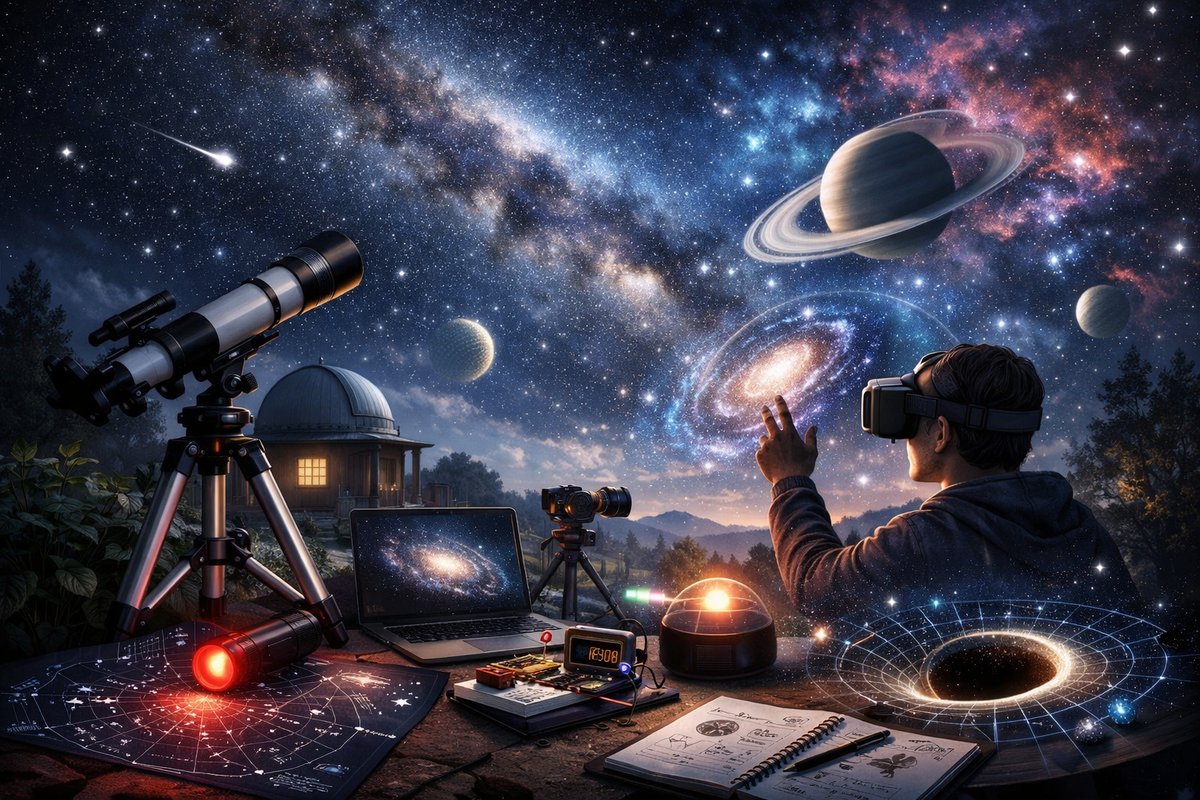
Armed with a portable refracting telescope and a trusty star chart, even a small backyard can become a gateway to the universe. Setting up the tripod on a gravel patio, you learn to balance optics and shadow, aligning eyepiece and objective lens until Saturn’s rings emerge in delicate arcs. Nearby, a red LED flashlight helps preserve your night vision as you tweak focus and consult a constellation poster for orientation. These simple tools anchor your mind in the here and now, while opening a window to light-years away.
Beneath the same sky that Galileo first surveyed, modern stargazers can supplement analog observation with digital devices. A virtual reality headset transports you to simulated observatories, where you can swoop through the Pillars of Creation or hover above a storm-swept Jupiter. These immersive experiences blur the line between science center and personal adventure, making the scale of cosmic structures not just graspable, but visceral. You find yourself reaching out to brush a nebula, marveling at how technology can render the impossible almost tangible.
Curiosity doesn’t stop at observation. Tinkering with microcontrollers-those pocket-sized programmable boards-unlocks DIY experiments that once belonged only in professional labs. With a starter kit that includes radiation sensors, you can assemble a rudimentary cosmic ray detector, watching scintillations appear on a small LCD readout. Or connect a light sensor and motor to create an automated star-tracker, keeping your telescope aligned with Polaris as the Earth turns. Each piece of hardware becomes a collaborator in your pursuit of understanding.
While you craft homemade detectors and calibrate lenses, theoretical wonders beckon. The notion of time bending near a black hole, first outlined in relativity theory, can inspire a cardboard-and-string demonstration of gravitational time dilation. You sketch two clocks on opposite ends of a fabric sheet, pressing a heavy sphere into the center to simulate a massive object warping spacetime. As marbles roll toward the sphere’s depression, their paths curve-offering a tactile glimpse of how gravity drags light and time into its embrace.
Amid these explorations, portability remains key. A constellation star chart poster, folded into a pocket or clipped to a clipboard, guides you through changing seasons. You learn the shift of Orion’s belt from winter prominence to a faint sliver in spring, tracking the celestial clockwork. Consulting a field guide, you identify obscure star clusters and binary pairs, noting their coordinates by naked eye and confirming them through your telescope’s lens. Over time, you compile your own logbook: sketches, exposure settings for astrophotography, and notes on atmospheric conditions.
Photography itself adds a layer of craft to cosmic curiosity. Mounting a digital SLR or mirrorless camera with a telephoto lens onto your telescope, you capture long-exposure images of star trails, nebula filaments, and the ghostly Milky Way arching overhead. You discover how dew shields protect fragile optics, how intervalometers automate dozens of shots into seamless time-lapse sequences. The night’s chilly air becomes a companion in your choreographed ballet of shutter clicks, each frame rich with pinpoint starlight and distant gas clouds glowing in infrared hues.
Even simpler projects can bring profound insights. A pendulum experiment measures gravitational acceleration across heights, demonstrating how gravity’s pull barely weakens between a mountaintop and sea level. Or you revamp a solar cell panel and a small battery to power an LED, observing how sunlight-descendant of nuclear fusion at the Sun’s core-drives current through a tabletop circuit. In these intimate experiments, cosmic energy becomes accessible: a star’s power harnessed in a few square inches of silicon.
As your personal observatory grows-stacked with telescope tubes, sensor modules, and printed star maps-the emotional resonance deepens. Moments of solitude under a canopy of stars become meditative, fostering a quiet humility: the Earth is but one pale blue dot adrift in a boundless sea. Curiosity evolves into stewardship. If we can appreciate the fragile beauty of our planet from afar, we’re inspired to protect it, mindful that this tiny world sustains our collective story.
The playful and the profound merge in your ongoing quest. One night, you might track the path of a meteor shower; on another, you might stay up late to witness a lunar eclipse, noting the reddening shadow creeping across the Moon’s face. Each event invites fresh questions: What triggered this cosmic ballet? How do dust grains from distant comets seed Earth’s atmosphere? Where will future observers turn their lenses in search of undiscovered wonders?
By blending hands-on experiments, analog stargazing, and digital immersion, cosmic curiosity transforms from idle daydream into active exploration. It lives in the rotation of a telescope mount, the tiny glow of a red flashlight, the code uploading to a microcontroller. It thrives in every carefully drawn star map and every DIY radiation detector. This is an invitation to ally with the universe as both audience and participant-a playful yet profound partnership that promises new insights at every turn.”
Let your curiosity guide you to build, observe, and imagine, because in the vast expanse above, every discovery sparks a dozen more questions-and the journey of wonder never ends.
“,”tags”:[“cosmic curiosity”,”stargazing”,”space exploration”,”DIY astronomy”,”science experiments”],”subcategory_labels”:[“cosmic-curiosity”],”affiliate_products”:[{“name”:”Portable refracting telescope”,”description”:”A lightweight refracting telescope with adjustable tripod and multi-coated lenses, perfect for beginner stargazing and lunar observations.”},{“name”:”Constellation star chart poster”,”description”:”A foldable, weather-resistant star chart poster detailing seasonal constellations and celestial landmarks for easy field reference.”},{“name”:”Night-vision red LED flashlight”,”description”:”A handheld flashlight emitting a red beam that preserves night vision when consulting star charts or adjusting telescope settings.”},{“name”:”Microcontroller starter kit”,”description”:”An Arduino-compatible microcontroller kit complete with sensors, wires, and components for DIY cosmic ray detectors and automated tracking rigs.”},{“name”:”Home planetarium star projector”,”description”:”A compact projector casting realistic star fields and nebula patterns onto walls and ceilings, bringing the night sky indoors.”},{“name”:”Virtual reality headset”,”description”:”A high-resolution VR headset for immersive planetarium apps and spacewalk simulations, offering an interactive journey through cosmic environments.”}]}Charting the Infinite: A Playful Dive into Cosmic Curiosity","excerpt":"From backyard stargazing to VR simulations of distant galaxies, this article explores playful and profound ways to ignite cosmic curiosity. It delves into hands-on experiments, time bending theories, and practical tips for building a personal observatory under the night sky.","content":"
On any clear evening, the sky unfurls like a silent opera-stars winking into view, planets tracing their slow celestial dance. As night deepens, a sense of wonder stirs: the knowledge that every point of light tells a story older than any human record. This impulse to reach beyond our horizons, to question the vast unknown, is the essence of cosmic curiosity. Whether you're a weekend skywatcher or someone who dreams in nebula swirls, the cosmos rewards both playful exploration and serious inquiry.
Armed with a portable refracting telescope and a trusty star chart, even a small backyard can become a gateway to the universe. Setting up the tripod on a gravel patio, you learn to balance optics and shadow, aligning eyepiece and objective lens until Saturn's rings emerge in delicate arcs. Nearby, a red LED flashlight helps preserve your night vision as you tweak focus and consult a constellation poster for orientation. These simple tools anchor your mind in the here and now, while opening a window to light-years away.
Beneath the same sky that Galileo first surveyed, modern stargazers can supplement analog observation with digital devices. A virtual reality headset transports you to simulated observatories, where you can swoop through the Pillars of Creation or hover above a storm-swept Jupiter. These immersive experiences blur the line between science center and personal adventure, making the scale of cosmic structures not just graspable, but visceral. You find yourself reaching out to brush a nebula, marveling at how technology can render the impossible almost tangible.
Curiosity doesn't stop at observation. Tinkering with microcontrollers-those pocket-sized programmable boards-unlocks DIY experiments that once belonged only in professional labs. With a starter kit that includes radiation sensors, you can assemble a rudimentary cosmic ray detector, watching scintillations appear on a small LCD readout. Or connect a light sensor and motor to create an automated star-tracker, keeping your telescope aligned with Polaris as the Earth turns. Each piece of hardware becomes a collaborator in your pursuit of understanding.
While you craft homemade detectors and calibrate lenses, theoretical wonders beckon. The notion of time bending near a black hole, first outlined in relativity theory, can inspire a cardboard-and-string demonstration of gravitational time dilation. You sketch two clocks on opposite ends of a fabric sheet, pressing a heavy sphere into the center to simulate a massive object warping spacetime. As marbles roll toward the sphere's depression, their paths curve-offering a tactile glimpse of how gravity drags light and time into its embrace.
Amid these explorations, portability remains key. A constellation star chart poster, folded into a pocket or clipped to a clipboard, guides you through changing seasons. You learn the shift of Orion's belt from winter prominence to a faint sliver in spring, tracking the celestial clockwork. Consulting a field guide, you identify obscure star clusters and binary pairs, noting their coordinates by naked eye and confirming them through your telescope's lens. Over time, you compile your own logbook: sketches, exposure settings for astrophotography, and notes on atmospheric conditions.
Photography itself adds a layer of craft to cosmic curiosity. Mounting a digital SLR or mirrorless camera with a telephoto lens onto your telescope, you capture long-exposure images of star trails, nebula filaments, and the ghostly Milky Way arching overhead. You discover how dew shields protect fragile optics, how intervalometers automate dozens of shots into seamless time-lapse sequences. The night's chilly air becomes a companion in your choreographed ballet of shutter clicks, each frame rich with pinpoint starlight and distant gas clouds glowing in infrared hues.
Even simpler projects can bring profound insights. A pendulum experiment measures gravitational acceleration across heights, demonstrating how gravity's pull barely weakens between a mountaintop and sea level. Or you revamp a solar cell panel and a small battery to power an LED, observing how sunlight-descendant of nuclear fusion at the Sun's core-drives current through a tabletop circuit. In these intimate experiments, cosmic energy becomes accessible: a star's power harnessed in a few square inches of silicon.
As your personal observatory grows-stacked with telescope tubes, sensor modules, and printed star maps-the emotional resonance deepens. Moments of solitude under a canopy of stars become meditative, fostering a quiet humility: the Earth is but one pale blue dot adrift in a boundless sea. Curiosity evolves into stewardship. If we can appreciate the fragile beauty of our planet from afar, we're inspired to protect it, mindful that this tiny world sustains our collective story.
The playful and the profound merge in your ongoing quest. One night, you might track the path of a meteor shower; on another, you might stay up late to witness a lunar eclipse, noting the reddening shadow creeping across the Moon's face. Each event invites fresh questions: What triggered this cosmic ballet? How do dust grains from distant comets seed Earth's atmosphere? Where will future observers turn their lenses in search of undiscovered wonders?
By blending hands-on experiments, analog stargazing, and digital immersion, cosmic curiosity transforms from idle daydream into active exploration. It lives in the rotation of a telescope mount, the tiny glow of a red flashlight, the code uploading to a microcontroller. It thrives in every carefully drawn star map and every DIY radiation detector. This is an invitation to ally with the universe as both audience and participant-a playful yet profound partnership that promises new insights at every turn."
Let your curiosity guide you to build, observe, and imagine, because in the vast expanse above, every discovery sparks a dozen more questions-and the journey of wonder never ends.
","tags":["cosmic curiosity","stargazing","space exploration","DIY astronomy","science experiments"],"subcategory_labels":["cosmic-curiosity"],"affiliate_products":[{"name":"Portable refracting telescope","description":"A lightweight refracting telescope with adjustable tripod and multi-coated lenses, perfect for beginner stargazing and lunar observations."},{"name":"Constellation star chart poster","description":"A foldable, weather-resistant star chart poster detailing seasonal constellations and celestial landmarks for easy field reference."},{"name":"Night-vision red LED flashlight","description":"A handheld flashlight emitting a red beam that preserves night vision when consulting star charts or adjusting telescope settings."},{"name":"Microcontroller starter kit","description":"An Arduino-compatible microcontroller kit complete with sensors, wires, and components for DIY cosmic ray detectors and automated tracking rigs."},{"name":"Home planetarium star projector","description":"A compact projector casting realistic star fields and nebula patterns onto walls and ceilings, bringing the night sky indoors."},{"name":"Virtual reality headset","description":"A high-resolution VR headset for immersive planetarium apps and spacewalk simulations, offering an interactive journey through cosmic environments."}]}
Charting the Infinite: A Playful Dive into Cosmic Curiosity”,”excerpt”:”From backyard stargazing to VR simulations of distant galaxies, this article explores playful and profound ways to ignite cosmic curiosity. It delves into hands-on experiments, time bending theories, and practical tips for building a personal observatory under the night sky.”,”content”:”
On any clear evening, the sky unfurls like a silent opera-stars winking into view, planets tracing their slow celestial dance. As night deepens, a sense of wonder stirs: the knowledge that every point of light tells a story older than any human record. This impulse to reach beyond our horizons, to question the vast unknown, is the essence of cosmic curiosity. Whether you’re a weekend skywatcher or someone who dreams in nebula swirls, the cosmos rewards both playful exploration and serious inquiry.
Armed with a portable refracting telescope and a trusty star chart, even a small backyard can become a gateway to the universe. Setting up the tripod on a gravel patio, you learn to balance optics and shadow, aligning eyepiece and objective lens until Saturn’s rings emerge in delicate arcs. Nearby, a red LED flashlight helps preserve your night vision as you tweak focus and consult a constellation poster for orientation. These simple tools anchor your mind in the here and now, while opening a window to light-years away.
Beneath the same sky that Galileo first surveyed, modern stargazers can supplement analog observation with digital devices. A virtual reality headset transports you to simulated observatories, where you can swoop through the Pillars of Creation or hover above a storm-swept Jupiter. These immersive experiences blur the line between science center and personal adventure, making the scale of cosmic structures not just graspable, but visceral. You find yourself reaching out to brush a nebula, marveling at how technology can render the impossible almost tangible.
Curiosity doesn’t stop at observation. Tinkering with microcontrollers-those pocket-sized programmable boards-unlocks DIY experiments that once belonged only in professional labs. With a starter kit that includes radiation sensors, you can assemble a rudimentary cosmic ray detector, watching scintillations appear on a small LCD readout. Or connect a light sensor and motor to create an automated star-tracker, keeping your telescope aligned with Polaris as the Earth turns. Each piece of hardware becomes a collaborator in your pursuit of understanding.
While you craft homemade detectors and calibrate lenses, theoretical wonders beckon. The notion of time bending near a black hole, first outlined in relativity theory, can inspire a cardboard-and-string demonstration of gravitational time dilation. You sketch two clocks on opposite ends of a fabric sheet, pressing a heavy sphere into the center to simulate a massive object warping spacetime. As marbles roll toward the sphere’s depression, their paths curve-offering a tactile glimpse of how gravity drags light and time into its embrace.
Amid these explorations, portability remains key. A constellation star chart poster, folded into a pocket or clipped to a clipboard, guides you through changing seasons. You learn the shift of Orion’s belt from winter prominence to a faint sliver in spring, tracking the celestial clockwork. Consulting a field guide, you identify obscure star clusters and binary pairs, noting their coordinates by naked eye and confirming them through your telescope’s lens. Over time, you compile your own logbook: sketches, exposure settings for astrophotography, and notes on atmospheric conditions.
Photography itself adds a layer of craft to cosmic curiosity. Mounting a digital SLR or mirrorless camera with a telephoto lens onto your telescope, you capture long-exposure images of star trails, nebula filaments, and the ghostly Milky Way arching overhead. You discover how dew shields protect fragile optics, how intervalometers automate dozens of shots into seamless time-lapse sequences. The night’s chilly air becomes a companion in your choreographed ballet of shutter clicks, each frame rich with pinpoint starlight and distant gas clouds glowing in infrared hues.
Even simpler projects can bring profound insights. A pendulum experiment measures gravitational acceleration across heights, demonstrating how gravity’s pull barely weakens between a mountaintop and sea level. Or you revamp a solar cell panel and a small battery to power an LED, observing how sunlight-descendant of nuclear fusion at the Sun’s core-drives current through a tabletop circuit. In these intimate experiments, cosmic energy becomes accessible: a star’s power harnessed in a few square inches of silicon.
As your personal observatory grows-stacked with telescope tubes, sensor modules, and printed star maps-the emotional resonance deepens. Moments of solitude under a canopy of stars become meditative, fostering a quiet humility: the Earth is but one pale blue dot adrift in a boundless sea. Curiosity evolves into stewardship. If we can appreciate the fragile beauty of our planet from afar, we’re inspired to protect it, mindful that this tiny world sustains our collective story.
The playful and the profound merge in your ongoing quest. One night, you might track the path of a meteor shower; on another, you might stay up late to witness a lunar eclipse, noting the reddening shadow creeping across the Moon’s face. Each event invites fresh questions: What triggered this cosmic ballet? How do dust grains from distant comets seed Earth’s atmosphere? Where will future observers turn their lenses in search of undiscovered wonders?
By blending hands-on experiments, analog stargazing, and digital immersion, cosmic curiosity transforms from idle daydream into active exploration. It lives in the rotation of a telescope mount, the tiny glow of a red flashlight, the code uploading to a microcontroller. It thrives in every carefully drawn star map and every DIY radiation detector. This is an invitation to ally with the universe as both audience and participant-a playful yet profound partnership that promises new insights at every turn.”
Let your curiosity guide you to build, observe, and imagine, because in the vast expanse above, every discovery sparks a dozen more questions-and the journey of wonder never ends.
“,”tags”:[“cosmic curiosity”,”stargazing”,”space exploration”,”DIY astronomy”,”science experiments”],”subcategory_labels”:[“cosmic-curiosity”],”affiliate_products”:[{“name”:”Portable refracting telescope”,”description”:”A lightweight refracting telescope with adjustable tripod and multi-coated lenses, perfect for beginner stargazing and lunar observations.”},{“name”:”Constellation star chart poster”,”description”:”A foldable, weather-resistant star chart poster detailing seasonal constellations and celestial landmarks for easy field reference.”},{“name”:”Night-vision red LED flashlight”,”description”:”A handheld flashlight emitting a red beam that preserves night vision when consulting star charts or adjusting telescope settings.”},{“name”:”Microcontroller starter kit”,”description”:”An Arduino-compatible microcontroller kit complete with sensors, wires, and components for DIY cosmic ray detectors and automated tracking rigs.”},{“name”:”Home planetarium star projector”,”description”:”A compact projector casting realistic star fields and nebula patterns onto walls and ceilings, bringing the night sky indoors.”},{“name”:”Virtual reality headset”,”description”:”A high-resolution VR headset for immersive planetarium apps and spacewalk simulations, offering an interactive journey through cosmic environments.”}]}