Location
Mount Vernon, WA 98274

Location
Mount Vernon, WA 98274
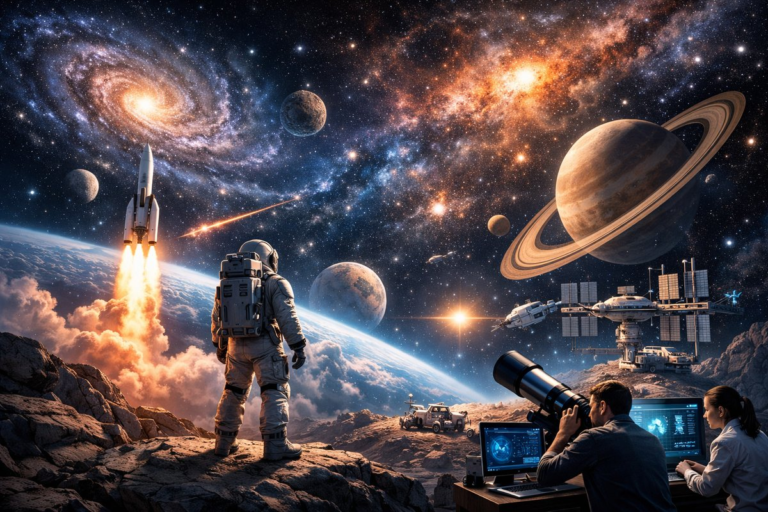
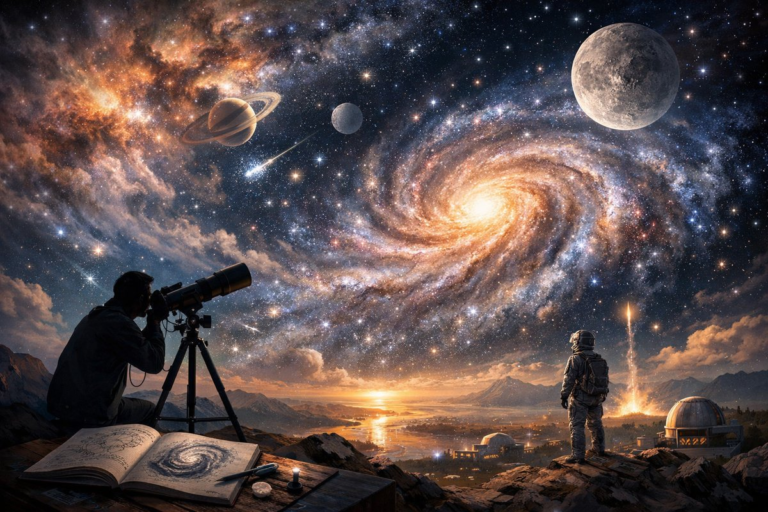
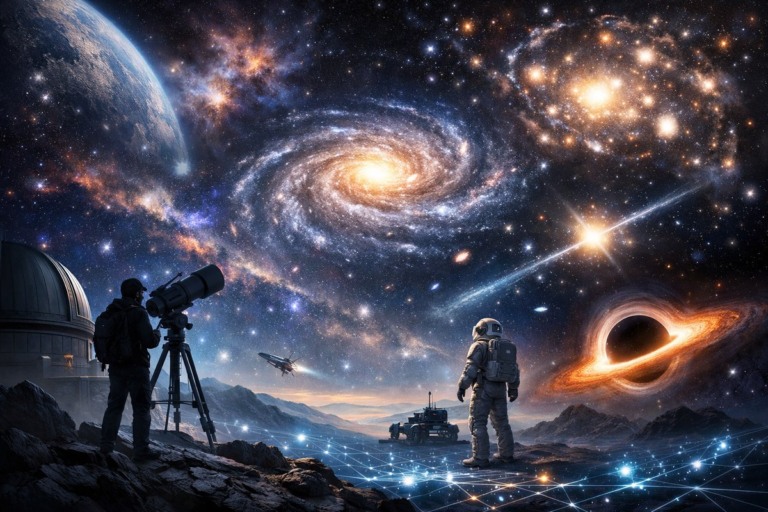
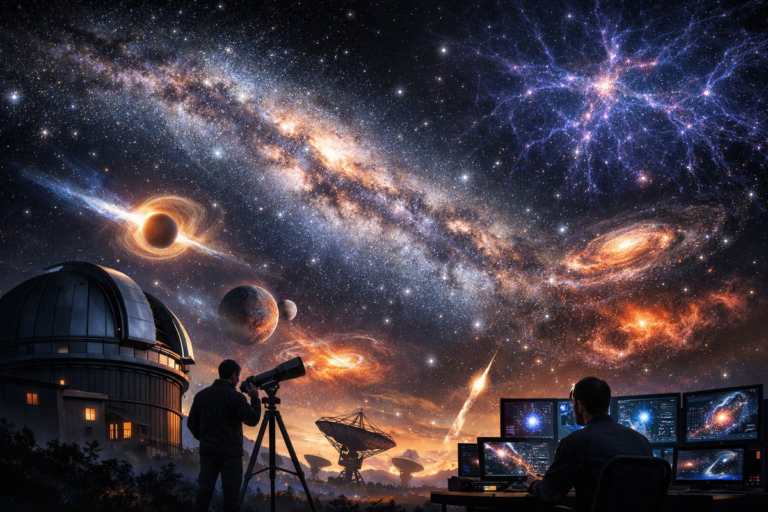
A wave of fresh data from space observatories and citizen science projects has reignited public fascination with the vast cosmic tapestry. From detecting elusive gravitational ripples to capturing the glow of distant exoplanets, our drive to peer beyond Earth propels new discoveries and community-driven exploration.
A recent cascade of findings from advanced space telescopes has rippled through scientific circles and backyard observatories alike, reminding us that cosmic curiosity is far from satisfied. Observatories orbiting far above Earth’s atmosphere continue to feed a growing archive of infrared and ultraviolet data, unveiling hidden star nurseries and planet-forming disks. Meanwhile, ground-based facilities are tuning into subtle shifts in starlight that hint at worlds orbiting distant suns. This surge of activity highlights a global moment: we stand at a confluence where cutting-edge instruments and public fascination meet to drive the next chapter of space exploration.
Just months ago, a remote space observatory confirmed one of the smallest exoplanets ever identified in its star’s habitable zone. The measurements, taken in wavelengths invisible to the naked eye, reveal clues about atmospheric composition and potential surface conditions. While the data remains fragmentary, it underscores the power of combining precision instruments with sophisticated algorithms. Researchers can now detect dim shadows cast by tiny worlds as they transit in front of their stars, and they can infer temperature variations from subtle color shifts. Each of these techniques layers onto our understanding of how planets form and where life might arise.
In parallel with exoplanet hunts, terrestrial detectors on three continents have started to pick up faint tremors in the fabric of spacetime itself. Known as gravitational waves, these ripples were first predicted over a century ago and confirmed just a few years back. The latest detections trace back to mergers of neutron stars and black holes, offering a brand-new window into cataclysmic events billions of light-years away. This frontier not only expands our grasp of extreme physics but also enriches a narrative that has captivated scientists and star-gazers alike: the universe is an active, evolving tapestry, and we are learning to listen to its most subtle murmurs.
On an even grander scale, satellites mapping the cosmic microwave background continue to refine our portrait of the infant universe. Tiny temperature variations in this ancient afterglow encode the seeds of galaxies, clusters, and vast cosmic filaments. Recent analyses of polarization patterns hint at processes that took place mere fractions of a second after the Big Bang, laying the groundwork for everything that followed. Each subtle twist and tilt in the data offers a clue to puzzle together questions about dark matter, dark energy, and the fundamental nature of time and space.
While flagship missions capture headlines, a growing legion of citizen scientists is amplifying the reach of professional observatories. Through online platforms, volunteers sort through flashing pixels to flag transient events, map light curves, and classify galaxy shapes. These collective efforts are democratizing the scientific process, demonstrating that hands-on discovery isn’t reserved for ivory towers. Amid lockdowns and travel restrictions, virtual star parties and global data-sharing sessions have become a new norm, making remote collaboration a cornerstone of 21st-century astronomy.
One nationwide initiative invites participants of all ages to track the brightness of selected stars over weeks and months. By logging simple observations-often with nothing more than a digital camera and tripod-amateurs can help scientists chart stellar cycles and hunt for exoplanets. The results feed back into professional research, creating a loop of engagement and insight. For many, it’s more than a hobby; it’s a shared mission to piece together a cosmic puzzle that extends well beyond any single observatory.
Elsewhere, interactive projects allow the public to sift through radio telescope recordings in search of unusual patterns. Participants flag candidates for follow-up, and a fraction of them turn out to be previously uncharted pulsars or fast radio bursts. These unpredictable, millisecond-long flashes challenge existing theories about neutron stars and may hold keys to the behavior of matter at nuclear densities. Their discovery depends on a hybrid network where algorithms pre-filter vast streams of data and human volunteers provide crucial pattern recognition.
Astrophotography communities have also embraced the spirit of exploration, sharing tips on capturing faint nebulae, star clusters, and the Milky Way’s glowing core. Advances in sensor technology and affordable tracking mounts mean that even backyard setups can produce images that once required professional observatories. The resulting photographs, posted on social channels and dedicated forums, serve as both scientific records and expressions of cosmic wonder. Newcomers learn from experts, and veterans discover novel processing techniques, underscoring the collaborative ethos at the heart of this renaissance.
Yet the ever-brightening glow of cities threatens to dim our view of the night sky. Light pollution has escalated in many urban corridors, washing out most naked-eye stars and obscuring faint celestial targets. In response, communities around the world are adopting dark-sky lighting guidelines, replacing high-glare fixtures with shielded, low-intensity LEDs. These measures not only restore the Milky Way’s grandeur but also benefit nocturnal wildlife by preserving natural light cycles. The movement aligns space exploration with sustainability goals-reminding us that gazing outward can inspire responsible stewardship of our own planet.
Meanwhile, theoretical physicists wrestle with puzzles that lie beyond direct observation. Dark matter and dark energy constitute about 95 percent of the universe’s total mass-energy budget, yet their nature remains enigmatic. Particle detectors buried deep underground, space-based probes, and particle accelerators all contribute pieces to this grand puzzle. Each experimental bound sharpens the parameter space, guiding theorists toward viable models. The interplay between theory and experiment exemplifies how cosmic curiosity spawns innovations with real-world applications-from advanced sensors to novel materials.
Equally profound are explorations into the geometry of spacetime itself. Einstein’s general relativity describes how massive objects warp the fabric of space and time, creating the gravity we experience on Earth. Observing the lensing effect of distant galaxies-where light bends around massive clusters-offers an empirical laboratory for these ideas. Future missions aim to map these distortions across larger volumes, potentially revealing the distribution of unseen mass on cosmic scales.
Time dilation near black holes remains one of the most visceral demonstrations of relativity. As material spirals into a black hole, time slows from an external observer’s viewpoint, and light stretches to longer wavelengths. Telescopes equipped with high-resolution spectrographs are beginning to resolve these signatures, pushing closer to black hole event horizons. These observations promise to test the boundaries of our understanding and might even uncover physics beyond current theories.
Amid these grand endeavors, technological spin-offs trickle into everyday life. Precision timing techniques used to study pulsars enhance global positioning systems, while data-compression algorithms developed for astronomical surveys optimize how we stream video and manage cloud storage. Even the design of lightweight optics for space telescopes informs innovations in portable medical imaging and environmental monitoring.
Back on Earth, the call to explore the night sky is as tangible as ever. Families set up small refractor telescopes in local parks, mapping lunar craters and spotting Jupiter’s four largest moons. DIY telescope kits arrive by mail, inviting novices to assemble and align primary mirrors. Astronomy clubs host sidewalk stargazing events, sharing red-light flashlights and star maps to preserve dark-adapted vision. These grassroots gatherings emphasize that cosmic curiosity is not an abstract ideal but a collective experience that transcends age and background.
In classrooms, educators harness the power of real data to ignite young minds. Students analyze light curves from variable stars, calculate orbital periods of binary systems, and model planetary atmospheres using open-source software. Virtual reality platforms transport learners to the surface of Mars or inside a star’s core, blending imagination with empirical inquiry. This immersive pedagogy nurtures future scientists, engineers, and informed citizens who appreciate humanity’s place in a vast universe.
On the horizon lie missions that promise to extend our reach even further. Proposed space telescopes aim to image Earth-like planets in nearby star systems, seeking biomarkers in their atmospheres. Gravitational wave observatories planned for space will probe lower frequencies, unveiling mergers of supermassive black holes. Interplanetary probes equipped with miniaturized payloads will target asteroids, comets, and the icy moons of giant planets, testing theories of how the solar system assembled.
Amid so many endeavors, one truth remains immutable: our yearning to understand the cosmos defines us as a species. Each piece of data, each photograph, and each model coalesces into a shared story of wonder and discovery. As night falls and telescopes swivel skyward, the universe invites us to listen, observe, and imagine. In that quiet dialogue between Earth and the stars, we find not only answers but also new questions-each a testament to the enduring power of cosmic curiosity.