Location
Mount Vernon, WA 98274

Location
Mount Vernon, WA 98274
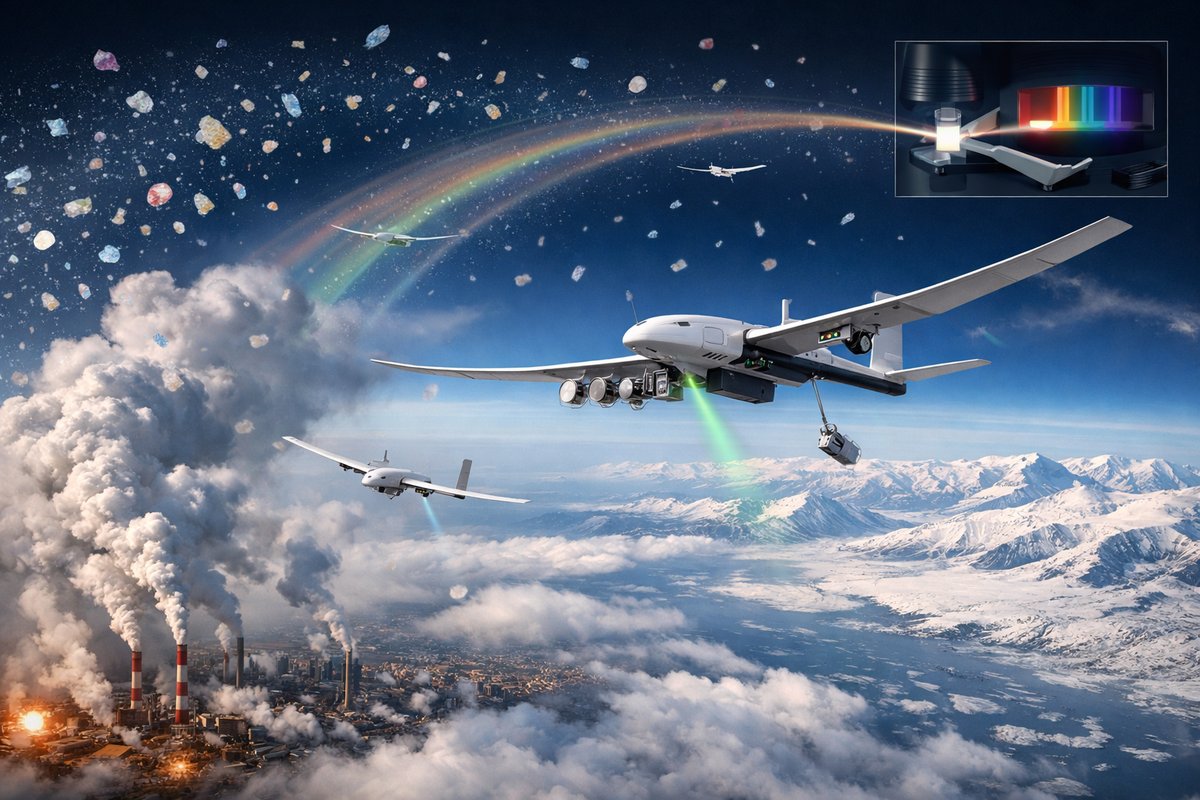
A fleet of stratospheric drones has traced the invisible journey of microplastics from industrial regions to polar skies. Cutting-edge sampling and spectroscopy reveal surprising concentrations aloft, raising new questions about global pollutant cycles and ecosystem vulnerability.
Unseen currents of air may now carry more than just water vapor and dust. Recent expeditions deploying high-altitude drones have captured the first detailed maps of microplastics circulating in the lower stratosphere, showing how tiny polymer particles hitch rides on jet streams to reach the planet’s most remote regions. This breakthrough study transforms our understanding of pollutant pathways and underscores the atmosphere’s role as a global conveyor belt.
Earlier this year, an international consortium of atmospheric scientists launched twelve autonomous drones from mid-latitude launch sites across three continents. Each drone ascended to altitudes between 12,000 and 18,000 meters, a layer beyond typical commercial flight routes. Equipped with custom sampling chambers and onboard telemetry, the robotic platforms traveled hundreds of kilometers over open oceans and mountain ranges, collecting airborne particulates along predetermined flight corridors.
Synchronized flights were critical. By flying parallel routes at staggered altitudes, the teams could distinguish between boundary-layer pollution lingering near the surface and particles lofted into the freer atmosphere. Within just a few hours, the fleet amassed thousands of air samples, each sealed in a sterile collection spool. Back at mobile field laboratories, technicians transferred the filters into inert‐gas chambers, preventing contamination before spectroscopic analysis.
The analytical cornerstone was a portable micro-FTIR spectrometer, calibrated to detect polymers down to sub-10-micron size. In many filters, fragments of polyethylene, polypropylene, and PET appeared alongside unexpected bits of polystyrene and polyurethanes. Concentrations peaked at 15 micrograms per cubic meter in some mid-latitude air corridors, tapering off toward the poles but never disappearing entirely. Even near Antarctica, trace amounts of microplastic were present, suspended invisibly in freezing air masses.
Meteorological data revealed how powerful jet streams can act as express lanes for pollutants. Warm industrial plumes from factory belts rising in daytime thermals intersected with strong westerlies, lifting plastics across hemispheres within days. Seasonal shifts in atmospheric circulation then carried these foreign visitors poleward. In effect, the sky itself becomes a network of microplastic highways linking urban centers to fragile polar zones.
Lead investigators emphasize the sheer scale of these transfers. “What astonished us was how quickly particles disperse at high altitudes,” one researcher explained. “Prevailing winds up there act as a planetary bloodstream, circulating contaminants far beyond their origin. This isn’t just local smog; it’s a global pollutant panorama.”
Impacts on polar ecosystems are still poorly understood. When stratospheric air descends through cyclonic storms or radiative cooling, microplastics can be deposited onto ice sheets and snowfields. Laboratory snowfall experiments suggest that embedded plastics can alter albedo, accelerating melt rates under sunlit conditions. Moreover, when these particles enter cold meltwater streams, they become available to near-surface microbes and invertebrates, potentially disrupting food webs at the base of the polar food chain.
Beyond the poles, high-altitude microplastics challenge assumptions about atmospheric chemistry. Particles may serve as novel ice‐nucleating sites, influencing cloud formation and precipitation patterns. Small-scale cloud chamber tests indicate that polymer fragments can induce ice crystal formation at temperatures a few degrees higher than mineral dust particles do. If confirmed in real clouds, this could subtly alter local weather, affecting rainfall and snowfall distributions in mountainous regions.
The study also demonstrates the value of modular, networked sampling platforms. Compared to stationary ground stations, drone fleets offer unprecedented spatial coverage and vertical profiling. Scientists can reprogram flight plans in real time to target emerging pollution events, such as wildfire smoke plumes or industrial accidents. This agility could prove vital for rapid response monitoring and public health advisories.
Looking ahead, researchers plan to integrate solar-powered aerial gliders that can remain aloft for weeks, harvesting energy from thermal updrafts. Coupled with advanced onboard sensors for volatile organic compounds and nanoparticle metals, these craft could construct a near-continuous picture of airborne pollution dynamics. Creating an open-access database of global microplastic concentrations will enable modelers to forecast transport pathways and deposition hotspots with increasing precision.
The revelations of high-altitude plastic transport raise critical policy questions. International treaties on atmospheric pollution have long focused on gaseous emissions, but solid particulates deserve equal attention. Regulating microplastic release at source-from textile fibers to automotive tire wear-could become a cornerstone of future air quality protocols. In the meantime, industries and communities must recognize that plastic waste doesn’t simply end up in landfills or rivers; it can circle the globe in a fragile layer of sky.
Citizens can get involved through coordinated balloon and drone launch events organized by local universities or environmental groups. Even handheld air samplers costing a few hundred dollars can yield meaningful data on microplastic levels in suburban and urban air. Enthusiasts and educators have started to develop open-source designs for simple impactors and filters, democratizing access to atmospheric science.
In many ways, the atmosphere is the last frontier of global pollution research. We’ve mapped ocean currents, surveyed deep-sea trenches, and charted land-use changes from space. Yet the thin air above us has remained largely uncharted territory for solid pollutants. With drones now illuminating unseen highways of microplastic travel, we are called to imagine a new generation of environmental stewardship-one that embraces the sky as part of our shared ecosystem and not merely a silent backdrop to human activity.