Location
Mount Vernon, WA 98274

Location
Mount Vernon, WA 98274
A groundbreaking show at the Museum of Contemporary Art Chicago invites visitors to experience art through sight, sound, and touch. Synesthetic Pathways features interactive light sculptures, data-driven textiles, VR painting environments, and recycled-material installations, all designed to blur the boundary between creator and observer.
When visitors step into the vast atrium of the Museum of Contemporary Art Chicago this season, they are greeted by a sweeping kinetic chandelier that pulses in time with the murmur of foot traffic and ambient street noise. The new exhibition, Synesthetic Pathways, unites 15 multimedia installations to explore the interdependence of perception, technology, and sustainability. Rather than hanging static canvases on white walls, this show incites visitors to trigger, manipulate, and even co-create works of art.
Curated by a team of interdisciplinary designers and technologists, Synesthetic Pathways builds on the growing fascination with sensory crossover in contemporary practice. According to the museum’s director of exhibitions, this initiative aligns with a mission to engage diverse audiences in active exploration rather than passive consumption. Early attendance figures show a 12 percent boost over last year’s benchmarks, a clear sign that interactive, multisensory art resonates deeply with today’s museumgoers.
Sustainability lies at the heart of these installations. Nearly 70 percent of works incorporate upcycled or locally sourced materials, from reclaimed plastics to responsibly harvested textiles. Each artist responsible for the show submitted a materials manifesto outlining life-cycle considerations, reusability strategies, and end-of-exhibition recycling plans. This emphasis on ecological stewardship complements the show’s sensory ambitions, suggesting that a holistic art experience must also honor environmental responsibility.
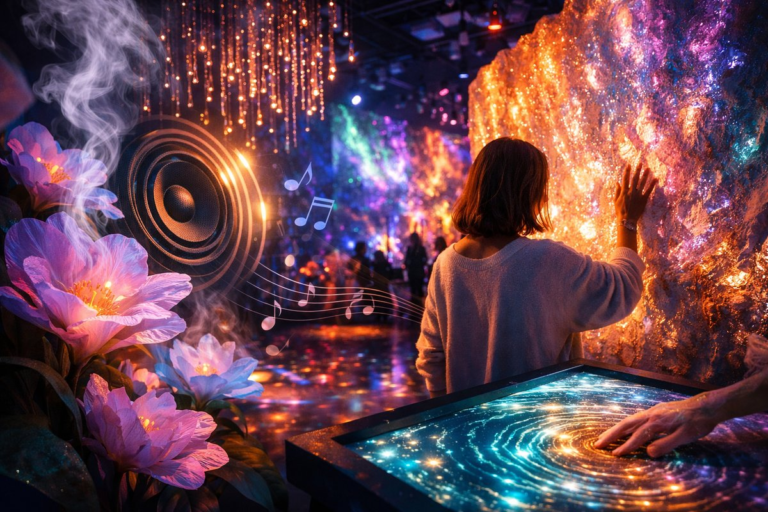
At the center of the atrium, Spectral Rhapsody hangs like a glowing constellation. Hundreds of individually addressable light nodes hang from long, slender cables, forming an immersive canopy. Motion sensors and microphones scattered throughout the space pick up steps, whispers, and shuffles, translating them into shifting color gradients and undulating light patterns. When a group gathers beneath, the canopy ripples in synchrony with laughter or hushed conversations, making each visit wholly unique.
Audience members describe Spectral Rhapsody as hypnotic and intimate. A single footstep can send waves of lavender across the ceiling; a whispered conversation can spark sudden bursts of gold and teal. The installation invites close examination of how ambient sound triggers emotional response. Many visitors move slowly beneath the lights, hands outstretched, watching their presence orchestrate a silent symphony of color.
A short walk leads to Data Tapestry, a towering digital loom that weaves pixelated threads in real time. Instead of an artisan pulling mechanical pedals, an algorithm ingests live weather reports from around the Great Lakes region-temperature, humidity, wind speed-and maps each data point to a hue. As storms churn or sunny skies prevail, the tapestry shifts its palette from stormy blues to radiant yellows without human intervention.
Visitors are encouraged to manipulate touchscreens at the base of the loom, exploring how changes to data-mapping algorithms could alter the final pattern. A child drags a slider to amplify wind readings, flooding the woven surface with streaks of violet, while a researcher experiments with humidity scales to deepen emerald tones. The piece transforms abstract environmental metrics into tactile color fields.
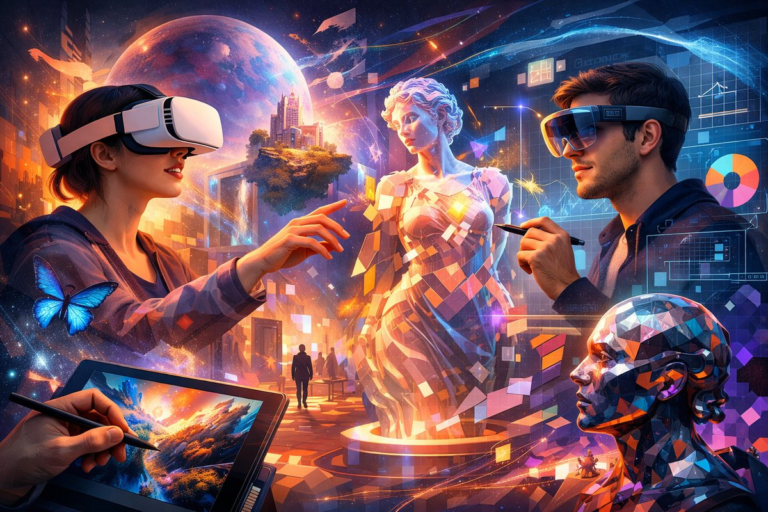
Next door, Aurora Drift offers a virtual-reality painting suite where visitors don lightweight headsets and gesture through empty air to paint streams of neon particles. Each movement emits a gentle chime, blending audio feedback with visual creation. Users can save snapshots of their floating, ephemeral artworks and share them on a communal digital wall, projected just outside the VR area.
Aurora Drift’s co-creators describe the piece as “an arena for playful experimentation.” By conflating gesture, sound, and vision, they aim to shake viewers out of the assumption that art must be bound to paper or canvas. The VR environment dissolves those boundaries, inviting people with no formal training to explore color, form, and auditory rhythm purely through intuitive movement.
In a quieter corner, Biomorphic Flow presents a cluster of sculptural forms 3D-printed from recycled ocean plastics. Each module contains proximity sensors that detect a visitor’s approach, triggering subtle mechanical shifts-sections expand, contract, or rotate, mimicking the ebb and flow of living organisms. The installation’s artist collective emphasizes the importance of reanimating discarded waste into new visual metaphors for resilience.
Museumgoers are struck by Biomorphic Flow’s tactile minimalism. Without sound or overt spectacle, it offers a meditative counterpart to the more exuberant works nearby. Placing a hand on one of the printed panels feels warm and oddly organic, reinforcing a sense of connection between the viewer’s touch and the dynamic response of the sculptural forms.
Taken together, these installations echo key themes in today’s art and design discourse: sensory integration, participatory experience, and ecological mindfulness. The show taps into a broader trend of dismantling the “white-walled gallery” model, inviting physical movement, technical play, and collaborative authorship. It asks whether art can remain static in a world defined by rapid technological and environmental change.
Designers and curators behind the scenes emphasized the value of cross-disciplinary collaboration. Engineers provided code frameworks for real-time data processing, while fiber artists offered expertise in materials sourcing and weaving techniques. Sound designers fine-tuned audio triggers, ensuring that each beep or chime felt polished yet unobtrusive. The result reads less like a conventional solo exhibition and more like a shared laboratory of creative experimentation.
Beyond the main gallery, the museum hosts a series of workshops for students and local artists. Participants can build their own micro-light sculptures using LED modules and recyclable materials or prototype simple motion-sensing circuits. These sessions have attracted high school robotics teams and community art groups eager to learn hands-on skills in electronics and sustainable craft.
Feedback from emerging artists has been enthusiastic. Many cite the show as motivation to integrate sensor technology into their own practice, whether in performance, textile art, or digital media. One workshop attendee described finally seeing a way to blend her love of pattern weaving with machine-learning tools for dynamic color shifts-a creative possibility she had not previously considered.
As the exhibition runs through late spring, museum staff are already planning touring versions of key works for smaller galleries in other regions. The goal is to spark similar community-driven encounters with multisensory art across diverse urban and rural contexts. Organizers stress that true impact requires decentralizing access to interactive art, rather than confining it to major institutions.
In an age when digital screens mediate so much of our daily life, Synesthetic Pathways reminds us of art’s capacity to engage the full spectrum of human senses. It suggests that immersive design can foster deeper empathy, spark curiosity about environmental systems, and treat each visitor as an active participant rather than a passive spectator.
For anyone seeking a fresh perspective on how sight, sound, and touch can converge, this exhibition offers a rare opportunity to step into a realm where data becomes fabric, shadows morph into light, and recycled fragments pulse with new agency. It’s a reminder that art and technology need not be at odds but can form vibrant alliances that echo long after the final light dims.