Location
Mount Vernon, WA 98274

Location
Mount Vernon, WA 98274

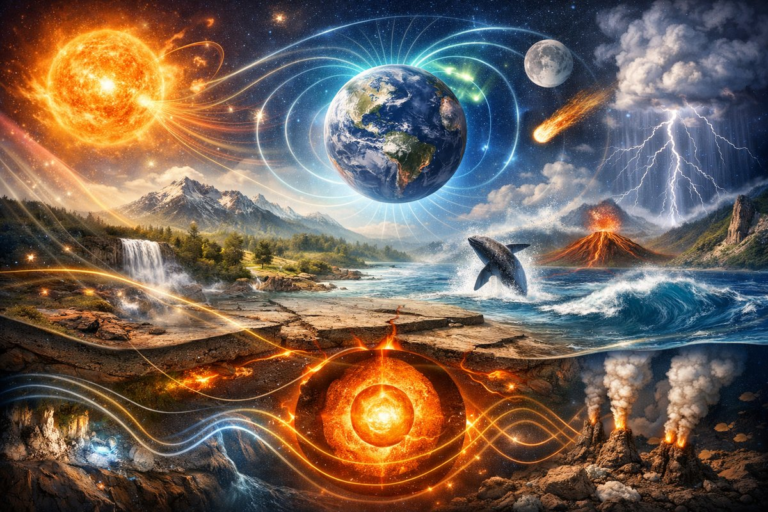
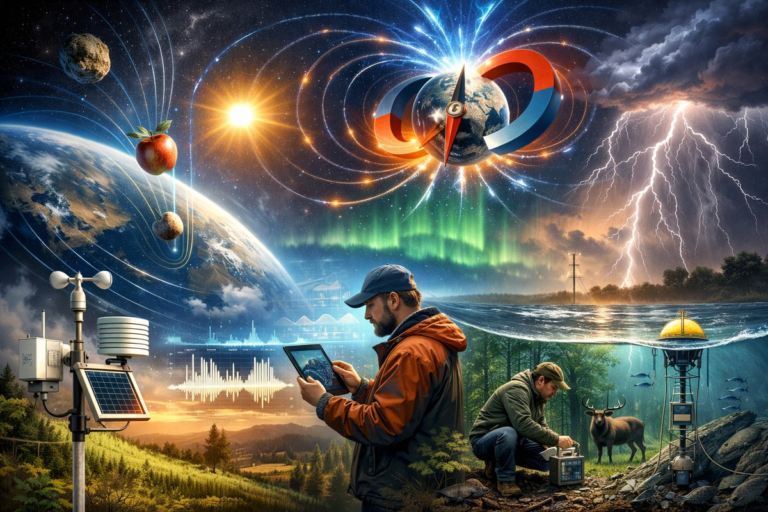
From satellite constellations scanning the magnetosphere to ground-based labs simulating gravity and emergent patterns, scientists are revealing a tapestry of invisible forces shaping our world. Cutting-edge observations and experiments are uniting magnetism, gravity waves, complex systems, and quantum quirks into a new frontier of discovery.
In laboratories and observatories around the globe, researchers are piecing together a hidden landscape sculpted by forces that cannot be seen with the naked eye. Magnetism flowing through Earth’s protective shield, ripples of gravity traveling across the cosmos, self-organizing swarms of particles in exotic fluids, and quantum entanglements in ultracold materials-all are now within reach of precise measurement and vivid visualization. A suite of recent studies and mission data published in peer-reviewed journals has transformed abstractions into quantifiable maps, sparking fresh insights and practical applications.
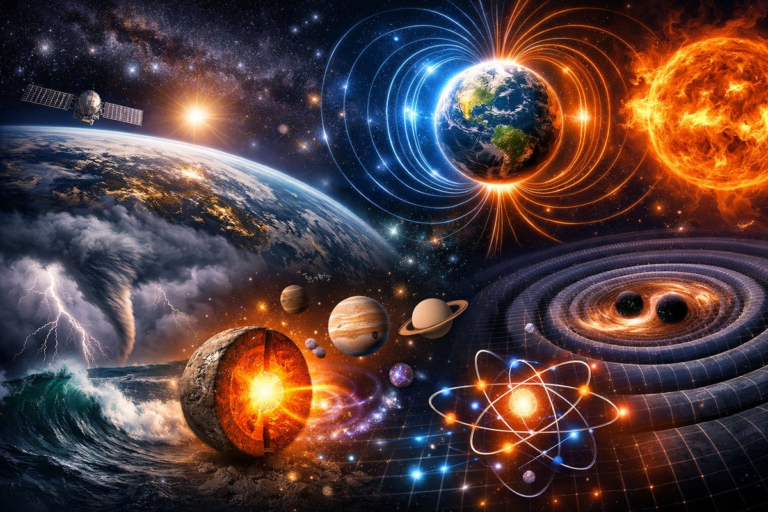
A major leap in our understanding of terrestrial magnetism arrived this spring with preliminary results from a joint orbital mission. Using twin satellites placed in highly elliptical orbits, the project has traced electric currents at the boundary where Earth’s magnetic field meets the solar wind. Those boundary currents sculpt auroral ovals and protect the planet from charged particles. Early data show unexpected asymmetries in field strength over the polar caps, with one hemisphere experiencing a 15 percent stronger compression during solar storms. These measurements refine space-weather forecasts and help engineers design more resilient power grids and satellite systems.
Simultaneously, teams working with four identical probes flying in formation have mapped tiny magnetic structures inside the boundary layer itself. High-frequency fluctuations, once thought to be noise, are now recognized as small vortices that channel energy and particles into the upper atmosphere. Researchers plan to filter billions of data points through machine-learning models to uncover dynamic patterns that unfold over minutes or hours-a level of detail that was impossible just five years ago.
Beyond magnetism, the saga of gravity is taking a new turn. Ground-breaking gravitational wave detectors have now eclipsed their initial runs in sensitivity by a factor of two. In the most recent observing campaign, they recorded low-frequency signals that hint at a background “hum” generated by innumerable distant black-hole mergers and neutron-star collisions. This cosmic static could serve as a probe of the Universe’s early structure, revealing conditions fractions of a second after the Big Bang.
Back on Earth, physicists are engineering tabletop analogs of curved spacetime. By sending acoustic waves through metamaterials-synthetic structures with carefully tuned density and elasticity-they have created zones that mimic gravitational lensing, bending sound around an object as if it were in a warped space. Such experiments promise new acoustic devices and a deeper grasp of how gravity shapes waves of all kinds.
Meanwhile, emergent phenomena in complex systems are moving from theory to real-world demonstration. In a recent study of self-propelled droplets on a vibrating fluid bath, researchers observed that thousands of droplets spontaneously align into swirling patterns that mirror flocking birds or schooling fish. The system exhibits a phase transition: as droplet density crosses a threshold, chaotic motion organizes into coherent vortex lanes. Insights from this work may aid the design of micro-robotic swarms capable of collective tasks, such as environmental monitoring or targeted drug delivery.
Another laboratory group has coaxed micron-scale particles suspended in a laser-cooled gas to form dynamic crystal lattices. By adjusting laser intensity, they induce transitions from ordered arrays to fluid-like states and back, enabling direct observation of the birth and death of defects at the atomic scale. Such precision experiments provide a sandbox for testing fundamental ideas about phase changes, friction, and material strength.
At the smallest scales, quantum effects continue to surprise. Teams using superconducting qubits have reported strong evidence of topological phases that persist even when individual qubit parameters vary by more than 20 percent. This robustness suggests new paths toward error-resistant quantum computers. In parallel, investigators manipulating ultracold atoms in optical lattices have engineered synthetic gauge fields, essentially creating artificial magnetism for neutral atoms. By sweeping lasers in precise patterns, they simulate electrons moving under powerful magnetic influences, opening doors to explore exotic quantum states that have no natural counterpart.
Taken together, these advances paint a picture of nature as a multi-layered stage where invisible forces weave patterns across scales. From the vast arcs of Earth’s magnetosphere down to the holographic webs of quantum information, each revelation enriches our understanding and sparks new questions. As measurement techniques become ever more sensitive, researchers anticipate uncovering connections between domains once considered separate, such as how cosmic-scale gravitational waves might influence large-scale fluid dynamics in the ocean or atmosphere.
Public engagement is rising in step with professional research. Citizen-science platforms enable enthusiasts armed with smartphones to log local magnetic-field readings, contributing to global maps that reveal magnetosphere fluctuations in near real time. Amateur seismic networks, built from off-the-shelf sensors, are already detecting far-off tremors and capturing fleeting gravity-wave signatures from passing tsunamis. These grassroots efforts boost data density, fill geographic gaps, and foster a community of curious learners.
Looking ahead, a series of planned missions promises to deepen our grasp of invisible realms. A next-generation space observatory will deploy triangular satellites millions of kilometers apart to detect ultra-low-frequency gravitational waves. On the ground, enhanced radio arrays aim to image the magnetospheres of other planets, offering comparative laboratory conditions for models honed on Earth. Back in the lab, collaborative networks of quantum simulators will explore hybrid systems where superconducting circuits talk to ultracold atoms, forging a new frontier in tunable interactions.
As these projects launch and labs refine their experiments, the convergence of data is likely to yield surprises. Researchers are already speculating about hybrid phenomena: could quantum entanglement be influenced by macroscopic gravitational gradients? Might emergent swarming behaviors alter localized magnetic anomalies in meaningful ways? The answers could reshape technologies from navigation and communications to materials science and beyond.
In an age when satellite images and high-speed computers reveal familiar landscapes in stark detail, it is the unseen realms of force and field that hold the next wave of wonder. By decoding these invisible patterns, scientists are not only unveiling the hidden architecture of the natural world but also forging tools that touch everyday life-from improved GPS accuracy and more efficient energy grids to quantum-secure communications and bio-inspired robotics. Each discovery illuminates a facet of reality once relegated to speculation, proving that the most profound forces often lie beyond sight but within the reach of human ingenuity.