Location
Mount Vernon, WA 98274

Location
Mount Vernon, WA 98274
A recent suite of studies has unveiled unexpected twists in Earth's magnetic shield, mesmerizing patterns in flocking birds and fresh glimpses of quantum oddities. From satellite data to laboratory cloud chambers, researchers are decoding the hidden currents that shape our world.
In a landmark series of observations, an international team of satellites has detected an unprecedented disturbance in Earth’s magnetosphere. Simultaneously, field biologists have decoded the choreography of starlings in flight, revealing emergent rules that could inform everything from traffic flow to crowd safety. Meanwhile, tabletop experiments in university labs are capturing photon entanglement in cloud chambers, shining new light on quantum behavior once considered purely theoretical. Taken together, these breakthroughs are transforming our grasp of gravity, magnetism and the deep structures underlying complex systems.
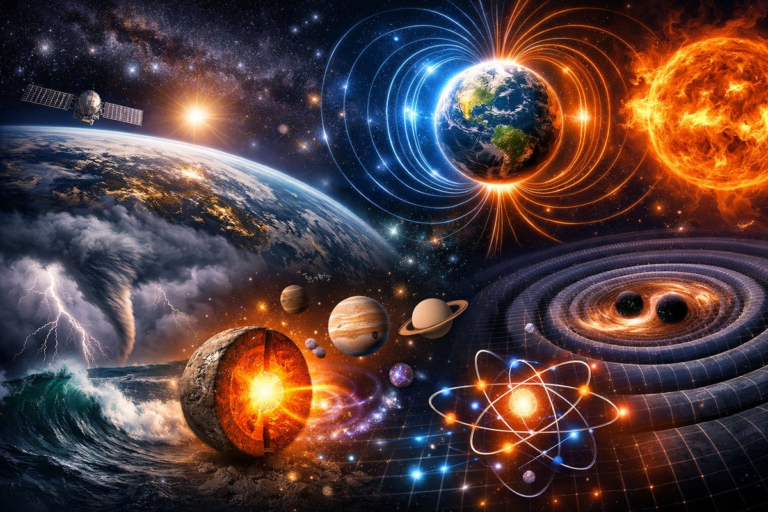
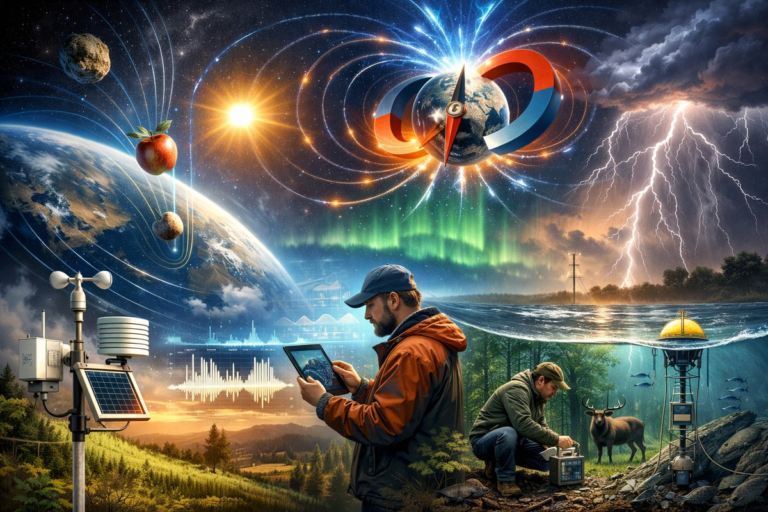
The magnetospheric event began when a solar storm ejected a powerful burst of charged particles toward Earth. Instruments aboard a constellation of low-orbit satellites recorded ripples in the magnetic field thousands of kilometers above the planet’s surface. Instead of a smooth compression, the field lines buckled into intricate vortices, creating pockets of intense reconnection where energy was explosively released. These mini-storms generated dazzling auroral displays at latitudes much farther south than usual, captivating skywatchers across multiple continents.
Lead investigators describe the phenomenon as a “magnetic heartbeat,” a pulsing signature that may help predict when satellite systems or power grids are at risk. By modeling these reconnection zones, researchers aim to develop real-time alerts for communication networks and navigation systems vulnerable to geomagnetic surges. The observations also challenge existing theories of how plasma flows around Earth’s dipole field, suggesting deeper couplings between solar wind variations and our planet’s internal dynamo.
Back on terra firma, ecologists have been applying similar principles of field interactions to the world of living systems. High-speed cameras and GPS trackers affixed to flocks of starlings revealed that each bird adjusts its flight speed and direction based on the motion of seven nearest neighbors, not the entire flock. This surprisingly simple rule produces the breathtaking murmurations that have long mesmerized observers. Computer simulations based on these parameters reproduce the swooping, vortex-like formations with stunning accuracy.
Beyond its aesthetic appeal, this research holds practical promise. Urban planners are exploring algorithms derived from murmurations to ease pedestrian flow in crowded spaces, potentially reducing bottlenecks at transit hubs and large events. Emergency responders are testing drone swarms programmed with the same rules to maintain safe distances and avoid collisions while conducting search-and-rescue missions. The marriage of field theory and flock behavior exemplifies how understanding emergent systems can yield solutions far outside traditional physics.
While magnetism and flock dynamics operate on vastly different scales, another frontier in physics is interrogating the smallest constituents of matter. In a series of tabletop experiments, scientists have constructed compact cloud chambers that allow students and researchers to visualize alpha and beta particles in real time. By applying a fine electric field across a supersaturated alcohol vapor, charged particles leave delicate trails of ionization, revealing the invisible currents at play.
These modern cloud chambers incorporate digital imaging sensors, enabling high-definition recording of particle tracks. Researchers can adjust the voltage, pressure and temperature to study how cosmic rays or radioactive sources interact with matter. The result is a hands-on window into quantum phenomena, bridging classroom demonstrations and cutting-edge research. Plans are underway to deploy networks of these chambers in schools and community centers, democratizing access to particle physics.
Perhaps most tantalizing are experiments probing quantum entanglement within these compact setups. By sending photons through a crystal to generate entangled pairs, physicists can detect correlations in separate cloud chamber cells. When one photon’s path is measured, its twin’s behavior instantly reflects that choice-an eerie echo of Einstein’s “spooky action” across small distances. Although these entangled pairs are fragile, improvements in detector sensitivity are extending the lifetime of correlations, paving the way for quantum-secure communication links.
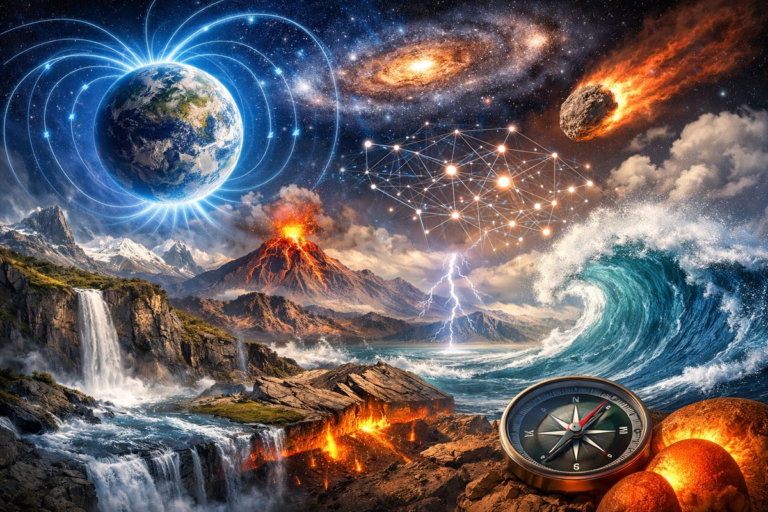
Gravity, too, has entered this tapestry of discovery. Precision gravimeters aboard low-flying aircraft have mapped subtle variations in Earth’s gravitational field over mountain ranges and deep ocean trenches. These gravity anomalies reveal hidden structures-dense mineral deposits, underground aquifers and tectonic fault lines-informing both resource exploration and disaster mitigation. By combining magnetic, gravitational and seismic data, geophysicists can create three-dimensional models of the planet’s subsurface, boosting our ability to anticipate earthquakes and volcanic activity.
One recent study employed a novel gravimeter strapped to a high-altitude drone, capturing data at resolutions previously possible only from spacecraft. The drone-borne sensor traced gravity gradients across a volcanic caldera, unveiling magma chambers that could signal an imminent eruption. Early warnings based on this integrated approach could save lives and guide evacuation strategies in vulnerable communities.
These breakthroughs underscore a broader theme: nature’s forces are deeply interconnected, from charged particles dancing along magnetic lines to the synchronized pulses of bird flocks and the entangled quirks of subatomic particles. Each discovery emerges from a fusion of observation, simulation and hands-on experimentation. As equipment becomes more compact, affordable and networked, citizen scientists can join professionals in mapping these invisible currents.
Educational outreach programs are already distributing DIY kits to measure local magnetic fluctuations or record pixel-perfect tracks in cloud chambers. Online platforms curate and analyze data uploads, turning classrooms into nodes in a global sensor network. Crowdsourced magnetometers have even spotted transient shifts tied to distant earthquakes, hinting that collaborative monitoring could offer new windows into planetary dynamics.
Looking ahead, researchers envision a unified framework that ties together gravity, electromagnetism and emergent behavior. While a grand “theory of everything” remains elusive, incremental steps are weaving disparate threads into a cohesive tapestry. Advances in machine learning are accelerating pattern recognition across huge datasets, revealing correlations that human eyes might miss. From satellite constellations to smartphone-powered sensors, our toolkit for decoding nature’s hidden pulses has never been richer.
Ultimately, these investigations remind us that the world is alive with invisible activity. The silent language of magnetic reconnection, the whispered commands among flocking birds and the probabilistic flickers of quantum particles all speak to a universe of interwoven forces. By observing, modeling and experimenting, we are learning to translate these signals-transforming wonder into knowledge and knowledge into action.
As our planet and its inhabitants face mounting challenges-from space weather disruptions to environmental instability-this deeper understanding offers both early warnings and new strategies. Whether it’s a student building a cloud chamber in her backyard or an engineer fine-tuning a magnetometer in orbit, each measurement brings us closer to anticipating nature’s next move. In the dance of forces both grand and minute, the next discovery may lie just outside our current field of vision.