Location
Mount Vernon, WA 98274

Location
Mount Vernon, WA 98274
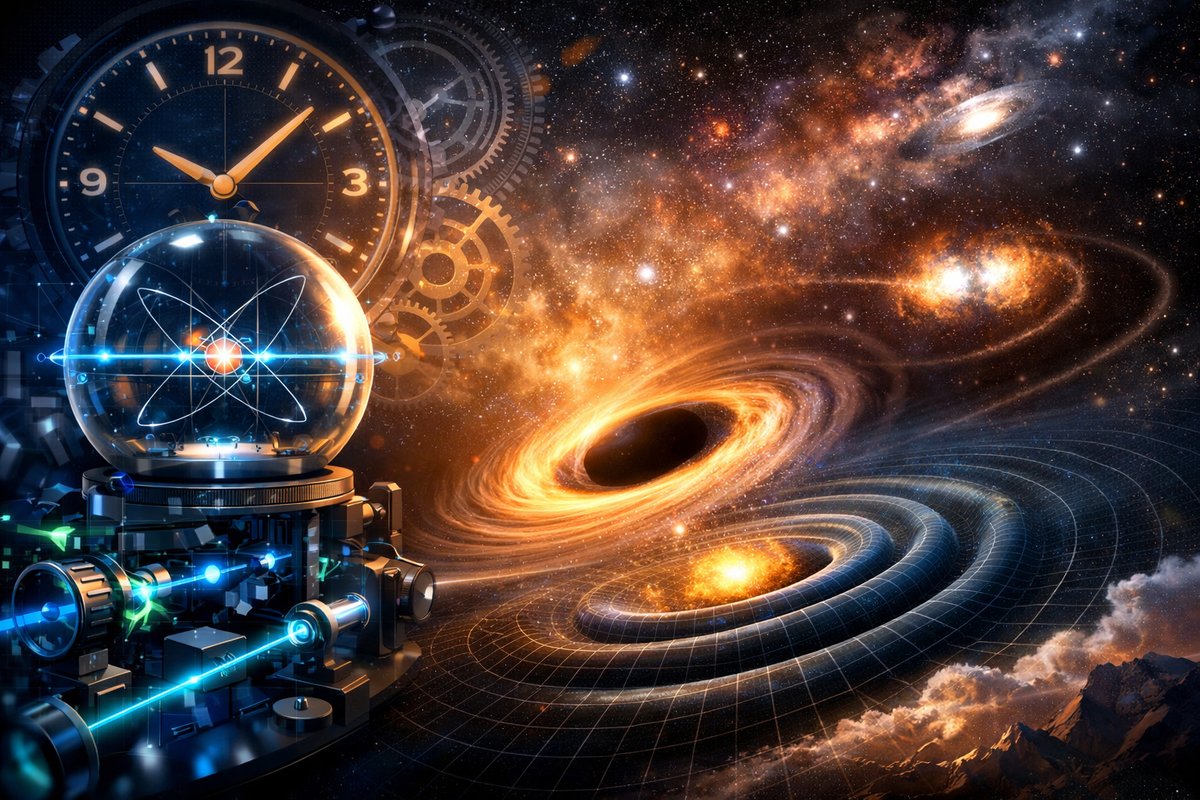
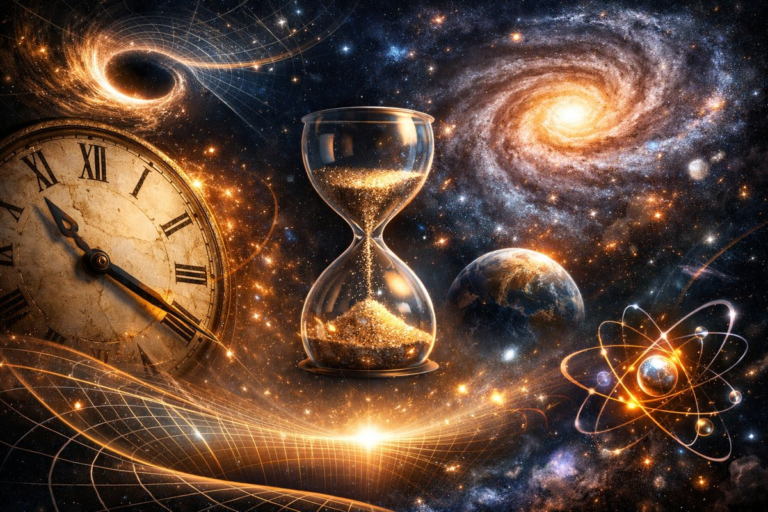
From the ticking of an atomic clock to the ripples of spacetime detected billions of light-years away, our understanding of time and matter is undergoing a revolution. Cutting-edge experiments are challenging long-held assumptions and inviting us to rethink the very fabric of reality. Dive into the latest findings that bridge laboratory precision with cosmic wonder.
On a crisp autumn morning in a subterranean laboratory, researchers huddle around a row of ultrastable atomic clocks. Each device measures time with precision so exact that they would lose less than a second over the age of the universe. Yet these same clocks are now revealing subtle discrepancies that hint at new physics-tiny deviations in time’s flow when matter moves at different speeds and resides in differing gravitational fields.
Across the globe, at a high-energy particle collider, beams of protons smash together at velocities approaching the speed of light. These collisions briefly recreate conditions similar to those just fractions of a second after the Big Bang, birthing exotic particles whose fleeting existence offers clues about the nature of mass itself. Together, these laboratories represent two pillars of modern inquiry: probing the arrow of time and unlocking the origin of matter.
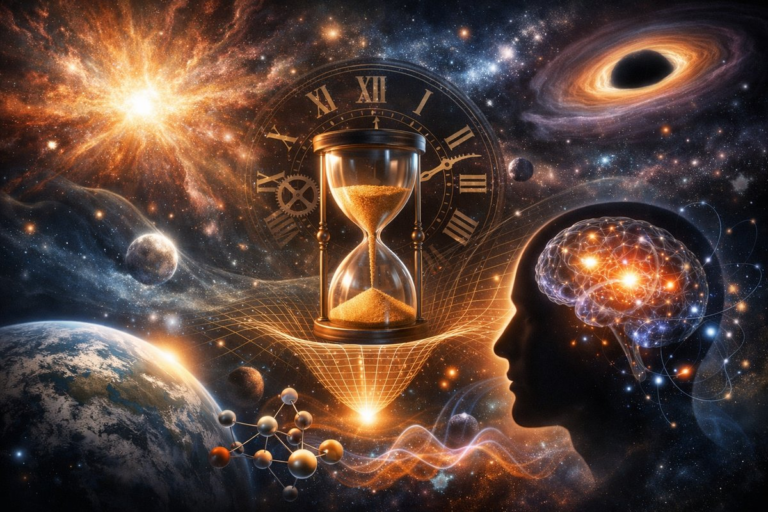
Until recently, time was treated as a steady backdrop for physical events, while matter was understood through well-tested equations. But new observations are blurring the line between these concepts, suggesting that time and matter emerge from the same underlying quantum tapestry. A series of experiments exploring quantum entanglement, gravitational waves, and particle masses are now converging toward a radical view of reality-one in which time might be an emergent phenomenon, inseparable from the interactions of fundamental particles.
Last summer, a team of physicists announced that by comparing two optical lattice clocks separated by just a few centimeters in altitude, they detected a tiny difference in ticking rates corresponding to Earth’s gravitational gradient. This direct laboratory measurement of gravitational time dilation is not only a technological feat but also an indication that precision timing can probe potential deviations from Einstein’s general relativity at unprecedented scales.
Meanwhile, in an accelerator facility thousands of miles away, researchers performed high-precision mass measurements on recently discovered particles. Using a Penning trap-which confines charged particles in magnetic and electric fields-they determined the mass of a rare isotope with eight decimal places of accuracy. The result challenges predictions from the Standard Model of particle physics, hinting that undiscovered forces or symmetries might be at play.
Perhaps the most cosmic milestone arrived when a network of gravitational-wave detectors recorded a subtle, continuous hum-dubbed the stochastic gravitational-wave background. Unlike the dramatic flash of merging black holes or neutron stars, this background is a persistent ripple left over from the universe’s earliest moments. Its detection opens a new observational window into the interplay between quantum fluctuations and spacetime itself, potentially illuminating the period when matter as we know it first emerged.
“We are witnessing a unification of approaches,” says a leading theoretical physicist. “Experiments on time dilation, mass anomalies, and gravitational waves are no longer separate threads. They’re weaving a comprehensive picture of how spacetime and quantum fields co-evolve.” This sentiment reflects a growing trend: bridging tabletop precision experiments with far-reaching astronomical observations, all in pursuit of a theory that reconciles general relativity with quantum mechanics.
At the heart of this quest lies the mystery of entropy and the arrow of time. In microscopic systems, quantum processes can run forward and backward without preference. Yet, in our macroscopic world, time appears to have a direction-eggs break but never unbreak, memories form but never erase. New work in quantum thermodynamics suggests that entropy’s growth may be tied to the entanglement structure of matter. As particles become entangled with their environment, a clear temporal ordering emerges, offering a possible explanation for why time seems to flow in one direction.
Meanwhile, cosmologists are scrutinizing the cosmic microwave background-the leftover radiation from the Big Bang-for fingerprints of primordial quantum entanglement. Slight temperature variations across the sky could encode information about how early quantum fluctuations spilled into the classical cosmos, seeding galaxies and shaping the distribution of matter. If confirmed, this would link the dawn of time itself to quantum interactions on the smallest scales.
Beyond pure theory, these discoveries carry practical implications. Next-generation atomic clocks are poised to revolutionize global positioning systems, making navigation accurate to within centimeters. Ultra-precise timekeeping will enhance synchronization in telecommunications networks and enable new tests of fundamental physics, such as the search for dark matter through tiny shifts in clock frequencies.
On the materials front, insights into mass generation could inspire novel metamaterials with tunable inertial properties. Imagine spacecraft whose effective mass can be altered mid-flight, reducing fuel requirements and enabling agile maneuvers. While such applications remain speculative, the underlying physics is being explored in laboratories that merge electromagnetic fields with quantum materials.
So why does this matter to us, beyond the realm of accelerators and cryogenic clocks? Because our human experience of time and matter defines everything we do. From the pace of our lives to the solidity of our surroundings, these phenomena govern the limits of technology, the boundaries of perception, and the very possibilities of exploration.
Consider space travel. Future missions to Mars or beyond will rely on precise timekeeping to navigate vast distances. Deep-space probes will measure gravitational time dilation as they swing by massive bodies, using the effect to refine trajectories. And as astronauts venture farther from Earth’s gravity well, they will age at slightly different rates-a tangible manifestation of relativity that will require new medical protocols and mindset shifts.
Back on Earth, the drive for ever-smaller, faster electronics also hinges on managing quantum properties of matter. As transistors approach atomic scales, time and matter become intertwined in ways that classical engineering can no longer ignore. Coherence times, quantum tunneling, and entanglement dynamics will shape tomorrow’s computing architectures.
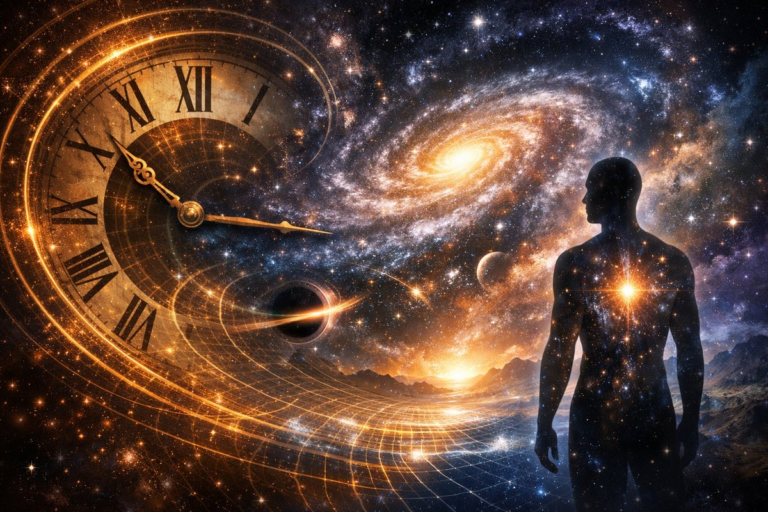
Yet for all the complexity, there is a poetic symmetry in our quest. We use time to measure change, and matter to anchor our senses. As experiments reveal their inseparability, we glimpse a universe where clocks, particles, and waves are facets of a single cosmic jewel. Each new measurement, each unexpected anomaly, draws us closer to a unified story of existence-one in which mystery is not a barrier but an invitation to wonder.
In labs bathed in neon glow and observatories perched atop remote mountains, researchers press on. Their tools range from crystal‐chambered ion traps to kilometer‐long interferometers, yet their aim is timeless: to find the threads that tie together the tapestry of reality. Whether it’s the steady tick of an optical clock or the distant echo of a gravitational wave, every signal carries a message from nature’s deep archive.
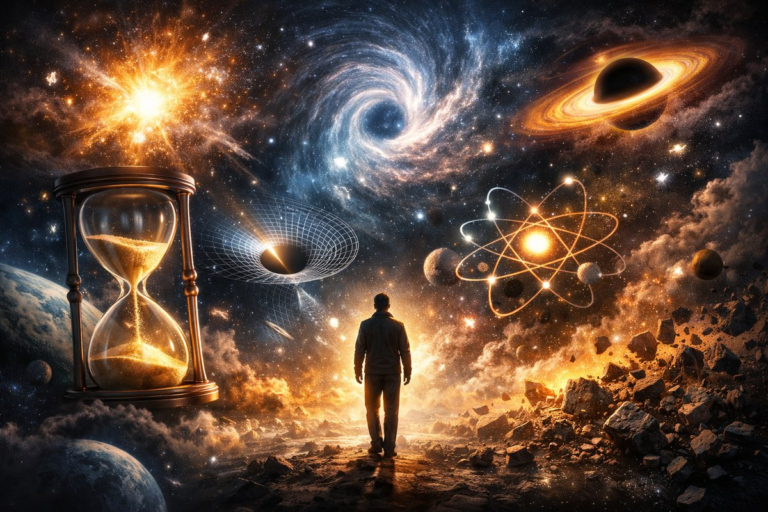
As the boundaries between time and matter dissolve, we stand at the threshold of a new era-one where human ingenuity deciphers the hidden code of the cosmos. The road ahead promises fresh mysteries, but also the chance to reshape technology, philosophy, and perhaps our own destiny. After all, in a universe woven from quantum threads, the greatest adventure may be discovering where we fit into the pattern.