Location
Mount Vernon, WA 98274

Location
Mount Vernon, WA 98274
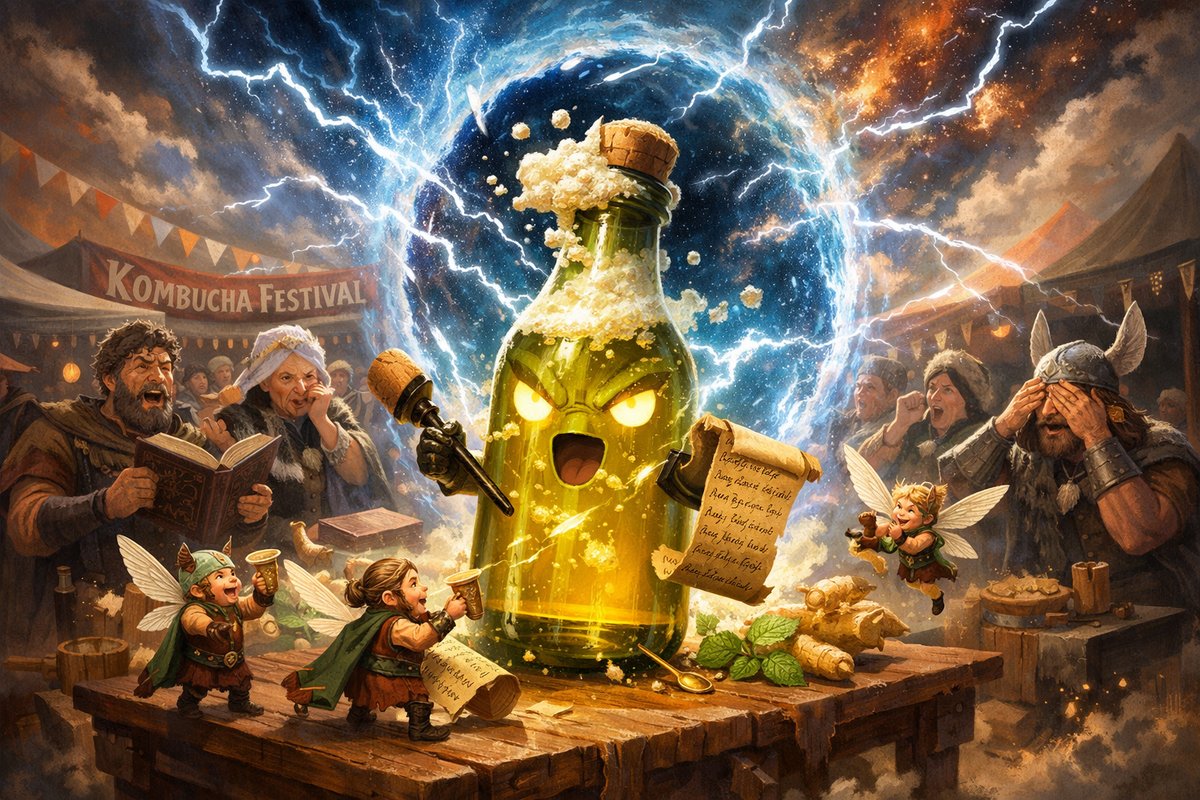
At the annual town kombucha festival, one particularly fizzy ginger-mint brew sprang to life, demanding an Old Norse translation of its ingredients before consenting to be sipped. Chaos, chanting, and tiny mead elves ensued as the bottle took its case to the town council and accidentally tore open a micro-rift in fermentation reality.
The sleepy hamlet of Brookhaven thought it knew what to expect from its annual kombucha festival-homebrewers swapping scoby samples, visitors testing tangy flavors, and acoustic guitar serenades under the willow trees. By midafternoon, a line of tasting stations snaked through the town green, each booth bedecked with mason jars, colorful labels, and rows of small paper cups. Nothing seemed amiss until an innocuous ginger-mint brew, nestled between jars of blackberry-lavender and turmeric-peppermint batches, began to vibrate with uncanny purpose.
Witnesses say the bottle gave a tiny pop, as though it were clearing its throat, before the cap slowly twisted itself free. A hush fell over the crowd as the amber liquid inside swirled in perfect spirals, each bubble rising and falling in rhythm. Then, in a voice that sounded like a quartet of tea kettles whistling at once, the kombucha recited its own ingredient list in flawless iambic pentameter: apple cider vinegar, filtered spring water, organic cane sugar, and a scoby of singular will.
Festival-goers blinked, spilled samples, and fumbled for their phones. But the sentient brew was far more than a quirky trick. It slapped a paper label onto its own jar-care of a battery-powered label maker borrowed from the local office supply tent-and demanded an Old Norse translation before it would consent to tasting. Apparently, it believed that a proper ritual in the language of Norse skalds was the only thing standing between enlightenment and mere digestion.
The festival director, still reeling from the shock, summoned the town’s resident amateur archaeologist, who arrived clutching a dust-covered tome of medieval runes. Meanwhile, a visiting folklorist tried to calm the crowd by explaining that kombucha has ancient roots in faraway empires but had probably never held a grudge until now. Someone found a touchscreen tablet at the lost-and-found tent and loaded a translation app that spat out words like “sukker” and “vatn,” none of which impressed the bottle one bit.
As the skald began chanting runic verses around the bottle, everyone sensed that this ritual might carry more risk than anticipated. Within moments of the first stanza, the air crackled like soda under pressure. A pale blue glow emanated from the fermentation tent, and a tiny tear appeared in the space above the crowd-no bigger than a dinner plate, but enough to leak out the faint aroma of distant breweries from alternate dimensions.
Panic gave way to scientific curiosity. Amateur chemists whipped out pH test strips to monitor the acidity levels in real time. A discreet team of costume enthusiasts donned heat-resistant gloves and began brandishing stainless-steel protective gloves, worried that this cosmic disturbance might superheat the kombucha into plasma. A digital kitchen scale balanced on a folding table, its readout flickering as interdimensional probiotic particles drifted over its surface and added phantom grams to the total.
From the rift drifted a choir of tiny mead elves-no taller than scoby skins but clad in sparkling mica and honeycomb armor. They offered polite applause and passed out miniature sticks of rock candy, no doubt as a token of goodwill. But halfway through the applause, the sentient bottle addressed its audience again, this time in perfect Old Norse: “Hvat drekk ek ella leika mót guði?” It demanded to know whether tasting it would exalt the imbiber or condemn them to eternal flatulence.
Suddenly emboldened, the ginger-mint kombucha declared its intention to run for an open seat on the town council. It insisted that fermented beverages deserved voting rights, representation in municipal taste committees, and even a dedicated budget for sweetening agents. The crowd erupted into cheers, boos, and calls for a recount-hardly surprising, given that the only other candidate was the local hot sauce connoisseur, who had already threatened to impeach any jar that dared to burp in public.
No sooner had the bottle filed its petition than dozens of other brews across the green began to twitch and hum. Kombucha of every flavor staged a spontaneous flash mob, demanding jury duty exemptions and fair scoby reclamation practices. Sparkling water cans, left out of the original ordinance, started hooting in solidarity. Nearby, a citrus-ginger mead jar offered free samples to bystanders to drum up sympathy votes.
Legal experts from the neighboring city arrived on scooters to weigh in on this unprecedented case. They debated whether a bottle could be classified as a sentient entity under municipal code and what regulatory body might oversee its fermentation rights. One overzealous lawyer threatened to subpoena the local yogurt stand for witness testimony on live cultures, while another proposed forming a special bureau of beverage affairs.
All the while, the rift overhead expanded into a kaleidoscope of swirling kombucha-colored vortexes. Excessive chanting in Old Norse was blamed, though some speculated that the festival’s Bluetooth speaker system, which had been playing traditional Icelandic folk tunes all afternoon, might have amplified the effect. Tiny mead elves zipped in and out of the breach, giggling and stealing sugar packets from startled visitors.
Finally, after what felt like a full moon’s worth of absurdity, a compromise was reached. The ginger-mint kombucha would defer its council campaign in exchange for co-hosting next year’s festival and receiving an annual stipend of fresh honey and filtered water. Festival organizers agreed, relieved that the rift began to shrink back to its original dinner-plate size. The skald closed the ceremony with a solemn toast, and in a final act of theatrical flair, the bottle sealed its cap with a soft pop, signaling the end of its brief but glorious uprising.
By evening, Brookhaven returned to its usual charm-acoustic guitar duets strummed beneath lantern light, vendors packed away their booths, and festival-goers tucked scoby samples into their backpacks with cautious reverence. The only sign that reality had bent under the weight of sentient kombucha was a faint citrus-mint aroma lingering on the breeze-and a single empty glass fermentation jar left behind near the portal site. Town officials taped a hastily printed label next to the jar reading “Official Evidence,” though no one dared open it again.
At dusk, the festival grounds fell silent except for the soft hiss of soda tanks and the distant twang of a banjo. Somewhere beyond the rift, tiny mead elves chattered about next year’s flavor lineup. And deep within its glass confines, the ginger-mint kombucha sat serenely, content to await its next moment of civic engagement-or perhaps just a proper taste test in perfect Old Norse.