Location
Mount Vernon, WA 98274

Location
Mount Vernon, WA 98274
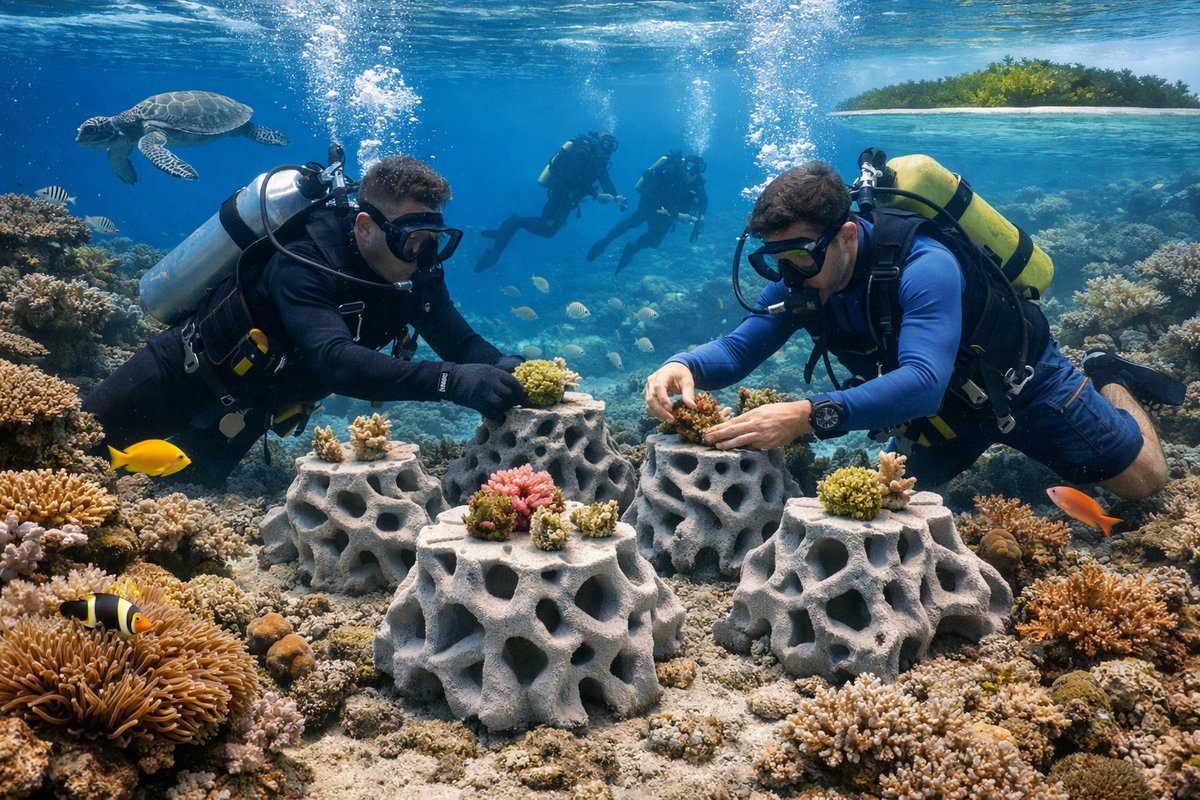
Facing unprecedented rates of coral bleaching, scientists have unveiled a pioneering approach that uses biomimetic 3D-printed reef modules to accelerate coral settlement and biodiversity recovery. Early field trials in a tropical atoll show promising recruitment rates and community engagement in a scalable restoration strategy.
Coral reefs, long hailed as underwater rainforests, are under siege from warming seas, ocean acidification, and the compounding stresses of pollution and overfishing. Mass bleaching events are becoming more frequent and severe, leaving large swaths of once-vibrant reef skeletons bleached white. Traditional restoration methods-manually transplanting nursery-grown coral fragments-have struggled to keep pace with losses, constrained by labor-intensive practices and limited scalability.
In response to these challenges, a collaboration between marine ecologists and materials scientists has produced an innovative solution: 3D-printed reef structures crafted from a biomimetic calcium carbonate composite. Drawing inspiration from the microscopic architecture of natural coral skeletons, the new material replicates the porous matrix that underpins nutrient flow, larval settlement, and structural integrity. This approach aims not only to provide physical support for coral outplants, but also to jump-start ecological processes that underpin reef resilience.
At the core of this effort is a proprietary printing ink formulated from sustainably sourced calcium carbonate powder, marine-grade polymers, and trace mineral additives. When cured, the composite hardens to a strength comparable with natural reef rock while retaining microchannels that measure just tens of microns across. These channels mimic the tiny grooves and ridges found in branching corals, guiding planktonic larvae toward attachment points and sheltering juvenile fish and invertebrates from predators.
To bring the technology from lab to lagoon, researchers developed a mobile 3D printing rig housed in a shipping container. The unit combines high-resolution stereolithography with an automated mixing chamber that adjusts pigment and mineral concentrations to match the local reef’s color and chemistry. Deployed directly at a sheltered bay on a remote atoll, the system can fabricate dozens of reef tiles each day, bypassing logistical hurdles of transporting heavy concrete modules from distant fabrication sites.
Once printed, reef tiles are affixed to existing substrates using biodegradable anchors that dissolve within months. In the pilot deployment, teams placed over 150 modules across a half-hectare plot of degraded reef. Each module features a lattice of arches, ledges, and sheltered cavities designed through computational fluid dynamics to optimize water flow and sediment shedding. The resulting microhabitats encourage a diverse array of organisms to colonize the surfaces, effectively fast-tracking ecological succession.
Within eight weeks of installation, surveys recorded a 50% increase in settling coral larvae compared to control sites using traditional cement blocks. Multiple coral species-including branching, massive, and encrusting forms-were observed recruiting to the new structures. Small herbivorous fish and grazing sea urchins also appeared in higher numbers, indicating a cascading effect on the broader reef community. Preliminary water quality data revealed localized buffering of pH swings around the new modules, potentially mitigating acidification stress during nocturnal respiration dips.
Underwater photogrammetry and remote-sensing surveys have allowed the team to measure structural complexity gains in real time. By comparing 3D models captured before and after deployment, researchers quantified a 30% boost in habitat rugosity-an important predictor of biodiversity on coral reefs. The modules’ design files are open-source, enabling restoration practitioners worldwide to customize shapes, pore sizes, and surface textures for local environmental conditions.
Local dive operators and community groups have been integral to the project’s success. Training workshops taught volunteers how to operate the 3D printer, install reef modules, and conduct biodiversity monitoring. These hands-on experiences foster a sense of ownership and stewardship, aligning scientific restoration with cultural and economic incentives for reef protection. By empowering local stakeholders, the initiative aims to create a self-sustaining restoration network rather than a top-down intervention.
Looking ahead, the research consortium plans to expand trials to different reef zones-from high-energy fore reefs to sheltered lagoon basins-and to integrate aquaculture-grown coral nubbins directly into the printing process. Combining living coral fragments with printed substrates could streamline outplant integration and reduce handling stress. Concurrent studies are assessing how microalgal coatings on the tiles might enhance symbiont uptake and heat tolerance in juvenile corals.
Beyond corals, the biomimetic printing platform shows potential for other marine restoration challenges-such as oyster reef rebuilding, seagrass bed reinforcement, and even kelp forest regeneration. By tailoring composite formulations and structural designs, the technology could support habitat recovery across a range of coastal ecosystems, providing a versatile tool in the fight against biodiversity loss.
In an era when nature-based solutions are critical to climate adaptation and biodiversity conservation, scalable innovations like 3D-printed reef structures offer a new frontier. While no single intervention can reverse the trajectory of global reef decline, combining cutting-edge materials science with community-driven action may tip the balance toward resilience. As these modular reefs grow and diversify, they stand as both symbols of human ingenuity and catalysts for marine renewal.