Location
Mount Vernon, WA 98274

Location
Mount Vernon, WA 98274
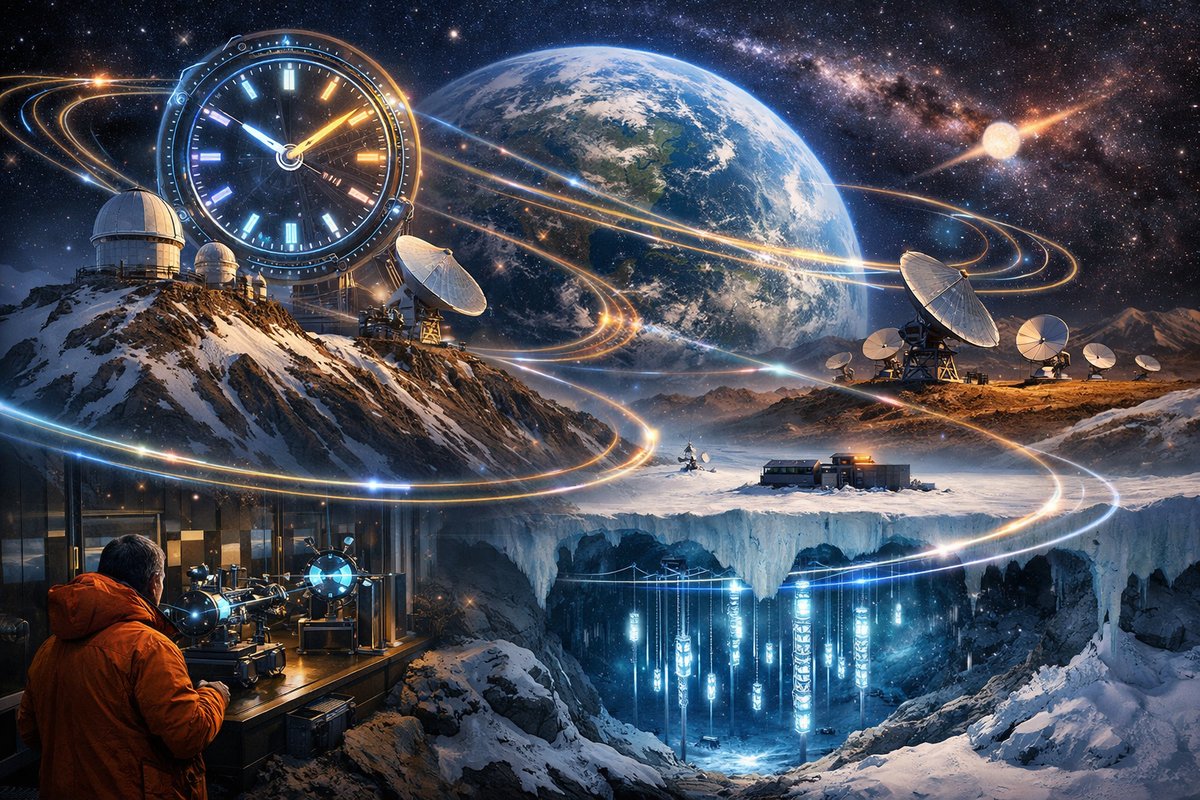
A global network of quantum clocks and deep-space observatories is revealing subtle ripples in time and unexpected signatures in matter. From mountain-top time dilation experiments to hidden neutrino patterns beneath Antarctica's ice, scientists are piecing together anomalies that challenge our notions of reality.
A cluster of metal chambers, cooled to near absolute zero, now hums in a subterranean laboratory beneath the Swiss Alps. Inside, clouds of atomic strontium dance in laser cages that pulse with unimaginable precision. These optical lattice clocks have reached accuracies once considered impossible, sensitive enough to detect time passing at different rates only a few centimeters apart. In parallel, neutrino detectors buried deep beneath Antarctic ice reveal fleeting ghost-like particles arriving from cosmic accelerators far beyond our galaxy.
Scientists in Geneva, Tokyo and Boulder are linking these experiments into a distributed timekeeping network. By comparing tick rates of ultra-precise clocks at different altitudes, latitudes and orbital positions, they are testing Einstein’s predictions with unprecedented resolution. Small deviations from expected time dilation could hint at subtle interactions between quantum fields and gravity, or reveal hidden forces that tug at matter itself.
At the same time, dark matter hunts in Italy’s Gran Sasso mountain and Japan’s Kamioka observatory are probing unseen particles that permeate the cosmos. While these experiments have yet to isolate a definitive dark matter signature, new data sets suggest tantalizing excess events that defy simple background explanations. If confirmed, these anomalous signals could reshape our understanding of mass and the building blocks of the universe.
Researchers describe this dual approach-precision time metrology on Earth and deep-space matter searches-as a new paradigm in fundamental physics. Rather than focusing on a single collider or telescope, they employ a mosaic of instruments that speak in different “languages”: the rhythmic pulse of quantum clocks, the faint flashes of particle detectors and the gravitational murmurs captured by interferometers.
Efforts to merge these data streams face daunting challenges. Synchronizing clocks separated by oceans requires fiber-optic links spanning continents, while neutrino and dark matter detectors generate vast volumes of data that must be sifted for rare events. Teams develop custom algorithms that cross-correlate timing residuals with particle detections and cosmic waveforms in real time.
In one recent campaign, meteorological fluctuations at Antarctic stations caused subtle shifts in the neutrino detector’s timing baseline. By integrating information from the clock network, researchers disentangled these environmental effects and sharpened the neutrino arrival times. This refinement sharpened the search for neutrino sources and allowed scientists to back-track the particles’ paths with greater confidence.
Meanwhile, high-altitude observatories in the Andes and Himalayas host mobile quantum clocks carried by mountaineers and pilots. On the summit of a 5,000-meter peak, researchers observed a clock running faster than its sea-level counterpart by a few parts in 10^18. This minute effect is a direct manifestation of general relativity: time flows differently in weaker gravitational fields.
These extreme experiments also offer a human story. Climbers endure frigid nights and thin air, balancing priceless timepieces with survival gear on precarious ledges. In laboratories, technicians don cleanroom suits to handle optics that would skew a clock’s tick if specked with dust the size of a single virus particle.
Deep underground, physicists monitor cryogenic systems that keep their detectors cold enough to shield them from thermal noise and background radiation. A single mechanical vibration or stray heat glitch can swamp the rare interactions they seek. Engineers fine-tune vibration isolators and design low-radioactivity materials to minimize interference.
At the cosmic scale, gravitational wave observatories in the United States, Europe and Asia continue to capture spacetime ripples from colliding black holes and neutron stars. Each detection informs models of matter under extreme density and energy. Combined with the precision clock network, these observations could one day reveal whether time itself has small discontinuities or “grains” at the Planck scale-a long-hypothesized granular structure beyond current theories.
Researchers are also exploring metamaterials that mimic negative mass and exotic phases of matter. In laboratory setups using ultracold atoms and tailored laser fields, physicists coax particles into behaving as though they possess inverted inertia. These artificial constructs could shed light on how dark matter or other unknown fields interact with normal matter.
Meanwhile, astrophysicists pore over radio telescope arrays that scan the sky for fast radio bursts. Some of these intense pulses traverse billions of light-years, carrying imprints of every cosmic structure they cross. The dispersion, scattering and polarization of these signals encode information about the intergalactic medium, dark matter filaments and magnetic fields.
In a recent breakthrough, scientists combined radio-burst timing with optical clock data to calibrate the delays caused by Earth’s atmosphere with extraordinary precision. This synergy sharpened distance measurements to remote galaxies and refined values for the Hubble constant, the rate at which the universe expands.
Amid these technical triumphs, theorists grapple with persistent mysteries. Why does time appear to have a direction only when entropy increases? Can information lost in black holes ever be recovered? Does gravity stem from quantum entanglement at a deeper level? While experiments proceed, thought experiments continue to push conceptual boundaries.
A growing community of interdisciplinary researchers delves into the philosophy of time and matter. Workshops bring together physicists, computer scientists, philosophers and artists. Collaborative projects explore how quantum processes might inspire new modes of storytelling or shape immersive virtual environments where time behaves erratically.
Education initiatives seek to demystify these complex topics. Online portals offer visualizations of time dilation around massive bodies, simulations of dark matter flows and interactive guides to gravitational waveforms. These tools empower students and enthusiasts to experience fundamental physics firsthand, reinforcing that scientific insight often emerges at the intersection of curiosity and play.
The stakes extend beyond pure knowledge. Networks of quantum clocks could bolster global navigation and communication systems, offering resilience against signal jamming and cyberattacks. Advanced particle detectors might improve environmental monitoring by spotting elusive signatures of natural radioactivity or nuclear materials.
However, some caution that the race to ever-finer precision risks unforeseen consequences. What if microscopic variations in fundamental constants arise over time? Could extreme sensitivity to gravitational or quantum fluctuations complicate emerging quantum networks? The community emphasizes robust verification, open data practices and an ethos of collaboration to anticipate and address potential disruptions.
Looking ahead, a new generation of projects is on the horizon. The Einstein Telescope, a planned underground gravitational wave observatory in Europe, promises tenfold sensitivity gains. The Square Kilometer Array, sprawling across desert landscapes, will map the universe in radio frequencies with exquisite detail. Quantum clock arrays in space could one day peer into the gravitational wells of distant stars and test relativity across interplanetary distances.
As time and matter continue to reveal their intertwined secrets, each experiment adds a new thread to the tapestry of reality. The patterns that emerge challenge our assumptions and inspire fresh questions. In the end, the quest is not just to measure time or capture particles, but to understand our place in a cosmos that constantly surprises us.
Let curiosity guide the next generation of explorers-those who will harness the tools of precision measurement, delve into the enigmatic depths of matter and probe the shifting contours of time itself.