Location
Mount Vernon, WA 98274

Location
Mount Vernon, WA 98274
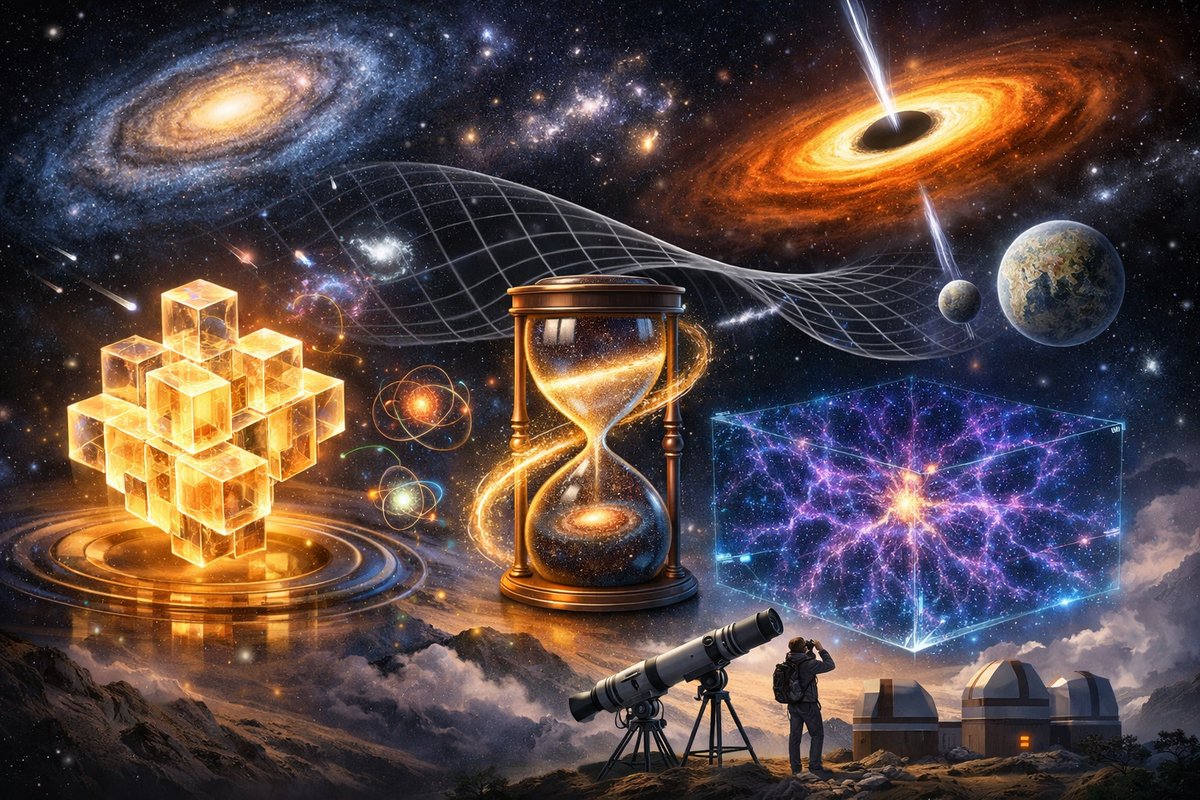
A wave of recent discoveries is reshaping our understanding of time, matter and the cosmic tapestry. From room-temperature time crystals to fresh maps of dark matter filaments, scientists are untangling the threads that bind the universe. This article dives into the latest breakthroughs and offers practical tips for amateur explorers to connect with these eternal mysteries.
In a laboratory filled with pulsing laser beams and electromagnetic traps, researchers have achieved a breakthrough that once belonged to the realm of science fiction: the creation of time crystals that tick in a rhythm of their own. These exotic phases of matter break the unspoken symmetry of time, oscillating without energy input and offering a glimpse of temporal order hidden beneath the surface of everyday reality. First theorized in the early 2010s, time crystals have now leapt from chalkboard equations to experimental reality, pressing us to reconsider the foundations of time itself.
The quest for time crystals accelerated when two independent teams published their findings in a leading physics journal. In one experiment, scientists cooled a chain of ions to near absolute zero and applied a precise sequence of microwaves. Instead of settling into equilibrium, the system began a perpetual dance-alternating its state like a clock that never winds down. Meanwhile, across the ocean, another group used a lattice of ultracold atoms and pulsed laser fields to reveal a similar time-crystalline heartbeat. Both demonstrations earned them international acclaim and opened a door into a world where time symmetry can be broken deliberately.
More recently, a collaboration of physicists reported observing elements of this phenomenon at room temperature. By engineering a solid-state crystal with tailored magnetic interactions and subjecting it to periodic laser pulses, they sustained time-crystal behavior long enough to capture high-resolution snapshots of its oscillations. Published in Nature Physics, the study suggests that time crystals could one day be harnessed for ultra-stable clocks, quantum computers, or novel ways to store information. The walls between temporal phases, once thought unbreachable, are now porous and beckoning exploration.
Yet these laboratory achievements, however astonishing, are but one thread in a grander tapestry woven across cosmic scales. Instruments like the Laser Interferometer Gravitational-Wave Observatory (LIGO) continue to listen for spacetime tremors produced by colliding black holes and neutron stars. The latest detection-an asymmetric merger of a neutron star and a heavy black hole-sent ripples through the fabric of spacetime, confirming theories about how extreme matter behaves under crushing gravity. Each gravitational wave event is a whisper from the universe’s most violent moments, a message in a bottle cast across eons of cosmic sea.
Parallel to these gravitational revelations, telescopes both on Earth and in orbit are mapping the elusive substance known as dark matter. The European Space Agency’s Euclid mission, which began sending back data late last year, has already detailed filaments of dark matter threading between galaxies. These ghostly highways form the scaffolding of the cosmic web, dictating how galaxies gather and evolve. By comparing Euclid’s lensing measurements with ground-based surveys, astrophysicists are refining models of structure formation and gaining clues to dark matter’s true nature.
Closer to home, experiments in statistical physics probe time’s arrow by reshaping our understanding of entropy. Teams using microscopic beads and optical tweezers have recreated Maxwell’s demon thought experiment, selectively filtering particles to momentarily reverse entropy increase. These tabletop demonstrations skirt the edge of thermodynamic limits, revealing that information itself carries an energetic cost. Questions linger about where to draw the line between computation, memory and the flow of time-a boundary that grows ever more intriguing as we miniaturize devices and push toward quantum-scale computing.
Meanwhile, in ultracold laboratories, arrays of atoms hovering in optical lattices are forming Bose-Einstein condensates with matter-wave interference patterns. By fine-tuning interactions and trapping geometries, physicists can slow or even freeze the motion of light within photonic crystals, creating circuits where photons behave like electrons. This cross-pollination of photonics and condensed-matter physics promises new materials with programmable properties, unlocking possibilities for high-speed optical computing and telescopes that can correct their own distortions in real time.
On the cosmic stage, the Planck satellite’s legacy endures through detailed maps of the cosmic microwave background. Researchers now combine Planck’s archival data with fresh readings from ground-based observatories to scrutinize anomalies such as the “cold spot,” an area of unexpected temperature deviation. Theories range from statistical fluke to the gravitational imprint of a vast cosmic void or even hints of a neighboring universe. Each hypothesis carries profound implications for our grasp of the universe’s birth and its ultimate fate.
Beyond cutting-edge labs and space telescopes, politicians and philosophers alike ponder the implications of these discoveries. If time symmetry can be intentionally broken, does that alter our philosophical notions of free will and causality? When matter can be so precisely sculpted that light itself is manipulated at will, how does that shift our relationship to technology and nature? Questions abound as we stand at a crossroads where human ingenuity begins to rewrite laws once considered absolute.
For those eager to experience these mysteries firsthand, the night sky remains the most accessible laboratory. Building a simple sundial out of wood or stone can connect one to the daily march of the Sun across the sky. Apps that chart stellar positions help novice astronomers track planets, nebulae and star clusters, while backyard telescopes and binoculars open windows to the Milky Way’s spiral arms. Recording one’s observations by hand or via smartphone is a practice that echoes the methods of astronomers throughout history, yet is only enhanced by today’s wealth of online databases.
Meanwhile, amateur physicists can experiment with tabletop optics kits that include lenses, lasers and diffraction gratings. Such kits illustrate core principles underlying photonic crystals and interference patterns. For the more adventurous, desktop electronics platforms paired with basic sensors can measure magnetic fields or temperature fluctuations, offering a hands-on glimpse of the interplay between information, energy and entropy.
These threads of time, matter and mystery weave a narrative that extends from subatomic oscillations to cosmic filaments, from theoretical speculation to do-it-yourself experiments. They serve as reminders that the universe remains at once comprehensible and infinitely strange, urging us onward in our quest to understand the loom of existence. As laboratories refine their instruments and telescopes sharpen their lenses, each discovery adds a stitch to a tapestry that spans the micro and the macro, the fleeting present and the unbounded future.
On the horizon, next-generation facilities such as upgraded synchrotron light sources and free-electron lasers will probe the structure of matter on attosecond time scales. The Large Hadron Collider’s high-luminosity upgrade will delve deeper into the quantum vacuum, searching for new particles that may anchor our theories or unravel them entirely. With each advance, the boundary between mystery and knowledge shifts, inviting collaboration between scientists, thinkers and dreamers.
Whether one gazes through a telescope, conducts an at-home optics experiment, or simply contemplates the arrow of time during a quiet moment, the interplay of time, matter and mystery remains a fertile ground for wonder. In an era when the very fabric of reality is under scrutiny, curiosity is our most vital instrument. Embrace these discoveries not as distant headlines, but as catalysts for personal exploration. After all, the universe’s greatest secret may be the spark it ignites in each of us.