Location
Mount Vernon, WA 98274

Location
Mount Vernon, WA 98274
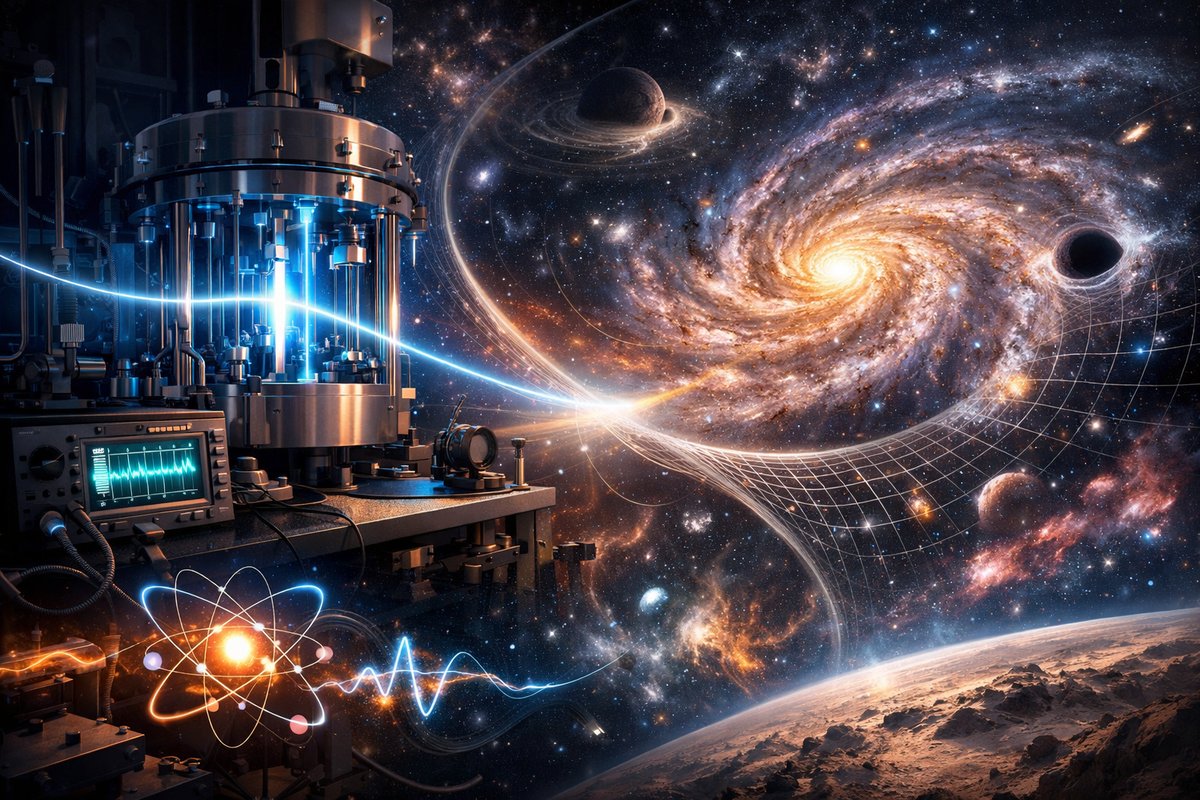
From the tick of an atomic clock to the swirling dance of galaxies, the universe is woven by subtle threads of time and matter that shape every experience. This exploration journeys from lab‐benches to cosmic voids, revealing how precision measurement, quantum quirks, and the unknown contours of spacetime challenge our most basic assumptions.
Anyone who has watched a sunbeam shift across a room has witnessed time’s unrelenting passage. Yet beneath that simple motion lie layers of complexity: particles flicker in and out of existence, clocks gain and lose infinitesimal fractions of a second, and the very fabric of spacetime can ripple like a cosmic pond. Modern science sits at the crossroads of measurement and mystery, striving to decode how time and matter conspire to shape reality.
Precision lies at the heart of this quest. In high-altitude laboratories carved into mountains, physicists isolate atoms from environmental noise to measure their natural oscillations. When these oscillations are harnessed as time standards, an atomic clock can keep time so accurately that it would neither gain nor lose a second over the lifetime of the universe. Yet small anomalies sometimes appear: minute shifts in frequency that hint at new physics or subtle influences from dark matter passing through Earth.
Meanwhile, deep underground, massive detectors listen for ghostly neutrinos, subatomic particles that zip through solid rock like phantoms. Their rare interactions reveal clues about the early universe, nuclear reactions in the Sun, and even the fusion engines powering distant stars. By correlating neutrino arrivals with time stamps from precision clocks, researchers can test whether these particles obey the same temporal symmetries as more familiar forms of matter-or if they carry secrets that break our conventional understanding of time itself.
On the quantum scale, time takes on an even more surreal character. Particles can exist in suspended superpositions of multiple energy states, and until measured, they do not yield a definite temporal location in the way a ticking clock does. This indeterminacy forces scientists to ask: is time a fundamental backdrop against which events unfold, or an emergent property born from the collective behavior of countless quantum interactions? Emerging experiments with ultracold atoms and entangled photons aim to probe these questions by simulating miniature universes where time’s arrow might bend or reverse.
Stretching from the quantum realm to the cosmic horizon, entropy plays a crucial role in defining the direction of time. In a sealed box of gas, molecules spread out until they evenly fill the space-an increase in entropy. On a universal scale, the inexorable rise of entropy sets a forward arrow from past to future. Yet black holes, those mysterious cosmic sinkholes, suggest a breakdown of this rule. As they grind matter into an infinitely small volume, black holes appear to erase information, challenging the second law of thermodynamics. Recent theoretical advances propose that quantum entanglement across the event horizon preserves this information, weaving a bridge between spacetime geometry and the hidden correlations of quantum fields.
Gravity itself affects the pacing of clocks. In Einstein’s theory of general relativity, time flows more slowly in stronger gravitational fields. Engineers must correct for this effect in satellite navigation systems, or GPS signals would drift by nanoseconds each day, rendering location data useless. On a grander scale, spacecraft venturing close to massive planets or neutron stars could test relativity’s predictions with unprecedented precision, monitoring how time dilates in curving spacetime and whether unknown forces subtly tweak the calculations.
At the edges of our solar system and beyond, astrophysicists search for time capsules from the dawn of creation. By capturing faint microwaves left over from the hot, dense fireball of the early universe, telescopes map fluctuations in temperature and density that seeded galaxies. These observations provide a clock for cosmic evolution, revealing how matter clustered under gravity’s pull and how dark energy accelerated expansion in the universe’s adolescence. Each data point refines our timelines for galaxy formation and the emergence of chemical elements vital for life.
Yet, for all the strides in understanding, mystery remains our constant companion. What is dark matter that tugs on galactic halos without emitting light? Does it consist of exotic particles born in the earliest moments, or is it a subtle modification to gravity itself? And what is the nature of dark energy that drives cosmic acceleration and challenges the limits of physical law? Efforts to answer these questions rely on collaborations that span continents: underground labs, particle colliders, space probes, and powerful supercomputers running simulations of unimaginable scale.
Perhaps the greatest lesson from this tapestry of time and matter is humility. Every precise measurement, every refined theory, still confronts the unknown. The more we peel back the layers-atom by atom, photon by photon-the more we encounter phenomena that elude easy explanation. Yet it is this very frontier that propels science forward, inviting the curious to ask deeper questions and embrace the adventure of discovery.
As we calibrate clocks, build ever more sensitive detectors, and gaze into the cosmic depths, we inch closer to understanding how reality knits itself together. Whether through the oscillations of a trapped ion, the fleeting glow of a neutrino collision, or the whisper of gravitational waves, the universe speaks to those who listen with precision instruments and open minds. Time, matter, and mystery are not isolated chapters in a textbook; they are threads woven through every moment of existence, beckoning us to explore their hidden patterns and share in the wonder of the cosmic story.