Location
Mount Vernon, WA 98274

Location
Mount Vernon, WA 98274
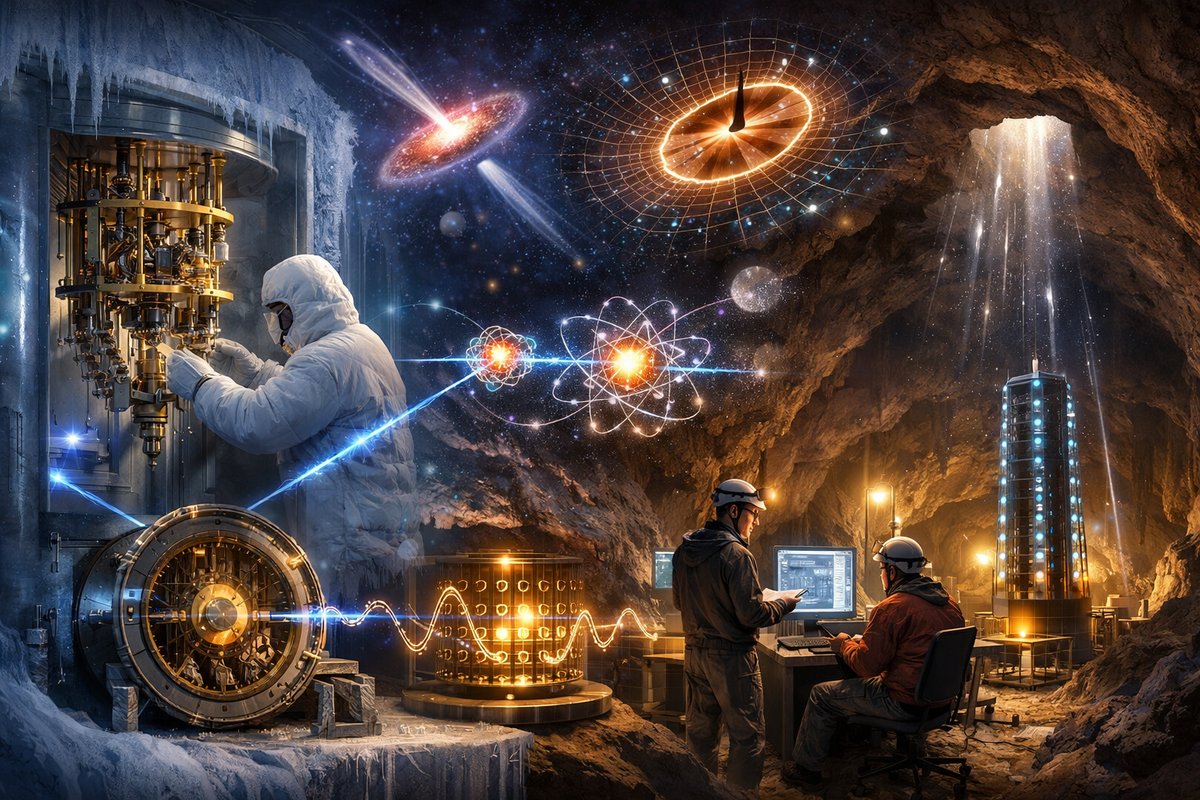
In labs from subzero chambers to deep underground caverns, scientists harness entangled atoms and ghostly particles to decode time's hidden patterns. New precision clocks, quantum phases, and cosmic ray observations join forces to unravel how time and matter intertwine, inviting us to reimagine reality.
A hush has fallen over the deep experimental halls where physicists now choreograph the dance of time itself. In one facility, beams of laser-cooled atoms drift in an optical lattice so stable that they lose only a second every 15 billion years. In another, ultracold crystals of ions pulse in rhythmic quantum states-so-called “time crystals”-that march out of step with the universe’s usual beat. Down in the subterranean caverns shielded by kilometers of rock, detectors await fleeting whispers from ghostly particles hurtling through Earth, remnants of cataclysms in distant stars.
These disparate efforts share a singular ambition: to pierce the veil between clockface precision and cosmic mystery. At the core lies a profound question that traces back to Newton, Einstein, and beyond: what is time, really? And how does the mass and entropy of matter shape the way we experience it?
Optical lattice clocks have advanced faster than anyone expected. By trapping neutral atoms in a grid of intersecting laser beams cooled to near absolute zero, researchers tune their ticking to frequencies millions of times higher than those in conventional microwave atomic clocks. The result is a stability so remarkable that the difference between two identical clocks could reveal the slight warping of time in a tall building. Teams in Europe and North America are racing to rewire global timekeeping, with potential applications from synchronizing next-generation GPS networks to enabling tests of fundamental theories of gravity.
Parallel to that, time crystals-once purely theoretical-have leapt from chalkboard equations into laboratory reality. These exotic phases of matter resist thermalization, maintaining a periodic oscillation even when driven by an external field. In effect, they keep ticking without absorbing energy the way ordinary materials would. Experiments using trapped ions and nitrogen-vacancy centers in diamond arrays have now demonstrated these persistent patterns. Though applications remain speculative, the discovery hints at future quantum devices capable of perfectly periodic memory registers or time-keeping elements immune to certain forms of noise.
Even more elusive are the neutrinos slipping through our planet by the trillions each second. Deep below the Swiss-French border, arrays of light-sensitive detectors watch for faint flashes when a neutrino collides with an atom of ice. Similar observatories at the South Pole and in the Mediterranean Sea scan for telltale Cherenkov radiation. By capturing neutrinos from solar fusion, exploding stars, and even Earth’s natural radioactivity, scientists piece together a portrait of matter under extreme conditions. The timing of those neutrino bursts can refine models of supernova dynamics and test whether these particles truly break time-reversal symmetry.
Closer to home, cloud chambers and cosmic-ray detectors are enjoying a renaissance among citizen scientists. Hobby kits allow curious minds to visualize trails from high-energy particles overhead, linking backyard observations to the deep-space phenomena that fuel our sun. That connection between amateur curiosity and professional investigation underscores a core truth: unraveling the fabric of reality often begins with a spark of wonder.
At the intersection of these threads, entropy looms as both villain and muse. As systems grow more complex, the arrow of time seems to march inexorably toward disorder. Yet quantum experiments reveal scenarios where correlations and entanglement push back against that arrow, at least locally and temporarily. Understanding how microscopic reversals of entropy emerge could shed light on long-standing puzzles-from the birth of cosmic structure after the Big Bang to the fate of information trapped inside black holes.
None of these experiments stands alone. Improved optical clocks feed data into global networks that compare time differences down to billionths of a second. Quantum time crystals inspire novel protocols for error-resistant qubits in emerging quantum computers. Neutrino observatories collaborate across continents to cross-validate signals and suppress background noise. Together, they form a tapestry of inquiry that knits time, matter, and mystery into a coherent narrative of scientific progress.
But beyond the equations and vacuum chambers, this story resonates on a human level. The shaping of new timepieces redefines our relationship to routine-imagine trains teleporting to exact schedules, financial systems trading on nanosecond scales, or virtual reality simulations that sync seamlessly with the physical world. And as neutrino bursts warn of distant supernovae, emergency systems might tap cosmic alerts to prepare for solar storms that disrupt power grids.
Even the poetic impulse finds sustenance here. Writers and artists have begun to draw inspiration from time crystals’ counterintuitive oscillations and neutrinos’ ghostly passage through matter. Exhibitions blend visual art with live data streams from cosmic observatories. Composers translate neutrino arrival times into musical sequences, creating symphonies shaped by stellar deaths billions of years ago.
Still, challenges remain. Building stable clocks in space demands radiation-hardened components and autonomous calibration. Scaling time crystals to larger systems requires new materials and fabrication techniques. Neutrino detectors must achieve greater sensitivity without ballooning costs or environmental impact. Each advance presses against technical and budgetary constraints, demanding ingenuity and collaboration across disciplines.
Sustainability is becoming a guiding principle, too. Researchers now seek to minimize energy consumption in ultra-low-temperature setups and recycle materials from retired quantum devices. Some labs are powered by renewable sources, aiming to align the quest for fundamental knowledge with stewardship of our planet.
Looking ahead, a suite of next-generation projects promises to deepen our grasp of time and matter. Plans for optical lattice clocks aboard satellites could map Earth’s gravitational potential in unprecedented detail, tracking sea-level rise and tectonic shifts. Proposed neutrino arrays under ice sheets in Greenland would expand our view of the high-energy universe. Quantum networks leveraging time-crystal protocols might one day form the backbone of a global quantum internet.
While these endeavors unfold, the boundary between observer and observed continues to blur. Every tick of an atomic clock, every flicker in a detector, and every oscillation of a time crystal reminds us that reality is not a static stage but a dynamic interplay of measurement and mystery. In probing the nature of time and the properties of matter, scientists are not just mapping the universe-they are inventing new ways to tell its story.
Our everyday lives may feel far removed from subatomic oscillations and subterranean observatories, but the ripple effects are already palpable. From enhanced precision in mobile communications to more accurate geophysical surveys and richer artistic collaborations, the fruits of these experiments touch us in subtle yet profound ways. We are living through a moment when time itself is a medium of innovation, and matter is a canvas for imagination.
As the latest results echo through journals and conference halls, one truth stands clear: the interplay of time, matter, and mystery will continue to surprise and inspire us. Whether in the pristine vacuum of an optical lattice or the dark silence beneath a mountain, the next breakthrough could emerge from where curiosity meets careful craftsmanship-and where the human desire to measure the universe finds harmony with the infinite possibilities of the quantum realm.