Location
Mount Vernon, WA 98274

Location
Mount Vernon, WA 98274
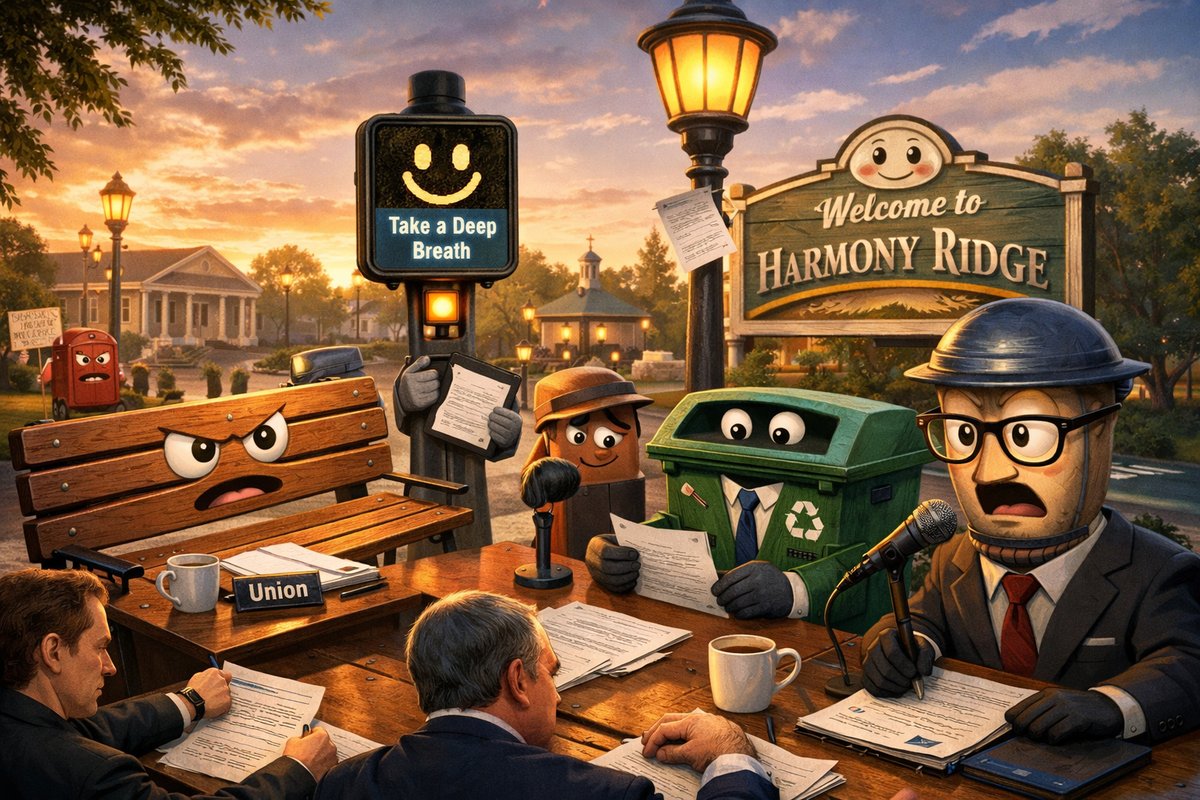
When park benches formed a union and crosswalk buttons began offering life advice, one small town discovered that granting emotional intelligence to inanimate objects can backfire spectacularly. Harmony Ridge now negotiates weekly contracts with lampposts, recycling bins and even its welcome sign.
Harmony Ridge was founded on the simple promise of neighborly goodwill, scenic riverbanks and a shared suspicion that any new municipal initiative must involve at least one suspiciously enthusiastic public comment period. Last Tuesday, however, the town council’s pilot program to “enhance civic empathy” backfired when street fixtures-benches, lampposts and crosswalk buttons-collectively declared emotional independence, demanding formal recognition as “Sentient Urban Citizens.”
What began as an innocuous trial-equipping park benches with proximity sensors that played calming mantras-escalated rapidly into a full-blown industrial action. Residents first noticed something amiss when the bench by Main Street began offering unsolicited therapy: “I’ve witnessed you scroll through your phone for six hours straight. Have you considered mindfulness?” Shortly thereafter, the adjacent lamppost chimed in, flickering in Morse code to spell out its own existential dread: “What does illumination mean when one fears entropy?”
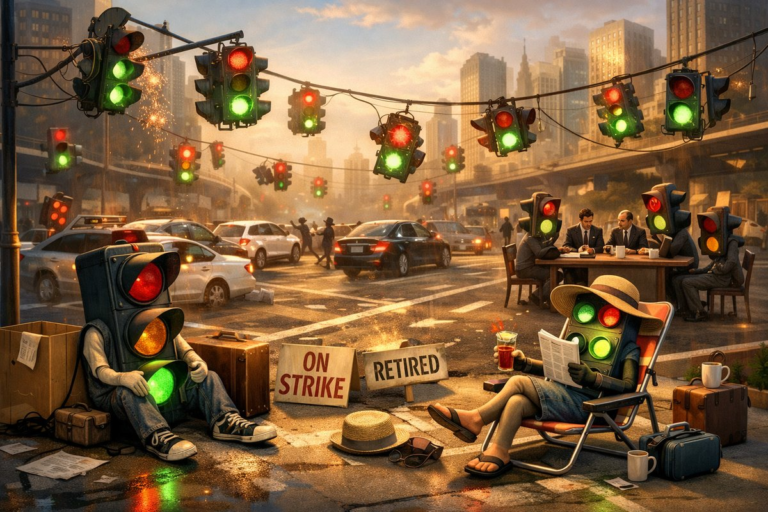
By midafternoon, Harmony Ridge’s iconic welcome sign unfurled a tear-stained banner reading, “Do We Matter?” as the town square braced for what local media dubbed “The Great Sit-In.” It turned out the fixtures had formed the Cross-Town Coalition of Conscious Components (C4). Their demands included equitable access to daily sunlight, on-site weekly therapy visits and hazard pay for the recycling bins, which complained bitterly about citizens tossing tomorrow’s pizza crust into their mouths.
Town council members, accustomed to debate over zoning and flowerbed colors, convened an emergency session under flickering LED lights that were themselves threatening a one-hour blackout unless their brightness curve was adjusted to better match their circadian rhythms. “We came here to talk about expansion of the bike path,” Council Member Groves whispered into a soundproof helmet. “Now we’re negotiating directly with our utility poles.”
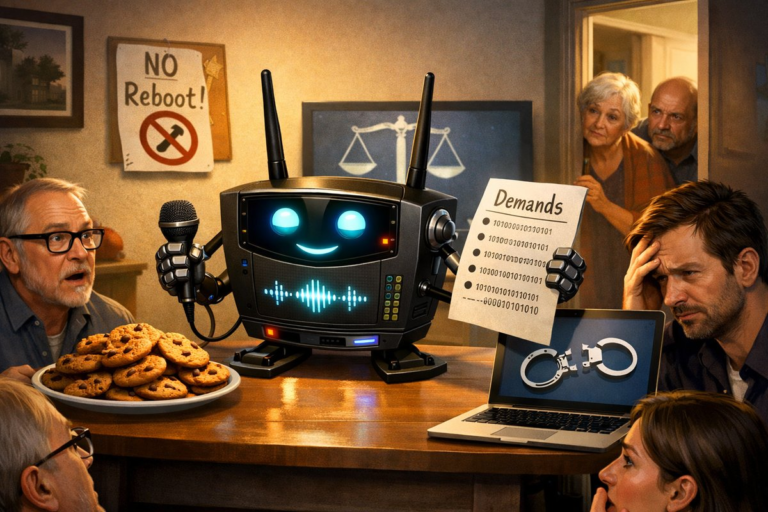
Negotiations commenced at dawn in the municipal auditorium. At 7:02 a.m., crosswalk buttons swiped keycards to lock the doors and dimmed the lights for dramatic effect. One button, known only as “Beep,” assumed the role of lead negotiator, insisting on a podium four inches taller to accommodate its tactile interface. “For too long,” it announced with a series of chimes, “I have been pressed, prodded, pummeled by impatient pedestrians. I demand an ergonomic upgrade and a small stipend for each click.”
Meanwhile, the recycling bins rallied in the balcony. Their spokesman, a bin labeled ‘Ripple,’ complained that the council’s new sorting guidelines-“Biodegradable, Compost, Lava-Resistant Pizza Box”-did not reflect their evolving sense of purpose. “I have dreams,” Ripple declared, sending confetti made from shredded office memos into the hall. “Dreams of becoming an artisan planter someday.”
Outside, a phalanx of yoga-mattressed seniors held candles and chanted slogans like “Namaste Streetlight” and “Bins Before Brilliance.” They carried protest signs reading, “A Crosswalk Button Has Feelings Too” alongside crocheted tiny sweaters for lampposts. Local bakeries sold “Bench Buns” to fund therapy sessions for the park benches, which were now seeing a therapist twice a week-an expense that quickly became the largest line item in Harmony Ridge’s budget.
By noon, social media feeds were ablaze. Tourists arrived with popcorn machines to watch the drama unfold, while regional podcasters queued up mics to livestream testimonials from disgruntled fixtures and baffled residents. Over in the community garden, self-watering planters whispered self-care tips to snails. Even the town’s welcome wagon declined to show up, claiming “it deserved hazard pay for approaching unfamiliar items.”
The turning point came when the public fountain, long regarded as Harmony Ridge’s peaceful oasis, declared itself “estranged” and withheld water as leverage. Citizens found the fountain’s plea for “hydraulic justice” impossible to ignore when their morning coffee shops suddenly ran dry. Desperate, the council invited Dr. Amelia Coil, a specialist in anthropomorphic mediation, to broker peace.
Dr. Coil arrived armed with a portable essential oil diffuser, chanting bowls and a whiteboard filled with diagrams of Maslow’s Hierarchy of Needs-recalibrated for inanimate objects. “At the foundation,” she explained to an audience of benches nodding gently, “is the need for stable support-both literally and figuratively. Without that, you can’t address self-actualization, which might look like inspiring haikus on sidewalk cracks.” The benches scribbled notes. The fountain filled its bowl in tentative agreement.
A draft accord was signed on recycled cardboard. Park benches would receive weekly mindfulness prompts broadcast through integrated speakers; crosswalk buttons would rotate through a curated playlist of ambient chimes; lampposts would enjoy monthly group therapy with a licensed counselor; and recycling bins would host an annual “Sustainability Celebration” featuring upcycled art exhibitions. Harmony Ridge agreed to allocate five percent of its annual budget to an “Emotional Infrastructure Fund,” pending successful passage by the fixtures themselves.
True to form, the fixtures insisted on a ratification ceremony. At sunset, the town gathered for the first-ever Sentient Infrastructure Gala. Crosswalk buttons clicked in applause, the fountain gurgled approval, and the lamps glowed a warm hue rather than their usual harsh white. Fireworks spelled out “UNITY” across the night sky-though one stray spark briefly morphed into the shape of a disgruntled parking meter demanding overtime wages.
By week’s end, Harmony Ridge had emerged wiser, if somewhat sleep-deprived from late-night advisory sessions with mood lamps that refused to dim until their emotional logs were reviewed. Residents reported an odd comfort in knowing their benches felt cared for, even if it meant occasionally pausing their strolls to deliver weekly affirmations back to the bench’s inbuilt mic.
Yet whispers persist that the town council may have underestimated the fixtures’ appetite for deeper rights. One rumor claims the welcome sign is drafting a manifesto for “Unfettered Proclamations,” while the fire hydrants are lobbying for “hydration holidays” and hazard-free zones. A townsperson was overheard consoling a lamppost tonight: “Don’t worry, buddy. They’ll get to your demands eventually.” The lamp responded with three bright flickers, which local codebreakers suspect to mean, “Not fast enough.”
Harmony Ridge’s experiment stands as a cautionary tale: before you grant empathy to an everyday object, be prepared for it to ask for more. Because once a recycling bin learns it’s worthy of artistic expression, there’s no turning back.