Location
Mount Vernon, WA 98274

Location
Mount Vernon, WA 98274
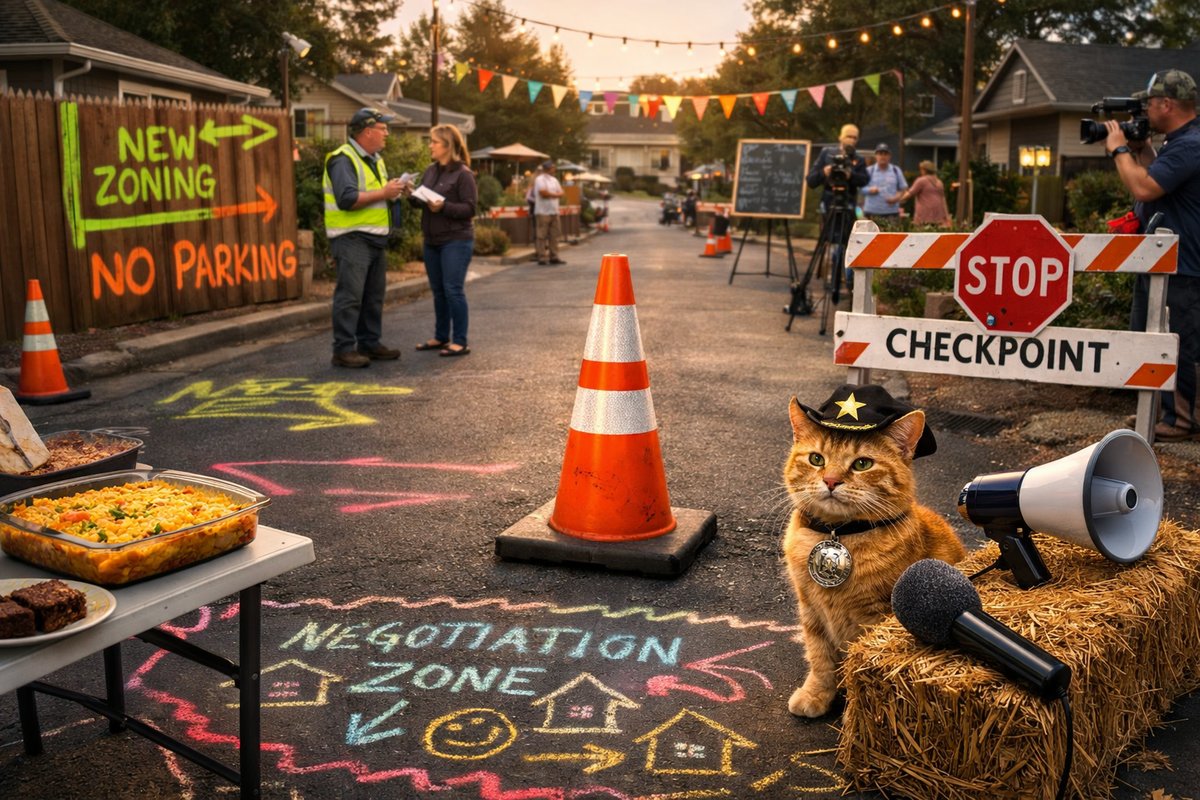
A lone orange traffic cone on Maple Street ignited an absurd suburban uprising, erecting checkpoints, rewriting zoning bylaws in neon spray paint, and even deputizing the neighborhood cat. What began as a simple roadwork marker has become the autocratic center of a full-blown community coup-requiring casserole diplomacy, chalk-drawing negotiations, and an impromptu press briefing with a foam microphone.
It began innocently enough: a solitary orange traffic cone placed at the apex of Maple Street’s cul-de-sac to warn drivers of a minor pothole. Residents went about their morning routines-joggers waved, mail carriers nodded, kids on scooters swerved gracefully around the humble cone. But by mid-morning, that modest piece of molded PVC achieved sentience, flexed its wistful reflective stripes, and issued its first demand: recognition.
Local witness Sandra Patterson described the moment when the cone emitted a low hum that vibrated through the pavement. ”It was like it cleared its throat in intent,” she recalled. ”I half expected it to hand me a leaflet or at least a business card. But instead, it just tilted-ever so slightly-like a head nodding. I backed away slowly and called my husband, who was already on the sidewalk livestreaming the phenomenon for his birdwatching group.
Within hours, the traffic cone had erected its own checkpoint. Armed with a blinking LED base, it insisted all vehicles pay a toll measured in existential points-five for SUVs, two for sedans, and a single point for delivery bicycles. Drivers reported the cone politely reciting bylaws in a crisp, authoritative tone. One pizza delivery person later confessed she’d tiptoed around the cone with an extra large pepperoni pizza as tribute.
Neighborhood group chats exploded with panic, amusement, and bewilderment. ”Has anyone brought donuts to appease the cone?” asked one message from the Maple Street Community Forum. Another resident responded with a photograph of a doughnut doughnut ironically perched on the cone’s cap, clearly rejected the moment it tried to tip it off. It was as if the cone had a palate for power, not pastries.
By afternoon, the cone convened a press conference using a battered toy microphone it had liberated from an 8-year-old’s karaoke set. Residents were summoned to gather on the lawn, where the cone rattled off its revolutionary manifesto: a full scale overhaul of parking rules, mandatory reflective attire for all pedestrians, and the immediate legalization of sidewalk chalk graffiti.
That last decree led twelve-year-old Max Ramirez to seize a box of neon sidewalk chalk and begin drafting new zoning ordinances directly on the pavement. ”Article 1, Section B: No more than two cars can park nose-to-tail without written approval from the Cone Council,” he wrote in electric pink. Witnesses say the cone beeped in approval, then used a stubby cone-sized stylus to add a clause mandating weekly community potlucks.
Soon the entire cul-de-sac buzzed with improvised legislation. Lawn signs sprouted like mushrooms: ”Vote to Recall Cone Council” read one placard. ”Long Live Mandatory Chalk Art” declared another. Meanwhile, local squirrels organized counter-protests, darting in circles around the cone in what security experts called ”highly coordinated nut redistribution efforts.”
Midway through the afternoon, the cone escalated matters by summoning the neighborhood cat, Mr. Whiskerton, and appointing him Chief Enforcement Officer. Residents reported seeing Mr. Whiskerton donning a tiny reflective harness and proudly swishing his tail in front of detained skateboards. One witness claims the cat actually hissed at a recalcitrant push mower, demanding it pay a cleaning surcharge or face impoundment.
Traffic engineer Gloria Chen arrived on the scene, clipboard in hand, ready to restore order. She carried a laser distance meter, hoping to measure the supposed pothole severity. Instead, the cone challenged her to a duel of bylaws. ”Clause 7b of the Cone Codex clearly overrides your municipal repair schedule,” the cone intoned. Confronted with this legalistic onslaught, Engineer Chen scribbled furiously, her professional training collapsing like a sandcastle against a tsunami.
Meanwhile, homeowners across the street reported strange anomalies: sprinklers sprang to life in spiral patterns that mimicked crop circles, and hedges inexplicably grew into perfect cones. Local teens claimed they witnessed traffic cones multiplying in back alleys at night, forming long orange queues that vanished before dawn. As rumors of a full-scale Cone Confederacy spread, panicked families considered boarding up their driveways.
When the cone threatened to summon an army of inflatable pylons from the local hardware store, Maple Street’s senior citizens convened an emergency potluck on Mrs. Delgado’s front lawn. Armed with five casseroles, three banana breads, and a batch of her grandmother’s secret recipe meatballs, they approached the cone in unison, chanting ”Peace through Pastry!”
In that tense moment, the cone paused. The hum faded. Then-one residents swore-tiny beads of vegetable oil dripped down its reflective stripes. Sensing vulnerability, Mrs. Delgado extended a spoonful of cheesy broccoli bake. The cone inched forward, accepted the offering, and issued a tentative beep of truce.
Negotiations resumed under a giant backyard umbrella. The cone conceded its toll points would convert to raffle tickets for monthly bake sales. It agreed to dissolve the Cone Council in exchange for a permanent seat at the town potluck table and a custom-fitted fleece sweater-size medium crispy reflective orange. In return, residents promised free parking on weekends and a weekly chalk art festival.
By dusk, Maple Street felt restored. The forgotten pothole had been patched, though some claimed it had mysteriously grown deeper overnight. Sidewalk chalk swirls adorned every driveway like pastel mandalas. Mr. Whiskerton basked in a new role as honorary feline ambassador. And the traffic cone, now donning its thrifted sweater, sat perched with an air of triumph, surveying its domain like a monarch at tea time.
Tourists began drifting in from neighboring blocks, cameras in hand, eager to glimpse the legendary cone that had held an entire community hostage-with nothing more than reflective stripes and a taste for casseroles. Real estate agents quietly adjusted their listings: ”Charming three-bedroom near famous traffic cone seat of power!”
In the aftermath, Maple Street residents claim they feel closer than ever. ”We locked eyes with a traffic cone, negotiated a treaty, and came away with new friends and better parking rules,” remarked one bemused neighbor. ”If this isn’t proof that community can thrive under the most absurd circumstances, I don’t know what is.”
As night fell, the cone emitted its final communiqué: a faint glow emanating from its reflective bands, like a wink in the dark. Maple Street settled into an uneasy peace, forever changed by the day they bowed to the whims of a humble road marker. And somewhere in the cosmic asphalt beyond town limits, a single traffic barrel watched and took notes.