Location
Mount Vernon, WA 98274

Location
Mount Vernon, WA 98274
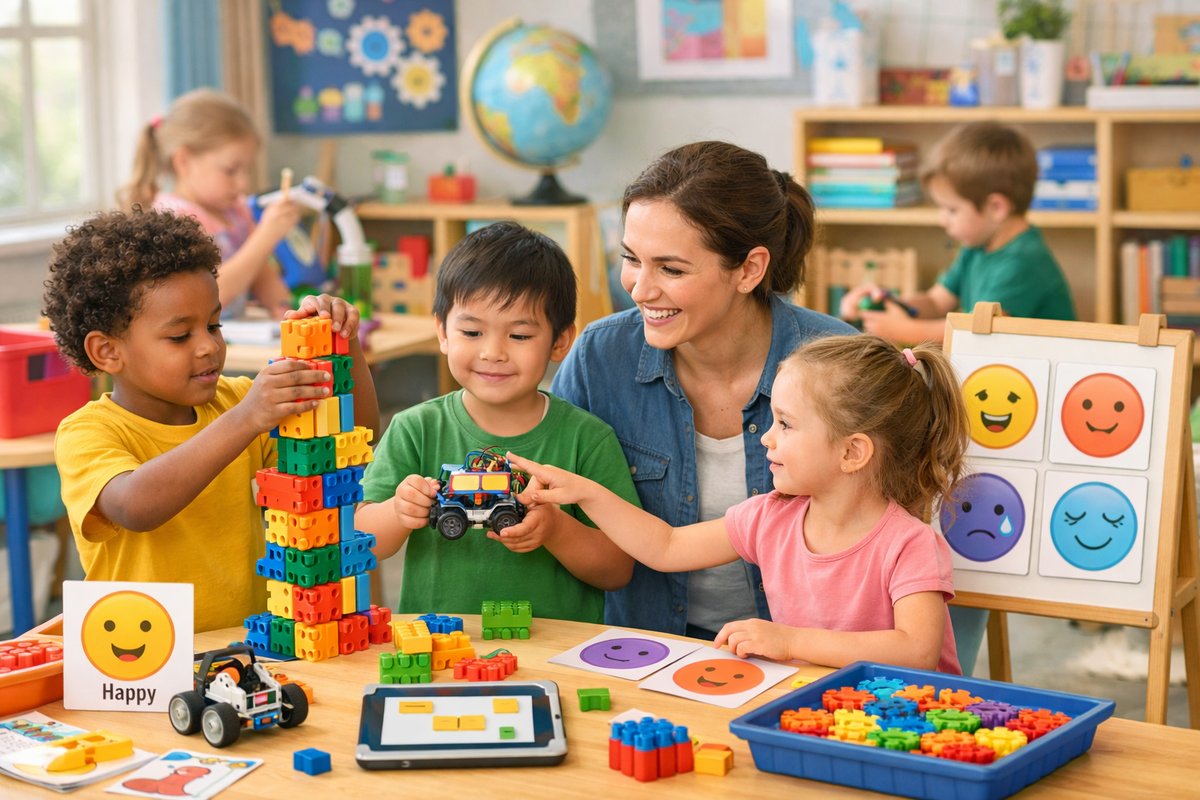
A sweeping new program is equipping preschool and elementary classrooms with tools that combine STEM exploration and social-emotional learning, empowering children to build towers and express feelings in equal measure. Educators and families report that when young learners link creative play with emotional vocabulary, curiosity and confidence flourish.
A coalition of educators and child development specialists has rolled out a groundbreaking initiative designed to merge hands-on STEM learning with social-emotional education in early childhood settings. Backed by a federal innovation grant and piloted in diverse districts, the program brings together wooden construction blocks, sensory activities, and guided discussions on emotions. Organizers say the combination helps children develop both critical thinking skills and the language to describe their inner experiences. The goal is to foster agency and empathy, nurturing the next generation of problem solvers who are also emotionally literate.
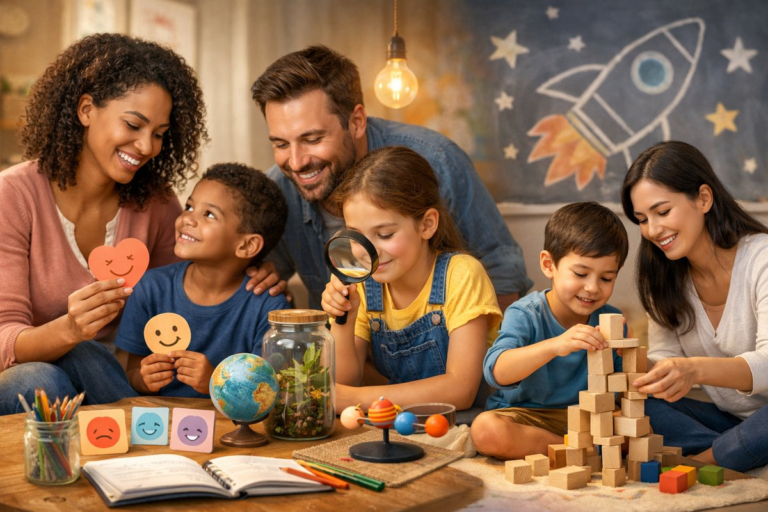
In classrooms from urban charter schools to rural preschools, teachers are introducing mixed-media activity stations where building towers sits alongside an emotion-recognition corner filled with picture cards and story prompts. One pilot site converted a section of the room into a “discovery zone,” complete with balance scales, colored counters, and feelings magnets that stick to a board whenever a child names an emotion. Educators report that students eagerly rotate between testing weight and volume one moment and mapping out story characters’ reactions the next. This fluid shift from STEM play to emotional check-ins is reshaping the learning environment into a holistic workshop.
Parents have taken note of these changes at home. Many describe children coming off the bus brandishing blocks, excitedly detailing how they calculated the height of a tower and then role-played a scenario in which one block “felt wobbly.” Stories of kids pausing mid-Lego session to ask a sibling how they feel are becoming commonplace. One mother shared that her daughter now refers to her “courage” when trying a new puzzle, and praises herself for patience when it doesn’t click right away. These small shifts in language reflect larger breakthroughs in emotional agency and self-regulation.
Research supports the synergy between social-emotional skills and academic performance. Studies from leading education journals have found that children equipped with emotional vocabulary and self-management strategies demonstrate better concentration, improved math outcomes, and stronger peer relationships. A meta-analysis published in a major educational review showed that when early learners engage in activities that explicitly combine problem solving with emotion reflection, behavior incidents drop by nearly 25 percent and spatial reasoning scores climb by 15 percent. Program leaders cite this evidence as the foundation for their integrated curriculum.
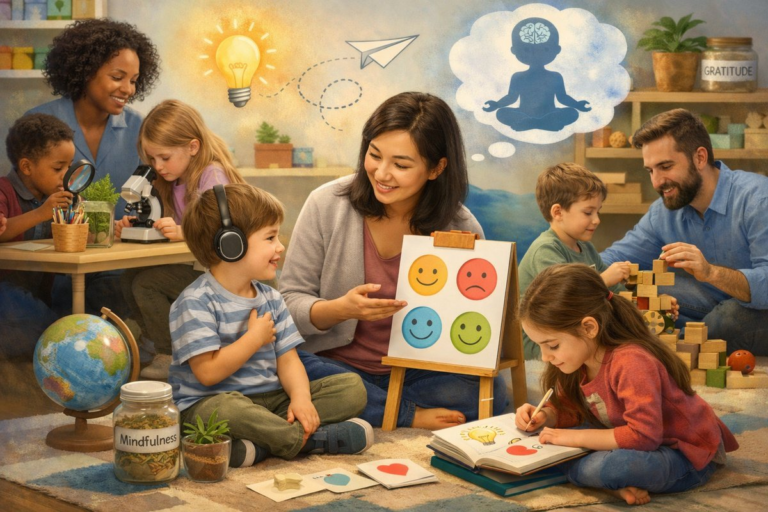
Classroom toolkits include several modular components that teachers can adapt to different age groups and abilities. Emotion recognition flashcards feature expressive illustrations paired with simple words like “proud,” “surprised,” and “frustrated.” Sensory bins stocked with rice, beans, and miniature scoops invite experimentation with volume and texture. Story mats printed with scenes from everyday life prompt small-group role-play, guiding children to act out scenarios that require cooperation or turn-taking. Each element is paired with open-ended questions designed to encourage reflection: “How do you think this character feels? What could help them calm down?”
Digital supplements provide another layer of engagement, although screen time remains limited by design. Child-friendly educational tablets come preloaded with interactive coding puzzles, virtual building challenges, and animated storybooks that pause to ask kids how a character might feel. Developers emphasize that these apps aren’t meant to replace hands-on play; rather, they support pattern recognition, sequencing skills, and emotional literacy in bite-sized segments. Educators receive guidelines on balancing screen-based tasks with offline activities, ensuring technology serves as a bridge rather than a barrier.
Community workshops offer parents and caregivers a chance to try out the tools alongside their children. One evening event transforms a school library into a mini maker space, with stations for planting seeds, testing paper bridges, and breathing exercises accompanied by calming music. Family teams rotate through guided rounds, first building a simple structure with dowels and connectors, then taking a moment to share how they felt when it wobbled or stood firm. Organizers say these joint experiences strengthen family bonds and reinforce the idea that learning is both a mental and emotional journey.
Child development experts highlight that fostering agency and empathy in young learners lays a foundation that extends beyond the classroom. When children understand their own emotions and recognize them in others, they become better communicators and collaborators. A developmental psychologist involved with the initiative explains that early emotional competence correlates with higher resilience in the face of setbacks-whether a math problem they can’t solve or a playground conflict. By weaving emotion talk into hands-on challenges, educators hope to nurture adaptable thinkers who can navigate complex social and academic situations.
Implementing an integrated curriculum isn’t without challenges. Schools serving high-poverty communities often lack resources for new materials, and teacher training requires both time and funding. Some educators worry that adding emotional check-ins might displace core literacy or numeracy instruction. Program administrators respond by embedding social-emotional activities into existing lesson plans rather than tacking on separate units. Professional development sessions model quick, two- to five-minute prompts that can slot into circle time or transitions, making it easier for teachers to adopt the approach without sacrificing instructional time.
For families seeking to bring these innovations home, experts suggest starting with simple, low-cost materials. A set of open-ended building blocks can spark engineering questions, while a small deck of emotion cards encourages conversations about feelings. Parents can create DIY sensory trays using rice or pasta they already have in the pantry. Story time becomes an opportunity to pause and ask, “Why do you think that character acted that way?”-linking narrative comprehension to emotional insight. These small steps help bridge school and home, creating a consistent environment for growth.
Early reports from the pilot sites show encouraging results: improved classroom engagement, fewer behavior disruptions, and increased parent-teacher communication. Students are not only mastering foundational math and science concepts but also articulating when they feel confident or overwhelmed. One school principal describes it as a cultural shift: “Our hallways hum with curiosity, but the conversations are different now. I hear children asking each other, ‘Are you feeling okay?’ as often as they say, ‘Can I try one more time?'”
As the initiative broadens to new districts next year, organizers plan to publish a detailed toolkit for educators and host online forums where teachers can share best practices. They’re also partnering with local libraries, museums, and after-school programs to extend learning beyond school walls. The ultimate vision is a generation of learners who approach challenges with both analytical tools and emotional insight. In these classrooms, curiosity isn’t measured solely by the number of questions asked but also by the depth of reflection on how each question feels to tackle.