Location
Mount Vernon, WA 98274

Location
Mount Vernon, WA 98274
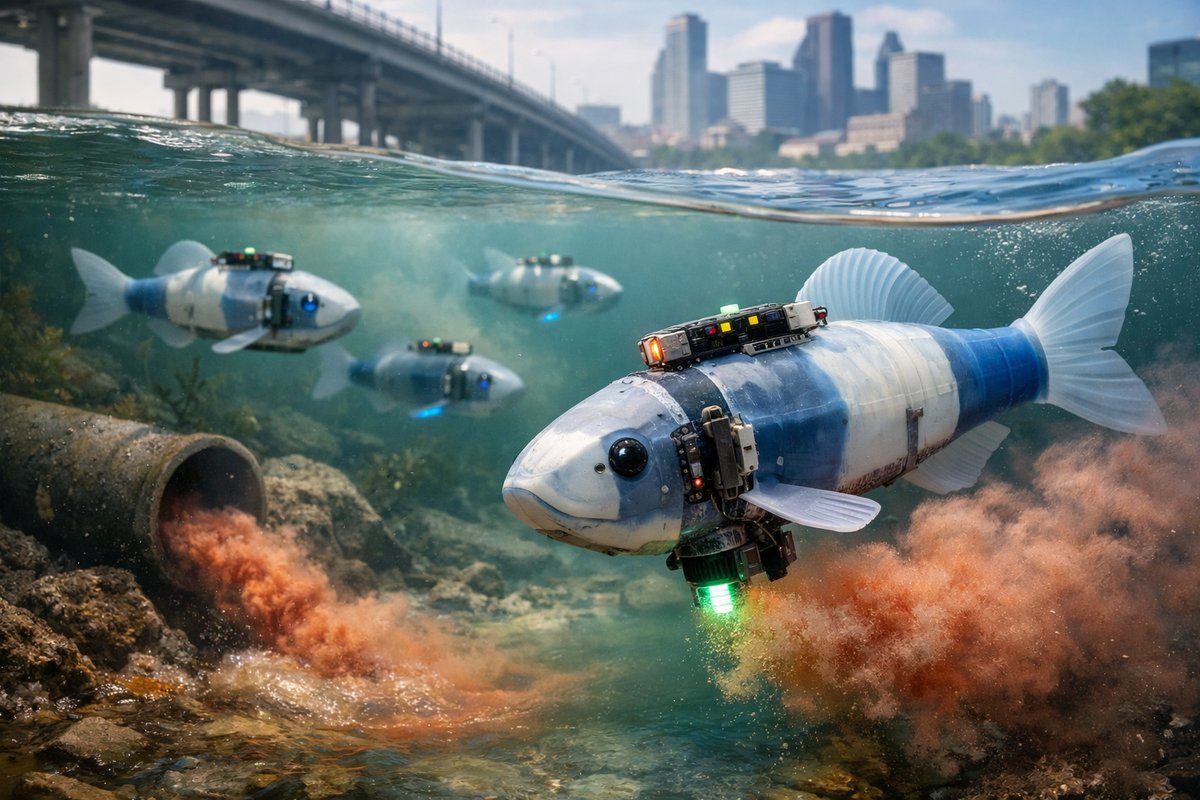
A fleet of soft robotic fish equipped with chemical and optical sensors is probing urban estuaries to chart pollutant plumes in real time. By combining flexible silicone actuators, microcontroller-based control systems, and machine learning for data analysis, researchers are opening a new chapter in noninvasive environmental monitoring.
Estuaries where rivers meet the sea are critical ecosystems that support diverse wildlife and serve as natural filtration systems for pollutants carried downstream from cities. Yet these dynamic environments have long resisted detailed mapping due to shifting currents, delicate habitats, and the logistical hurdles of sampling over wide areas. Now, a multidisciplinary team of engineers, marine biologists, and computer scientists has unveiled a fleet of soft robotic fish-nicknamed “River Guardians”-designed to glide through murky waters and chart real-time maps of chemical and particulate contamination without harming fragile organisms.
The concept merges advances in soft robotics, environmental sensing, and data analytics. At its heart, each River Guardian is wrapped in a layer of flexible silicone actuators that mimic the undulating motion of real fish. Unlike rigid underwater vehicles, these pliable drones can navigate close to submerged vegetation, maneuver through narrow channels, and absorb minor impacts without damage. Inside the soft hull, a compact microcontroller system orchestrates fin movements, powers onboard sensors, and records readings at up to 10 samples per second.
The sensor array blends standard and bespoke modules. A pH probe measures acidity fluctuations caused by urban runoff, while a turbidity sensor tracks suspended sediment from stormwater overflows. An optical dissolved oxygen sensor detects zones of hypoxia that threaten aquatic life. In field tests, additional modules were swapped in, including nitrate and phosphate sensors to pinpoint nutrient hotspots linked to algal blooms. Each reading is timestamped and geo-tagged via an integrated GPS receiver and pressure transducer, ensuring accurate three-dimensional positioning in the water column.
Power comes from a rechargeable lithium polymer battery pack that provides up to four hours of continuous operation. A wireless charging coil built into a docking station allows the robots to autonomously return to floating recharge hubs when their batteries dip below 20 percent. Data uplink uses a low-power acoustic modem that sends compressed summaries back to a shore-based command center. Scientists monitor status dashboards, deploy additional units as needed, and download high-resolution datasets when individual robots surface near the dock.
During a month-long pilot in a heavily industrialized estuary, a squadron of eight River Guardians crisscrossed 12 square kilometers of waterways. The resulting maps revealed narrow filaments of high turbidity tracing older factory outfalls and pockets of elevated nitrates near agricultural fields upriver. Curiously, the robots detected transient spikes in acidity early each morning, suggesting underexplored chemical reactions in shallow wetlands at dawn. These insights allowed local environmental managers to reroute stormwater diversions, adjust timing of dredging operations, and target remediation efforts on specific pollution sources.
Underwater footage captured by an onboard monocular camera also offered ecological context. Countless schools of baitfish darted away from plumes of sediment stirred up during heavy rains, and submerged aquatic vegetation appeared bleached in nutrient-rich hotspots. By overlaying sensor data on video, researchers could correlate physical stressors with biological responses, laying the groundwork for predictive models of ecosystem resilience.
Beyond pollution mapping, the soft robotic design holds promise for a range of applications. Planned upgrades include adding microfluidic sampling modules that can collect small water volumes for DNA analysis, enabling the detection of invasive species or microbial pathogens. Teams are also exploring deploying fleets in mangrove swamps, coral lagoons, and urban canals, where low-impact vehicles can gather crucial data without disturbing sensitive habitats.
On the software side, a machine learning pipeline is under development to automate anomaly detection. Instead of reviewing hours of sensor logs manually, algorithms will flag unusual chemical signatures, sudden turbidity jumps, or unexpected temperature gradients. Early tests suggest the system can detect subtle pollution events-like a small illicit discharge from a poorly maintained industrial site-within minutes of occurrence.
This fusion of soft robotics and environmental science underscores a broader trend toward distributed, autonomous monitoring networks. Traditional sampling methods-grab bottles, stationary buoys, or crewed boats-offer valuable snapshots but often miss rapid changes or localized events. With swarms of agile robotic sentinels, researchers can maintain near-continuous surveillance over extensive areas, democratizing data access for regulators, conservation groups, and citizen scientists alike.
Challenges remain. Battery life limits mission duration, acoustic communications can be hampered by ambient noise, and microcontroller hardware must survive biofouling and high salinity. Yet modularity is built into the design. Components can be swapped, sensors upgraded, and control algorithms refined without redesigning the entire platform. Open-source software and 3D-printable hull designs are already available on collaborative repositories, inviting contributions from hobbyists and educational labs.
Looking ahead, the River Guardian program hopes to integrate solar panels on surface-skimming variants, extend operational range via wireless underwater charging, and miniaturize propulsion systems for rapid deployment in narrow creeks. As fleets scale up, scientists envision an interconnected mesh of soft robotic probes streaming real-time environmental intelligence-a liquid digital twin of complex aquatic ecosystems.
In an era of mounting ecological pressures, these silent sentinels offer a noninvasive window into the hidden lives of waterways. By tracing pollutant plumes, charting oxygen dynamics, and illuminating the interplay of chemistry and biology, soft robotic fish could help safeguard the delicate balance of estuaries worldwide.
As the River Guardians glide through urban rivers and coastal marshes, they carry a simple promise: to reveal what has long been invisible, and in doing so, empower communities to protect their most vital natural resources.