Location
Mount Vernon, WA 98274

Location
Mount Vernon, WA 98274
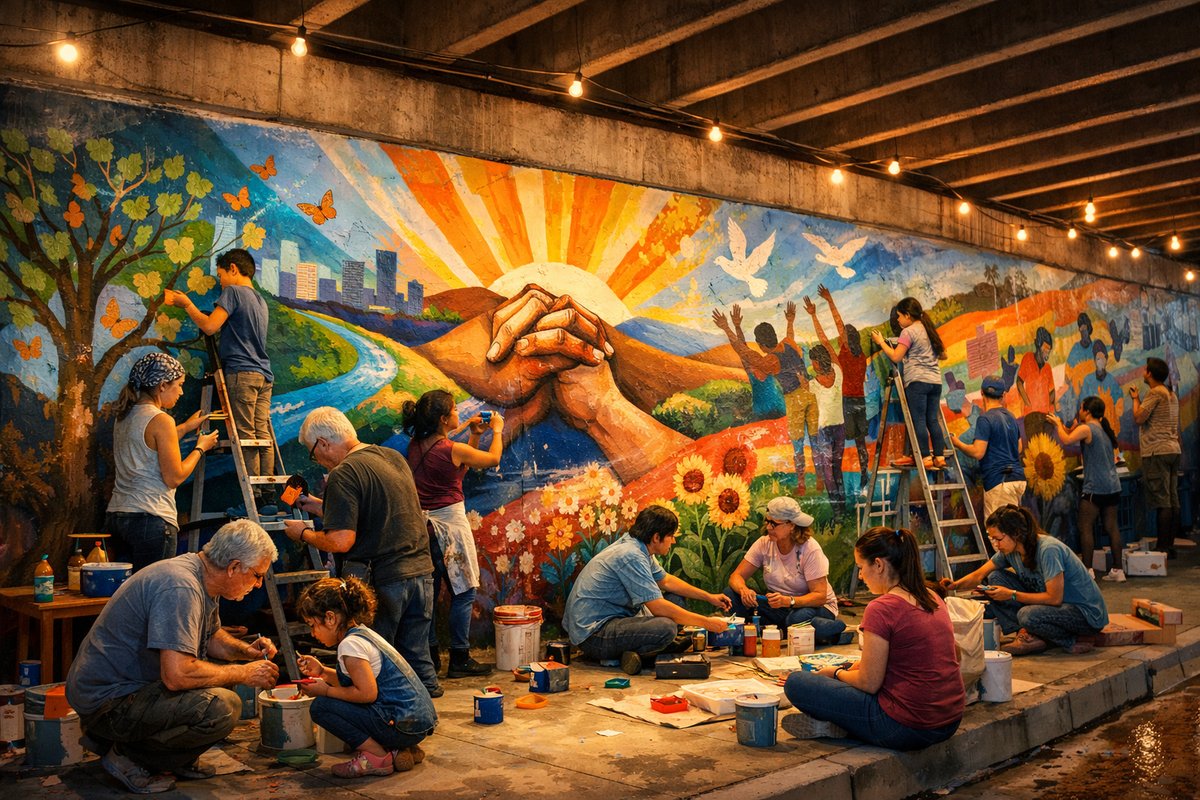
A once-forgotten underpass has been transformed into a living canvas of hope as hundreds of residents came together to paint a mural reflecting their shared journey of resilience. Through volunteer workshops, late-night painting sessions, and cross-generational collaboration, a divided neighborhood has discovered new bonds and a renewed sense of purpose.
In the heart of a neighborhood long marked by faded storefronts and crumbling sidewalks, an abandoned underpass has become the site of an extraordinary community effort. Over the past six months, local residents, artists, students, and business owners have joined forces to turn blank concrete walls into a sweeping mural that tells the story of their collective struggles, dreams, and unwavering spirit.
The project began when a group of passionate volunteers approached the city council with a simple proposal: restore the underpass with a public artwork that could serve as both a visual landmark and a rallying point for neighborhood pride. Cracks in the pavement had become a meeting place for restless youth, and the tunnel’s dim interior was often avoided after dusk. Yet the volunteers saw potential beneath the decay-a chance to spark transformation not only in the brick and mortar but also in human connections.
“This wall was speaking to us,” says one organizer, recalling their first walkthrough of the site. “It wasn’t just concrete-it was a blank page asking for our stories.” The city granted a modest grant to cover supplies, and local businesses donated brushes, safety cones, and even coffee to keep painters energized. From the outset, project leaders emphasized openness: everyone in the neighborhood was welcome, regardless of age, background, or artistic ability.
Weekly workshops in a nearby community center drew newcomers who had never held a paintbrush. Under the guidance of two professional muralists, participants learned fundamentales like color mixing, brush techniques, and how to prepare concrete surfaces for long-lasting artwork. Teenagers who once passed time on their phones found themselves sketching outlines, while retirees discovered fresh purpose as they retouched faded lines and filled broad swaths of sky-blue.
As the design took shape on graph paper, volunteers debated which symbols best captured community identity. Some pushed for images of local landmarks-an old mill, a century-old oak tree-while others suggested portraying collective experiences: scenes of harvest festivals, children playing in rain puddles, grandparents sharing stories on porch steps. Eventually, the mural unfolded as a visual timeline, beginning with the neighborhood’s early days as a settlement of immigrants, moving through periods of economic hardship, and ending in a vibrant swirl of colors representing hope for the future.
Challenges were plentiful. A heavy spring rainstorm washed away days of work on one section, forcing volunteers to strip off layers of damaged paint and start over. During sweltering summer afternoons, artists paused to wipe sweat from their brows and offer water bottles to passersby. Skeptics occasionally circulated rumors that the mural would attract vandalism or serve as a canvas for unwelcome graffiti. But each time doubt arose, someone else stepped forward-providing extra lighting, coordinating nighttime guard shifts, or simply offering words of encouragement.
By mid-summer, the underpass had become an open-air studio. On one side, three middle school students delicately painted a pair of intertwined hands symbolizing unity. On the other side, a group of older adults tackled a sweeping scene of a phoenix rising from ashes, a motif many said mirrored their own personal and collective struggles through layoffs, gentrification pressures, and family illnesses. Children on their way home from school frequently paused to watch the colors come alive, sometimes grabbing a scrap of chalk to add a small doodle before being gently redirected toward the main design.
For many participants, this was more than a creative outlet-it was a form of therapy. One resident described how working on broad brushstrokes helped soothe anxiety after a recent job loss. Another shared that the sense of teamwork reminded her she was not alone in caring for an ailing parent. Volunteers say they witnessed surprising friendships form across lines that once seemed unbridgeable. A high school senior from a rival neighborhood league found common ground with a grandmother who had lived on the block for decades. Conversations about art nurtured deeper discussions about school safety, mental health resources, and community gardens.
Local shop owners reported a steady uptick in foot traffic as people visited the mural site. A coffee cart set up at the underpass entrance, offering free warm drinks on chilly mornings and cold lemonade on hot afternoons. Buskers added a soundtrack of acoustic guitar and gentle percussion, turning the space into an impromptu cultural hub. On weekends, outdoor yoga instructors led free sessions in the dimly lit tunnel, their sun salutations illuminated by strings of safe, battery-powered lights strung overhead.
Last month, volunteers held a grand unveiling. Dozens of residents lined up to glimpse the finished work, snapping photos with smartphones and pointing out favorite details. A historian from a nearby museum spoke briefly about the mural’s significance, emphasizing how art in public spaces can foster civic pride and spark dialogue. Teenagers dabbed small splashes of paint onto paper ballots, voting for the next neighborhood initiative: a block-wide poetry festival, an alleyway herb garden, or an outdoor screening series of classic films.
In the days since the unveiling, several schools have scheduled field trips to the mural, using it as a teaching tool for local history and visual storytelling. A neighborhood watch group meets monthly beneath the painted arches, discussing safety and organizing community clean-ups. The graffiti that once marred the walls has all but disappeared, replaced by the mural’s vibrant imagery and the promise that someone truly cares about this shared space.
Looking ahead, project leaders hope to replicate the model in other parts of the city. They are drafting a “Mural Playbook” guide that outlines best practices-from securing permits and insurance to rallying volunteers and securing materials. They envision a network of painted corridors that link parks, schools, and public transit stops, creating a ribbon of art and hope binding neighborhoods together.
At its core, the mural stands as a testament to the power of art to heal and unite. It was born from a desire to reclaim neglected territory, but its true achievement lies in the relationships forged during brushes of paint, laughter shared over spilled buckets, and the collective belief that renewal is possible. In a world often fractured by difference and distrust, this mural reminds us that when people commit to a shared vision, even the plainest concrete can become a beacon of inspiration.
In the weeks to come, residents will continue to add finishing touches, swap stories about their favorite panels, and plan new gatherings under the painted arches. The underpass, once a symbol of neglect, now pulses with energy-a daily reminder that hope, like paint, can cover stains both visible and unseen, leaving a brighter canvas for all to admire.