Location
Mount Vernon, WA 98274

Location
Mount Vernon, WA 98274
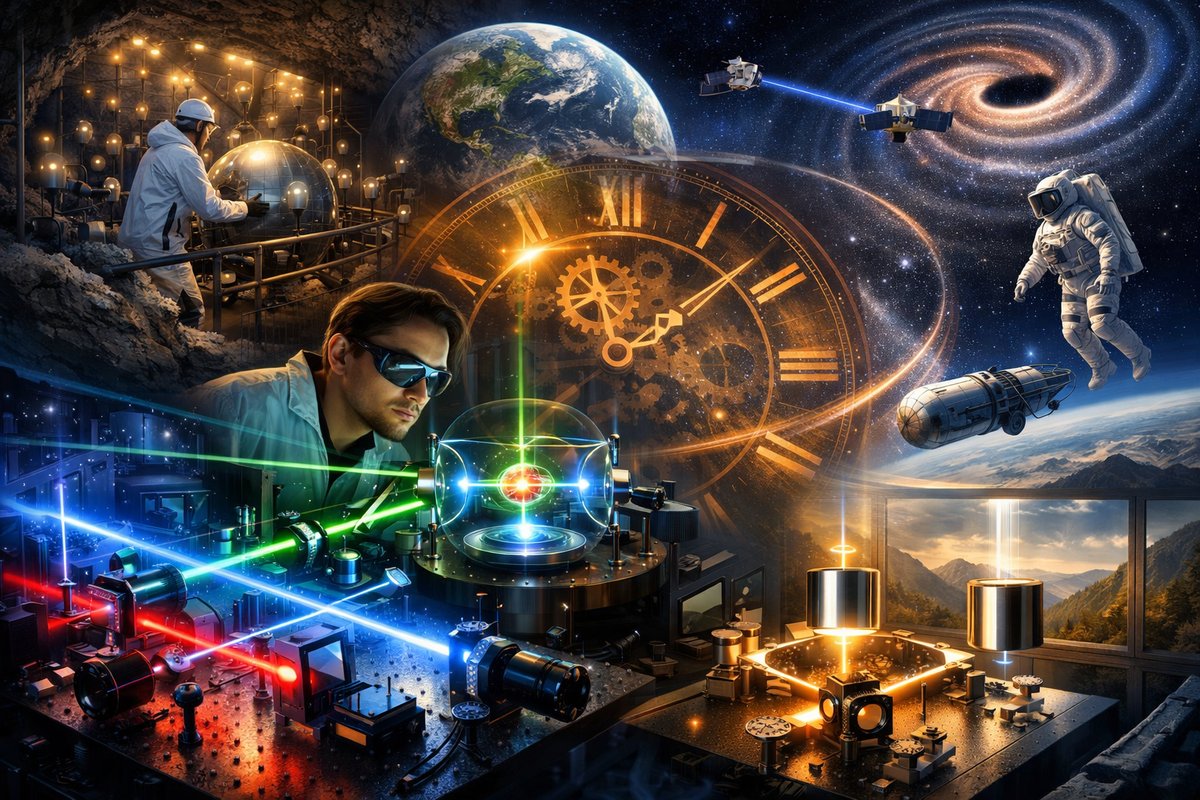
Scientists around the globe are deploying ever-more precise clocks, lasers, and detectors to probe the hidden interplay between time and matter. From underground observatories to space-based interferometers, these experiments promise to reshape our understanding of reality-and may eventually transform how we experience the flow of seconds and the weight of things.
The universe keeps its deepest secrets in plain sight: the relentless march of time and the invisible scaffolding of matter. Across laboratories and observatories, researchers are marshaling unprecedented tools to track shifts in atomic vibrations, detect the faintest ripples in spacetime, and weigh shadowy particles that could account for dark matter. These efforts blend high-precision engineering with cosmic-scale ambition, forging new connections between fundamental physics and the narratives we tell ourselves about past, present, and future.
In metrology centers, optical lattice clocks have become the crown jewels of temporal measurement. By trapping clouds of ultracold atoms in a grid of laser light, these devices now tick so steadily that they would lose or gain no more than a second over the lifespan of the solar system. Teams are already comparing clocks separated by just a few kilometers to map how local gravitational fields slow time itself-a real-time realization of Einstein’s predictions. Such experiments could one day refine satellite navigation, making GPS accurate at the centimeter level and enabling autonomous vehicles to chart courses through bustling cities with near-zero latency.
Meanwhile, gravitational wave observatories are preparing to upgrade their laser interferometers, pushing sensitivity to the point where even the gentle thrum of cosmic turbulence in distant galaxies might be audible. Future facilities plan to suspend mirrors inside vacuum chambers cooled to near absolute zero, reducing thermal noise that currently masks low-frequency signals. As detectors reach farther back in cosmic time, scientists hope to capture the signature of primordial events-perhaps the first tremor of inflation or the echoes of a cosmic phase transition that split forces apart in the infant universe.
On a smaller scale, high-intensity laser experiments are probing the vacuum itself. By colliding pulses that pack more energy into a speck of space than the surface of the sun, researchers aim to coax virtual particles out of emptiness and test quantum predictions under extreme conditions. These tabletop accelerators could complement massive particle colliders, opening a new frontier in the study of dark sector forces-hypothetical interactions that might explain why galaxies rotate faster than their visible mass allows.
Deep underground, in caverns carved from ancient rock, massive tanks of liquid xenon and argon await faint interactions with elusive dark matter particles. Shielded from cosmic rays by kilometers of earth, these detectors are tuned to spot the faint flashes produced when a passing particle delivers a tiny kick to an atomic nucleus. Though no definitive dark matter signal has emerged, each null result narrows the field, ruling out candidates and guiding theorists toward new models. The interplay of theory and experiment here reflects a humbling dance: as particles evade capture, our picture of the invisible universe grows sharper in the negative.
Far above our planet, an array of microwave telescopes is tuning its antennas to the cosmic microwave background-the afterglow of the Big Bang. New focal plane arrays boast tens of thousands of superconducting sensors, ready to map the polarization of faint relic photons with unprecedented resolution. Such measurements could reveal subtle imprints left by gravitational waves from inflation or uncover anisotropies seeded by exotic matter fields. In turn, those findings would inform laboratory searches, pointing them toward specific mass ranges or interaction strengths.
Entropy, often framed as the arrow of time, unites these inquiries. As clocks become more precise and detectors more sensitive, researchers are effectively charting the universe’s march toward disorder and deciphering how pockets of organization-stars, galaxies, life-emerge against overwhelming odds. The paradoxical relationship between order and chaos animates both cosmic history and human experience, fueling a growing dialogue between physicists and philosophers about the nature of causality, information, and free will.
The ripple effects of these efforts already ripple into everyday life. Quantum sensors designed to track minute magnetic fields are finding applications in brain imaging and mineral exploration. Ultra-stable lasers, once confined to physics labs, are revolutionizing telecommunications and data centers by synchronizing clocks across continents. Even public art installations are tapping atomic timekeepers, creating immersive experiences where visitors witness time dilation in real time as they move through simulated gravity wells.
As the quest continues, a new generation of scientists is being drawn to the frontier. Graduate students code algorithms to sift through petabytes of data from cryogenic detectors, while engineers design cryocoolers that keep sensors cold without bulky infrastructure. Outreach programs bring these concepts to classrooms, letting high schoolers build toy interferometers or explore virtual reality environments that illustrate spacetime curvature. Such hands-on engagement nurtures curiosity and underscores that the boundaries between fundamental research and human story are porous.
The search for dark matter has inspired proposals for space-based detectors orbiting beyond Earth’s magnetic cocoon. By operating in microgravity, these instruments could increase exposure time and reduce background noise. Combined with ultra-precise timekeepers, they may one day form a distributed network-an interplanetary lab-to test whether the passage of time itself varies across the solar system. If successful, this endeavor would merge cosmic exploration with metrology, threading humanity’s curiosity through the fabric of spacetime.
Meanwhile, next-generation particle colliders remain under design review. Whether they take the form of gigantic rings buried beneath countryside or linear accelerators stretching toward the horizon, their mission is to recreate conditions a trillionth of a second after the Big Bang. By producing heavy, short-lived particles, they could illuminate the mechanisms that gave mass to matter in the earliest epoch. Those insights would feed back into clock design, since the same interactions govern the stability of atomic energy levels that underpin precise timekeeping.
Ultimately, the tapestry of time and matter is still unfolding. Each experiment, from the depths of subterranean vaults to the vacuum of space, adds a fresh thread, weaving a story that stretches across scales-from subatomic quanta to galaxy clusters. As we tune our instruments to ever-finer detail, the universe reveals both its mathematical rigor and its ineffable mystery. In that tension lies a profound opportunity: to reshape not only our scientific models but also our sense of place in a cosmos where every second and every grain of matter carries the echo of origin stories yet untold.
In the coming years, milestones will include clocks accurate enough to map subterranean water flow, gravitational wave detections of black hole mergers at the cosmic dawn, and the first terrestrial hints of a nonluminous matter component. Each achievement will challenge our intuition and invite us to revise the narratives we use to make sense of reality. For curious minds, the allure is clear: to watch seconds stretch, to feel mass waver, and to stand at the edge of the unknown-with instruments in hand and wonder in our hearts.