Location
Mount Vernon, WA 98274

Location
Mount Vernon, WA 98274
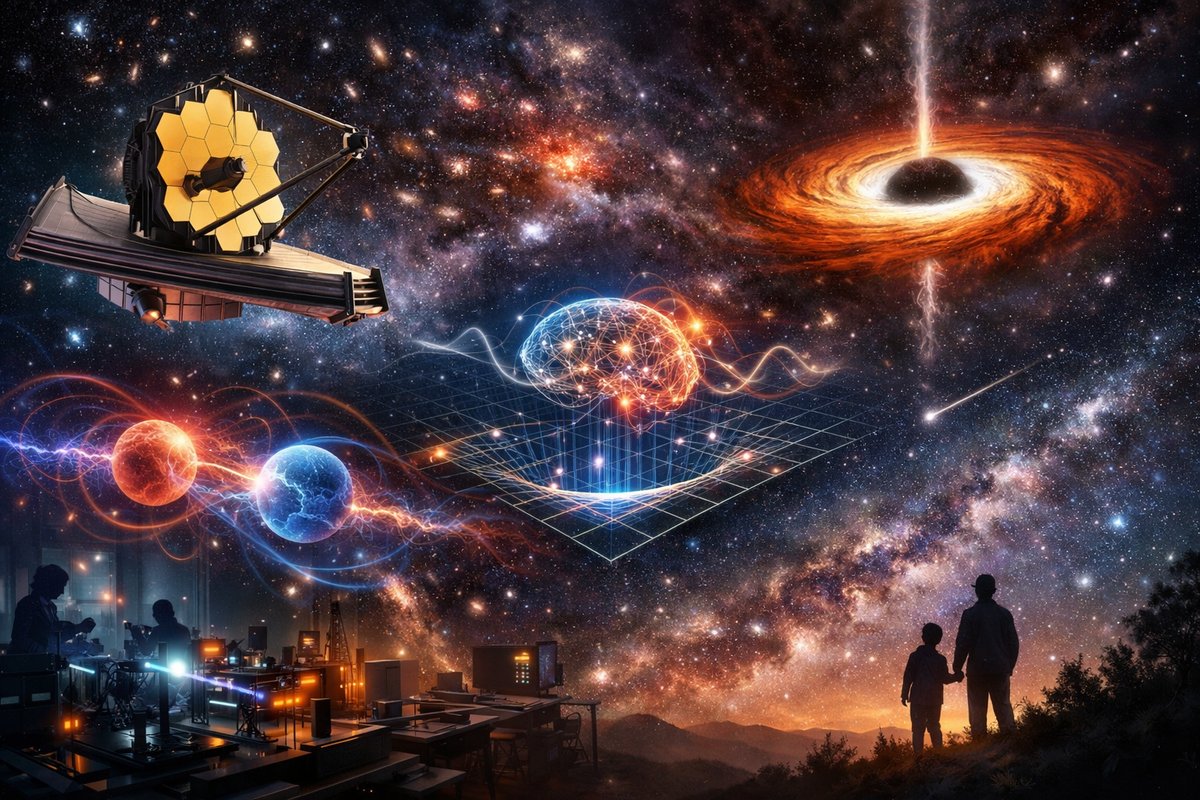
A cascade of recent discoveries-from Webb's glimpse of primordial galaxies to groundbreaking quantum entanglement studies-has sent ripples through the scientific community and beyond. This surge of insight is unlocking new questions about the fabric of reality and inspiring novices and veterans alike to look up in awe.
In observatories across the globe and deep beneath the Earth’s surface, a renewed spirit of exploration is unfolding. Over the past year, advances in space-based telescopes, subterranean particle detectors, and tabletop quantum experiments have converged to fuel a wave of cosmic curiosity. Researchers are probing the first billion years of the universe, teasing apart the elusive nature of dark matter, and unravelling the strange dance of entangled particles. Together, these efforts are crafting an ever more intricate portrait of the cosmos-and inviting all of us to join the quest.
At the heart of this resurgence stands the newest generation of space telescopes. Equipped with infrared sensors capable of detecting the faint glow of ancient galaxies, these observatories have revealed dozens of star systems forming when the universe was less than 5 percent of its current age. Each image-a swirl of gas and stars-acts as both a relic of cosmic dawn and a prompt for new questions: How did those earliest structures assemble so rapidly, and what seeds of chemical complexity were planted in their hearts?
Closer to home, physicists have pushed the envelope in isolating quantum systems from environmental noise, producing entangled particles that remain linked across record distances. In one recent demonstration, photons sent through fiber-optic cables eight hundred kilometers apart exhibited correlations that defy classical explanation. Such experiments are more than proof of principle; they hint at future quantum communication networks and challenge our deepest intuitions about space and time.
Meanwhile, underground laboratories have turned their gaze inward, seeking the ghostly interactions of dark matter particles. In the mountains of Italy and the mines of Canada, teams operating liquid xenon and cryogenic crystal detectors have reported tantalizing signals near the threshold of detection. Although none yet rise to the level of a confirmed discovery, each anomaly inspires a fresh round of improvements-purer materials, more sensitive electronics, and ever-larger target masses.
Higher still, balloon-borne observatories are mapping cosmic rays that cascade into Earth’s atmosphere, revealing patterns in particle energies that point to distant supernova remnants and possible sources of antimatter. By charting these high-energy visitors, scientists hope to decode the astrophysical engines that accelerate particles to near light speed and trace the contours of the galaxy’s magnetic fields.
These breakthroughs are reshaping the narrative of what it means to explore. No single mission or experiment stands alone; they form a braided thread connecting the very large with the very small, the ancient past with our unfolding present. In university labs, student teams build tabletop interferometers to test aspects of quantum gravity. At museums and planetariums, interactive exhibits simulate voyages through warped spacetime. Online forums spark lively discussions that bridge disciplines, from cosmology and information theory to philosophy and art.
Artists, too, are tuning into these vibrations. Recent gallery installations have projected real telescope data onto curved surfaces, immersing viewers in swirling nebulae that pulse to the rhythms of simulated starquakes. Poets and performance groups reinterpret dark energy as a metaphor for creative potential, inviting audiences to consider the unknown not as an abyss but as fertile ground for discovery.
This cultural feedback loop stirs a deeper truth: our drive to understand the universe is inseparable from our urge to express wonder. When a new spectrum of light reveals unexpected chemistry in a faraway galaxy, researchers describe it in papers while songwriters capture the emotion in lyrics. Each advance feels both technical and transcendental, reminding us that data points are also threads in a grand tapestry of human meaning.
For those who have never peered through a telescope, the night sky can seem remote. Yet community stargazing events have multiplied in parks and schoolyards, fueled by affordable backyard telescopes and smartphone-compatible eyepiece adapters. Amateur astronomers lead guided tours of lunar craters, point out the subtle hues of Jupiter’s cloud bands, and compare notes on timing the transits of exoplanets across distant suns. In these moments, science becomes a shared ritual-a chance to marvel at infinity while deepening our connections on Earth.
Do-it-yourself astrophotography groups have also emerged, inviting participants to convert old camera lenses into makeshift telescopes or to mount digital sensors on small telescopes for long-exposure star trails. Open-source software tools enable novices to stack multiple frames, subtract background noise, and bring out dim galaxies in dazzling color. Through online tutorials and collaborative code repositories, the technical barriers to capturing the cosmos continue to fall.
Education initiatives are weaving these advances into curricula that bridge the gap between theory and hands-on discovery. School programs now include microgravity simulations using parabolic flights, citizen-science campaigns that enlist volunteers to classify galaxy images, and quantum computing workshops that let students experiment with virtual qubits. By engaging learners at every level, from young children to lifelong enthusiasts, these efforts cultivate the next generation of thinkers ready to wrestle with the universe’s greatest mysteries.
The cross-pollination between art and science extends into virtual and augmented reality experiences, where participants walk through simulated exoplanet landscapes or manipulate quantum wave functions with hand gestures. Some installations let visitors craft their own cosmic soundtrack, remapping data streams from particle detectors into evolving musical patterns. This blend of sensorial immersion and rigorous data underscores the idea that understanding the cosmos can be both analytical and deeply poetic.
If you’re inspired to begin your own astronomical journey, the night sky awaits with an infinite canvas. Start by learning the brightest constellations visible from your hemisphere and use a simple planisphere to track their movement from season to season. Choose a moonless night, find a dark-sky site away from city lights, and let your eyes adjust for at least twenty minutes. Even a pair of binoculars will reveal more detail than you might expect: lunar mountains, the Andromeda galaxy as a fuzzy oval, the Pleiades cluster sparkling like a fragment of cosmic lace.
As you gain confidence, consider experimenting with an entry-level telescope that can resolve Jupiter’s cloud bands and the ringed profile of Saturn. With accessories like a smartphone adapter, you can capture snapshots of starfields and share them with online communities. For those curious about the quantum realm, tabletop kits offer hands-on demonstrations of entanglement and wave-particle duality, turning abstract theory into tangible experiment.
Ultimately, the surge of new data and technological leaps invites a personal response: to look up, to question, and to connect with something far greater than ourselves. Whether you are tracing the faint glow of a galaxy that formed billions of years ago or marveling at a simple starlit sky, each moment of discovery deepens our sense of belonging in an ever-changing cosmos.
The echoes from the quantum veil and the silent light of distant suns are calling out. As we stand at this threshold of insight, we have the tools, the knowledge, and the communal spirit to answer. All that’s left is to open our eyes, lift our gaze, and follow that spark of curiosity wherever it may lead.