Location
Mount Vernon, WA 98274

Location
Mount Vernon, WA 98274
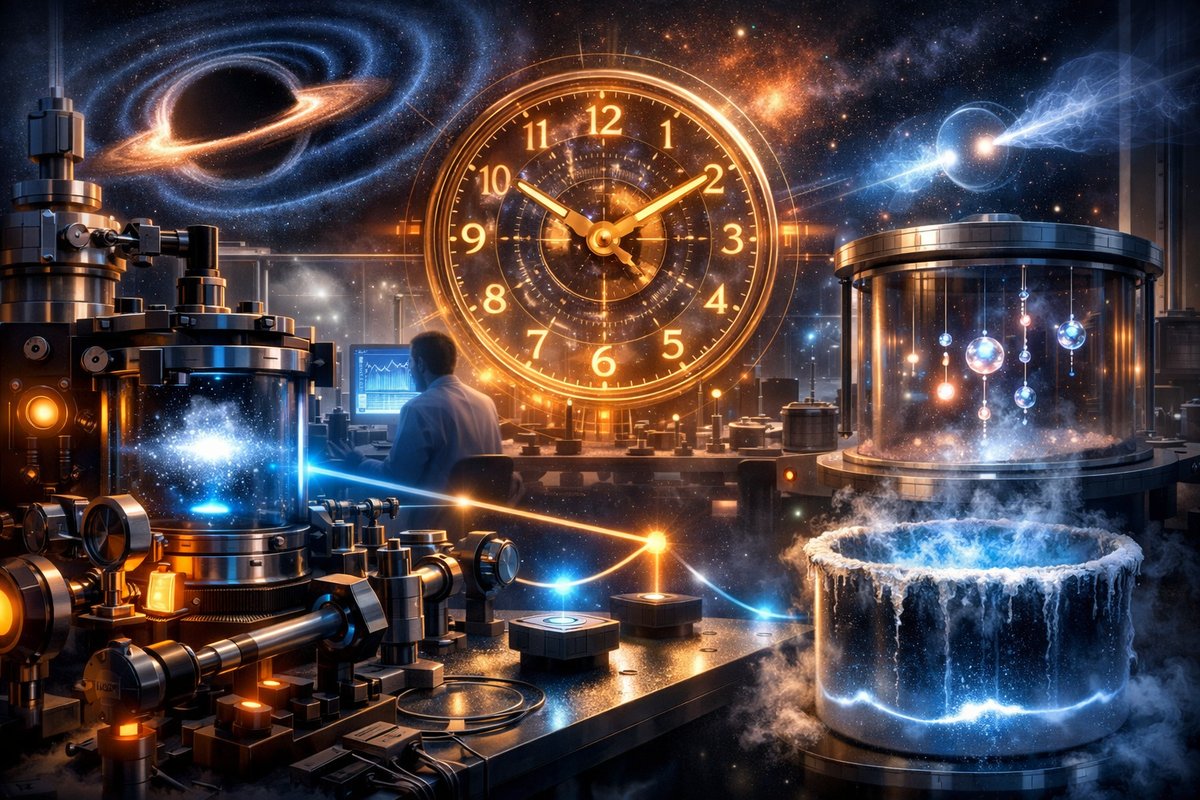
In laboratories around the globe, physicists are pushing timekeeping to unimaginable precision, creating new phases of matter and tuning into faint signals from the universe's shadowy side. From ultrafast atomic clocks that detect gravity's subtle pull across a table to chilled quantum states that flow like superfluids, the frontiers of time and matter are converging in ways that challenge our deepest assumptions.
Time has always been our most elusive dimension. We mark its passage with sundials, pendulums and quartz oscillators, but recent breakthroughs have shattered these familiar rhythms. In ultra‐quiet vaults, physicists are now freezing atoms to near absolute zero, guiding them with finely painted laser fields, and capturing their oscillations with a precision that makes yesterday’s best chronometers look like sundials under a streetlamp. These new clocks don’t merely keep better time-they measure the warping of spacetime itself, revealing how gravity strains and stretches each moment.
At the National Institute of Standards and Technology (NIST) in the United States, optical lattice clocks built from thousands of strontium atoms tick at a rate so steady that they would gain or lose less than a second over the lifetime of the universe. In Europe, similar devices are running experiments that show time runs slower just a few inches lower in a building, a direct demonstration of Einstein’s general relativity at human scales. As these devices evolve, they promise not only to redefine the second but to become sensors capable of surveying underground water, mapping geological faults, and even tracking climate‐driven variations in Earth’s mass distribution.
Meanwhile, in chilled chambers where lasers weave standing waves like invisible nets, matter adopts strange new forms. Bose-Einstein condensates, once mere theoretical curiosities, now flow through microscopic channels without losing energy. Researchers sculpt clouds of ultracold atoms into twisted knots of quantum fluid, or coax them into crystals that behave like magnets guided by quantum rules rather than classical ones. These topological phases, as they’re known, harbor robust properties immune to external disturbances-features that could power the next generation of fault-tolerant quantum computers.
In a handful of high-energy laboratories, meanwhile, protons and neutrons collide at near-light speeds to briefly liberate quark-gluon plasma, a soup of elementary particles believed to have filled the universe a split second after the Big Bang. As detectors record the spray of emerging fragments, scientists search for hints of how matter gained mass, how symmetries were broken, and how complex structures emerged from primordial chaos. Every collision is a new experiment in cosmic storytelling, tracing the evolution from seething plasma to the atoms that make up our bodies.
Yet among all these triumphs, mysteries linger. Dark matter, that invisible substance outweighing ordinary atoms by a factor of five, remains undetected despite exquisitely sensitive detectors burrowed deep underground. These instruments, cooled to fractions of a degree above absolute zero, sit in silent caverns listening for the faintest tap of a passing dark particle. Should they succeed, they would illuminate the hidden scaffolding of galaxies and reveal new physics beyond the Standard Model.
Beyond mass and substance, gravity itself has begun to speak in whispers. The Laser Interferometer Gravitational-Wave Observatory (LIGO) and its partners have already captured ripples from colliding black holes and neutron stars, each event stretching space by a fraction smaller than a proton’s diameter. These spacetime vibrations carry tales of cosmic cataclysms billions of light-years away, yet can be recorded here on Earth thanks to ultra-stable lasers, suspended mirrors, and intense noise-cancellation schemes. As next-generation detectors come online, we expect to hear the background hum of the universe itself-an unending chorus of mergers and explosions that will map the cosmos in a wholly new way.
What surprises lie ahead when precision timing meets exotic matter and gravitational whispers? One tantalizing frontier is geodesy performed with clocks. By comparing time readings between remote laboratory sites linked by optical fiber, scientists plan to create three-dimensional maps of Earth’s gravitational field with centimeter-level resolution. Such maps would revolutionize resource exploration, sea-level monitoring, and even our understanding of mantle convection.
In parallel, the strange properties of topological materials threaten to transform electronics by carrying currents around corners without loss, even at room temperature. While current demonstrations occur at a few kelvins, advances in materials chemistry could push operational temperatures higher, paving the way for ultra-efficient data centers and sensors with unprecedented sensitivity. Quantum networks built from these components might link atomic clocks across continents, enabling distributed sensing and ultra-secure time-stamped communications.
On an imagination-stirring scale, proposals to build clocks in space hold the promise of exploring time in regimes unreachable on the ground. A clock placed on a satellite in a highly elliptical orbit would experience varying gravitational potentials, offering a unique laboratory for testing fundamental physics and probing dark energy’s subtle influence. Such spaceborne chronometers could also enhance global navigation systems, improving accuracy from meters to centimeters and enabling autonomous vehicles to traverse complex environments with pinpoint reliability.
These leaps in control over time and matter inevitably raise deeper questions about our place in the cosmos. When we can manipulate atomic wavefunctions, measure gravity’s pull across a room, and listen to the faint echoes of black-hole mergers, we blur the line between observer and participant. Our instruments become extensions of human perception, magnifying our senses and challenging us to reconsider the narrative of reality itself.
In the coming decade, the convergence of optical clocks, quantum materials, and gravitational-wave astronomy will reshape not only fundamental physics but also practical technology. Precision clocks will fortify financial networks against fraud and improve synchronization across communication grids. Quantum sensors born from exotic matter experiments will detect underground structures, monitor volcanic activity, and even search for hidden cavities beneath archaeological sites. Gravitational-wave observatories a thousand times more sensitive will uncover populations of black holes and neutron-star remnants, offering fresh clues about the life and death of stars.
Each achievement will come with its own challenges. Ultra-precise clocks require extreme environments: vacuum chambers, cryogenics, and vibration isolation. Quantum materials often demand temperatures barely above absolute zero and intricate fabrication techniques. Gravitational-wave observatories must operate in near-perfect silence, miles from human activity. But as engineers refine designs and scale production, these once-esoteric laboratories may give rise to portable, rugged devices that find their way into industry, healthcare, and environmental monitoring.
The story of time, matter and mystery is far from written. Every tick of a next-generation clock, every strange phase of condensed atoms, every faint ripple of gravity reminds us that reality is woven from layers we are only beginning to unravel. As researchers usher in an era of unprecedented precision and control, the cosmic tapestry reveals new patterns-and invites us to imagine what might come next when we learn to speak its hidden language.
In the interplay of atoms and spacetime, we find both practical promise and philosophical wonder. Our quest to measure time finely, to craft matter curiously, and to listen to the universe’s faintest whispers reaffirms a profound truth: science is not just a catalog of facts but a grand narrative in which we are both authors and participants. And as the next chapter unfolds, we are poised to discover that the most mysterious threads often connect the vastest cosmos to the pulse of everyday life.