Location
Mount Vernon, WA 98274

Location
Mount Vernon, WA 98274
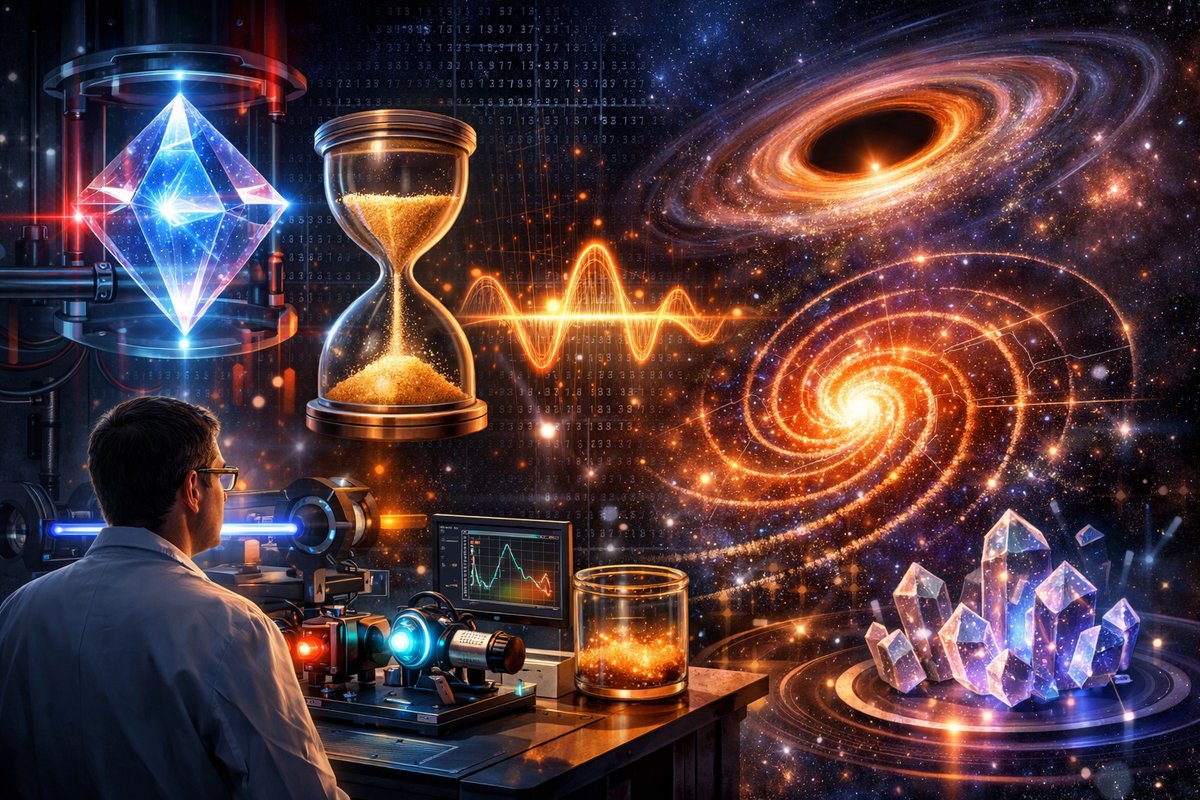
A groundbreaking series of experiments is revealing hidden rhythms in time and unexpected behaviors in exotic forms of matter. From lab-grown time crystals to refined measurements of entropy, researchers are piecing together a richer tapestry of the universe-and inviting us to reconsider our own experience of time and change.
In a quiet laboratory on the outskirts of a major research university, a small array of lasers and magnetic coils vibrates in precise synchrony. Over the course of just a few microseconds, these instruments coax an ordinary ensemble of atoms into an extraordinary state known as a time crystal. First theorized less than a decade ago, time crystals break the familiar rule that systems must settle into equilibrium. Instead, they settle into perpetual motion, oscillating in time without consuming energy.
Researchers at the lab have demonstrated that these time crystals can maintain their oscillations for thousands of cycles, a feat that defies classical expectations. “It’s like watching a perfectly tuned metronome that never requires winding,” explains one physicist leading the effort. But the implications go far beyond a lab curiosity. By probing the boundary between stasis and perpetual motion, scientists are reexamining the foundations of thermodynamics-the laws that govern heat, work and entropy.
In parallel to these experiments, astrophysicists analyzing data from the latest sky survey have uncovered subtle anomalies in the cosmic microwave background. These faint temperature fluctuations hint at interactions between dark matter particles and normal matter in the early universe. Although dark matter remains invisible to direct detection methods, its gravitational imprint on cosmic structure is well documented. The new findings suggest that dark matter may carry its own form of entropy and even participate in wave-like behaviors similar to those observed in time crystals.
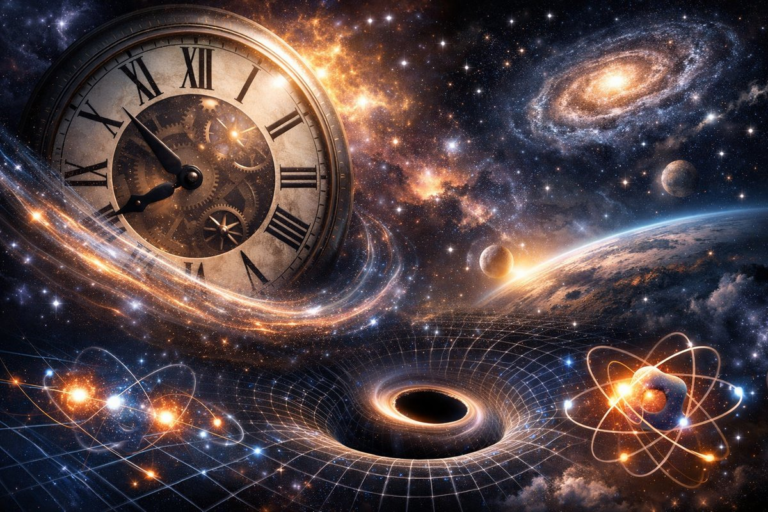
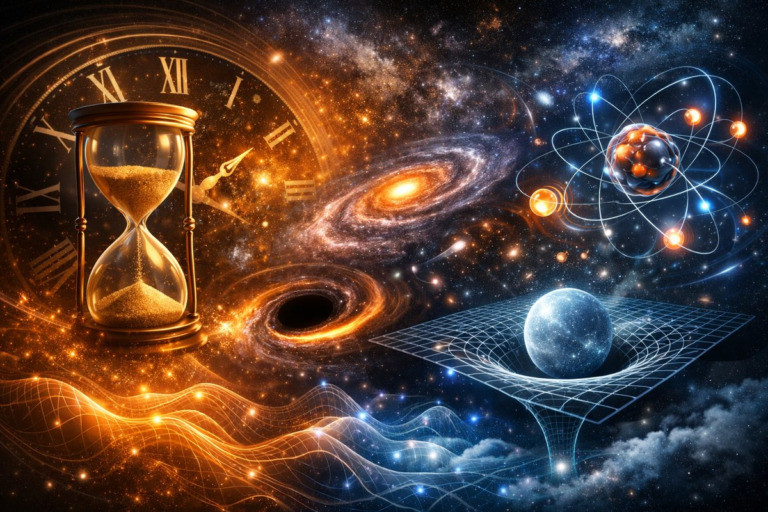
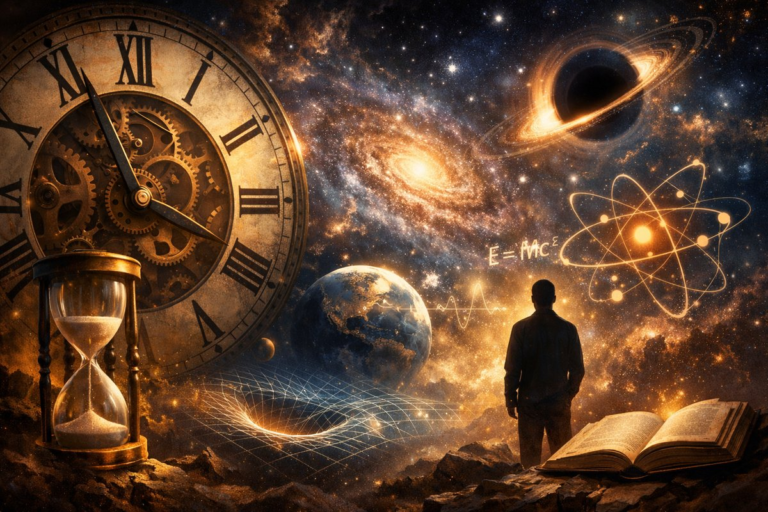
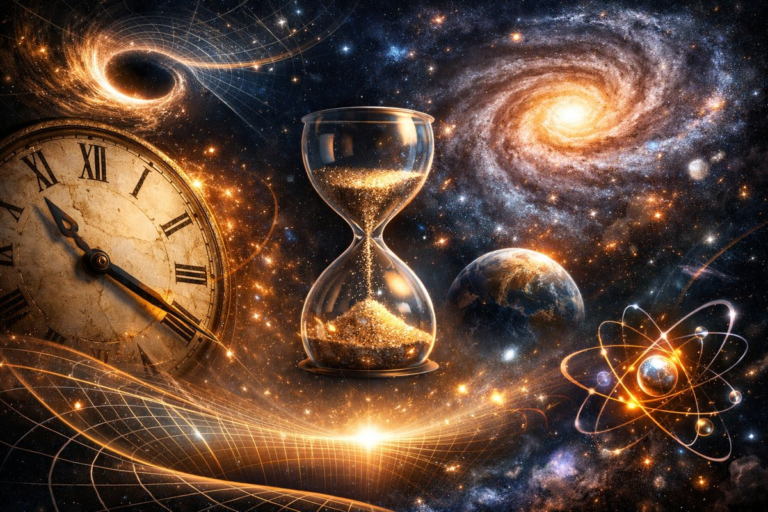
Together, these breakthroughs are blurring the line between time-traditionally treated as a backdrop for physical processes-and matter, the substance of the universe. What emerges is a portrait of reality where time and matter are entwined in a dance of mutual influence, shaping everything from particle interactions to the grand sweep of cosmic evolution.
The rhythm of time
Einstein’s theory of relativity taught us that time bends and stretches in the presence of gravity. Quantum mechanics, meanwhile, introduced a probabilistic flavor to microscopic events. Now, experiments with time crystals are adding a new verse to this ongoing saga. When driven by a periodic force, the atoms in a time crystal oscillate at half the frequency of the driving field. This phenomenon, called “discrete time-translation symmetry breaking,” defies the instinctive notion that systems mirror the rhythm of their environment.
Just months ago, a separate team recreated a form of time crystal in a solid-state platform using spin chains in diamond. By applying a careful sequence of microwave pulses, they observed stable oscillations at a subharmonic frequency for more than ten seconds-long enough to hint at potential applications in precision timekeeping or quantum memory. If clocks could harness these oscillations, they might achieve stability orders of magnitude beyond current atomic standards.
Dark whispers in the cosmic web
Meanwhile, the sky survey-using one of the world’s most sensitive radio telescopes-has mapped the large-scale structure of galaxies with unprecedented detail. Hidden within the data are slight distortions in microwave background fluctuations. Computational analysis suggests these distortions could arise from interactions between ordinary matter and a lightweight dark matter candidate.
The possibility that dark matter expresses its own form of entropy is tantalizing. Entropy, a measure of disorder or information content, underpins everything from the melting of ice to the eventual heat death of the universe. If dark matter carries entropy, it may participate in the cosmic balance sheet in ways we’ve yet to fully grasp. Could dark matter’s entropy affect the timing of galaxy formation? Might it leave detectable fingerprints in gravitational wave signals? These questions are now moving from speculative thought experiments to testable hypotheses.
Entropy and the human pulse
Beyond the cosmic scale, entropy shapes our everyday lives. It dictates why ice cubes melt, why coffee cools, and why time seems to flow one way rather than the reverse. Artists and musicians have long explored this asymmetry. An experimental composer recently created a sound installation that amplifies the faint hum emitted by a supercooled metal as its internal structure shifts toward equilibrium. Visitors step into a darkened chamber and hear sounds that evolve imperceptibly over hours-an auditory journey through entropy in action.
Storytellers, too, are drawn to time’s arrow. A new collection of short stories weaves together human experiences of memory, loss and renewal under the metaphor of microscopic time loops. In one tale, a protagonist relives the same hour repeatedly, each iteration revealing a deeper layer of meaning. These creative expressions underscore how our perception of time is inseparable from the physical processes unfolding all around us.
Bridging scales and disciplines
What unites these diverse threads-time crystals in the lab, dark matter signals in the sky, artistic explorations of entropy-is a shift in perspective. Instead of treating time and matter as separate arenas, scientists and creators are weaving them into a single narrative of unfolding complexity.
In the realm of technology, this synthesis has practical implications. Researchers are already experimenting with quantum computing architectures that exploit time-crystalline order to protect fragile qubits from environmental noise. Likewise, precision measurements of cosmic microwave background distortions could refine our estimates of dark matter properties, informing the design of next-generation detectors.
Educators are adapting, too. A university has introduced a new interdisciplinary course called “Temporal Matter,” where physics students collaborate with art and literature majors to explore time’s mysteries. The syllabus spans quantum field theory, non-equilibrium thermodynamics, and speculative fiction, encouraging holistic thinking at the frontier of knowledge.
Into the next cycle
As the oscillations of time crystals continue to tick and the cosmic web reveals ever-fainter whispers of dark matter, a new chapter in our understanding begins. We stand at the nexus of experiment, observation and imagination, ready to ask deeper questions about what it means to exist in a universe where time and matter are inseparable partners.
In the coming months, collaborations between laboratories, observatories and cultural institutions will likely yield fresh surprises. Perhaps we’ll witness the first time crystal-powered clock or detect a novel interaction channel for dark matter. Whatever unfolds, one thing is clear: the mystery at the heart of existence remains as vibrant as the oscillations of a time crystal, inviting each of us to listen closely to the hum of reality.
And as we tune our instruments and sharpen our theories, we might also pause to feel our own rhythms-the beating of our hearts, the flicker of memory-and remember that we, too, are woven into the grand tapestry of time and matter.