Location
Mount Vernon, WA 98274

Location
Mount Vernon, WA 98274
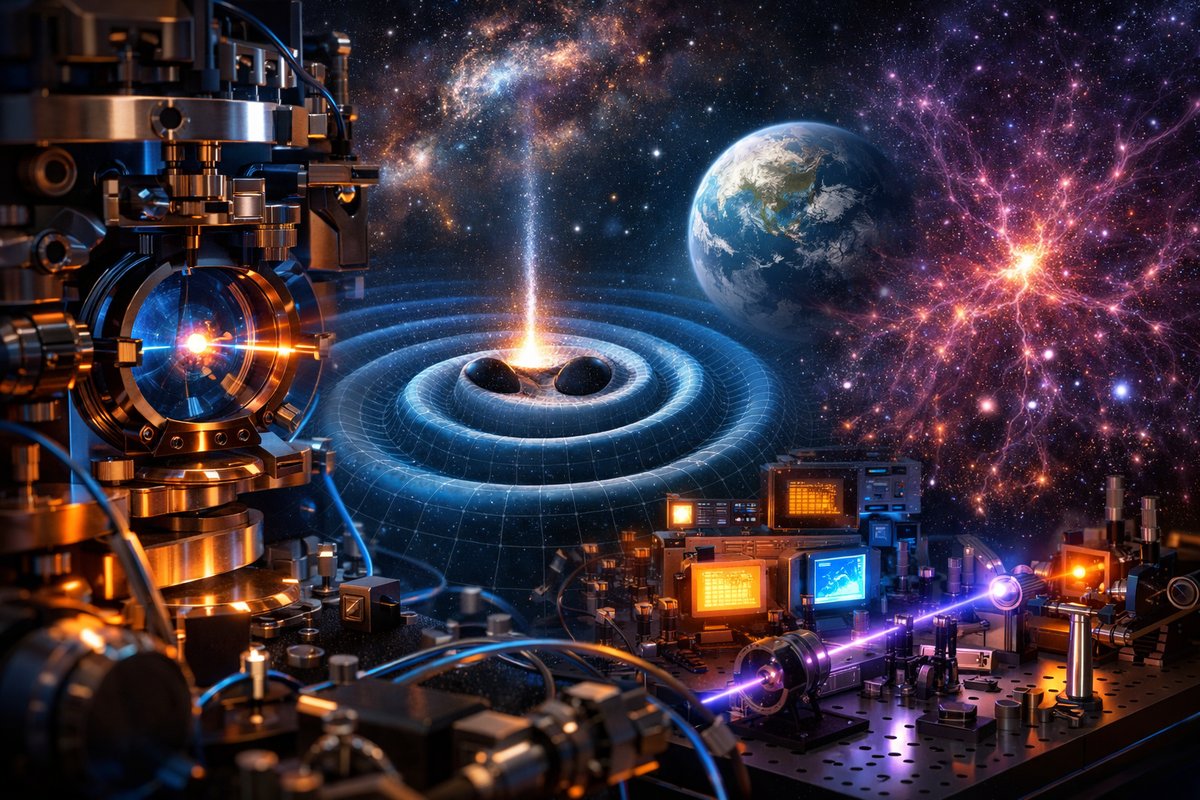
Researchers worldwide are converging on the enigmatic dance between time and matter, unveiling anomalies in atomic clocks and fresh data from gravitational wave detectors. As laboratories refine optical clocks to track infinitesimal shifts in time and experiments tease out dark matter's elusive signals, the story of reality grows richer-and even more mysterious.
Humanity’s quest to decode the universe has always hinged on two pillars: the fabric of time and the substance of matter. In laboratories spanning from Geneva to Tokyo, scientists are charting new frontiers where these pillars intersect, revealing phenomena that challenge our deepest assumptions. Time appears to dilate and contract under conditions once deemed theoretical, while matter-ordinary and dark-continues to whisper secrets about the cosmos’s hidden architecture.
In a recent international symposium on precision timekeeping, teams operating optical atomic clocks reported subtleties in gravitational time dilation at unprecedented resolutions. These clocks, which trap atoms in laser fields and measure their oscillations with staggering accuracy, detected time differences of mere quadrillionths of a second over height variations smaller than a human hair. Such sensitivity not only validates Einstein’s century-old predictions but also paves the way for geodesy applications that map Earth’s gravitational landscape in real time.
Meanwhile, the latest observing run of the global gravitational wave network-merging data from facilities in the United States, Italy, Saudi Arabia, and Japan-captured faint ripples from colliding black holes billions of light-years away. Each detection refines our grasp of spacetime’s malleability, confirming that even empty voids reverberate with echoes of cataclysmic events. Beyond thrilling headline-grabbing mergers, researchers are mining archival data for lower-frequency signals. The hope: to pinpoint interactions that hint at new forms of matter or alternative gravity theories.
Back in particle physics labs, the hunt for dark matter has reached a fever pitch. Deep underground detectors braced against cosmic radiation are now probing weakly interacting massive particles (WIMPs) and axion candidates with unmatched sensitivity. In one such experiment housed beneath layers of rock, sensors registered an energy deposition pattern that matched theoretical predictions for axion conversion into photons. Though the signal remains at the edge of statistical significance, the prospect of directly detecting a dark matter component has reignited excitement among theorists.
At the crossroads of these investigations, quantum entanglement experiments continue to challenge conventional wisdom. Researchers recently extended entanglement distances to tens of kilometers through optical fibers, exploring whether time delays or gravitational potentials could degrade the once-inviolable quantum link. The results: entanglement remains robust, suggesting that quantum coherence endures even when separated by geophysical differences in gravity. Such findings bolster visions of a quantum internet, potentially shielded against environmental disruptions.
These disparate threads-optical clocks, gravitational waves, dark matter searches, and large-scale entanglement-are weaving a tapestry that speaks to the unity of physical law. When an atomic clock in Europe ticks slightly faster than its counterpart atop a remote mountain peak in Asia, it underscores that time is not a universal metronome but a dynamic quantity shaped by mass and energy. When gravitational wave detectors register echoes from the dawn of black hole formation, they demonstrate that spacetime itself resonates like a cosmic instrument.
Beyond pure science, these breakthroughs carry practical promises. Ultra-precise clocks are already being integrated into next-generation navigation systems, offering centimeter-level positioning accuracy for autonomous vehicles. Geologists envision deploying clocks to monitor magma movement beneath volcanoes in real time, transforming disaster prediction. Quantum networks leveraging entanglement could revolutionize secure communication, fundamentally altering data privacy in an age of increasing digital threats.
Yet every answer invites deeper questions. If time and matter are so malleable, what anchors our notion of cause and effect? Could a future theory reveal time as emergent rather than fundamental, arising from the collective behavior of quantum bits? Might dark matter, once glimpsed in underground detectors, redefine our concept of what “substance” means in a universe dominated by empty space?
A new generation of experiments is gearing up to tackle these puzzles. Space-based interferometers aim to measure gravitational waves at frequencies inaccessible from Earth, opening a window onto events like supermassive black hole mergers at the heart of galaxies. Satellite clocks drifting in orbit will probe gravitational time dilation over thousands of kilometers, testing relativity on a grand scale. Deep learning algorithms are being trained to sift through petabytes of data, hunting for anomalies that human eyes might overlook.
In classrooms and living rooms alike, the story of time and matter is taking on renewed fascination. Documentaries featuring these discoveries are finding audiences hungry for cosmic perspective. Amateur astronomers are pointing telescopes toward transient sky events, eager to witness light echoes from distant supernovae. Hobbyists are assembling DIY spectroscopy kits to study the elemental makeup of starlight. In coffee shops and online forums, conversations swirl around the philosophical implications of a universe where time can stretch and shrink like a rubber sheet.
Perhaps the most profound mystery lies close to home: consciousness itself. As physics inches toward a unified description of spacetime and matter, some theorists speculate that the same quantum principles governing particles could play a role in the brain’s information processing. Though this idea remains controversial, it underscores how deeply entwined our sense of self might be with the physical substratum of reality.
As night falls and the Milky Way stretches across the sky, we are reminded that our own lives occupy but a fleeting moment in cosmic time. Yet by refining atomic clocks, capturing gravitational murmurs, and probing the dark scaffolding of matter, humanity inches toward a deeper kinship with the universe. Each experiment-no matter how small-echoes across scales, from the quantum to the cosmic, inviting us to reconsider what it means to exist in a realm where time and matter conspire to shape every heartbeat and starburst alike.
In the decade ahead, we can expect even more startling revelations: perhaps signs that spacetime emerges from entangled quantum nodes, or definitive proof of dark matter particles swirling through us. No matter the outcome, the unfolding narrative of time and matter stands as one of the grandest stories ever told. By marrying meticulous measurement with bold imagination, science continues to illuminate the mystery that binds all things.