Location
Mount Vernon, WA 98274

Location
Mount Vernon, WA 98274
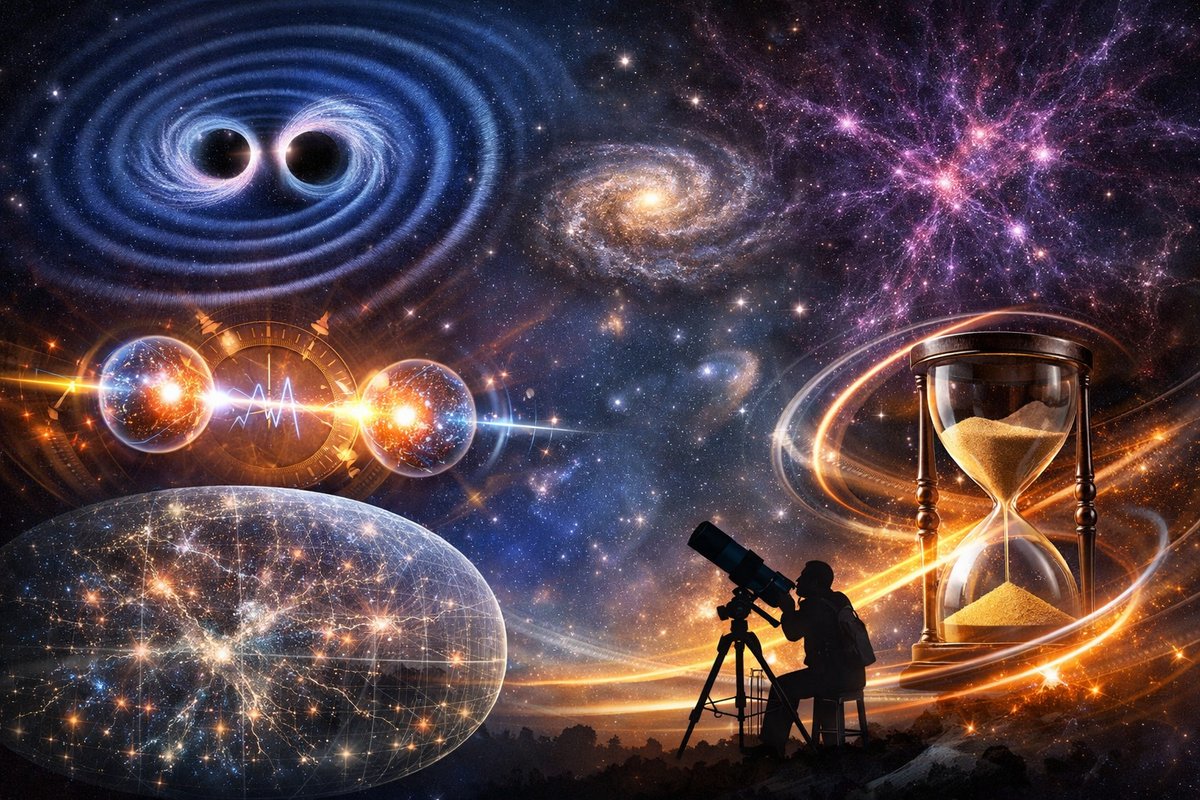
Scientists are peering into the intertwined nature of time and matter as new detections of gravitational waves and dark matter candidates sharpen our picture of the universe. Quantum entanglement experiments are blurring the boundary between past and future, while astronomical surveys map the unseen scaffolding of dark energy. This exploration reveals both the physics that underpin reality and the mysteries that fuel our curiosity.
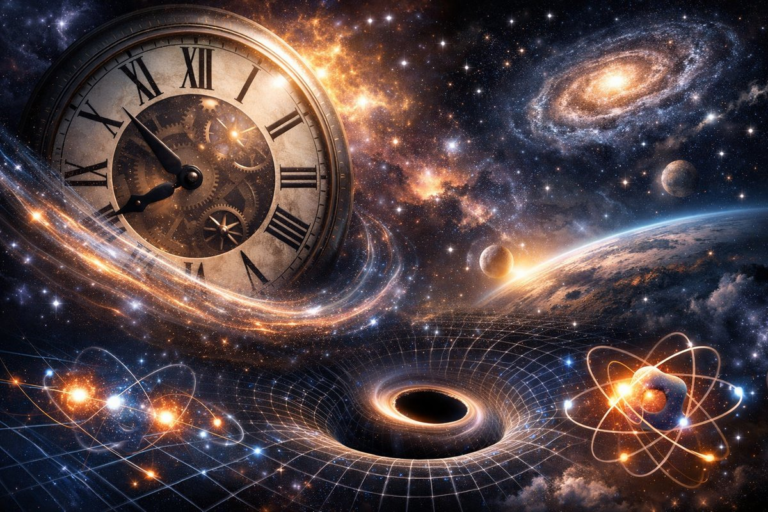
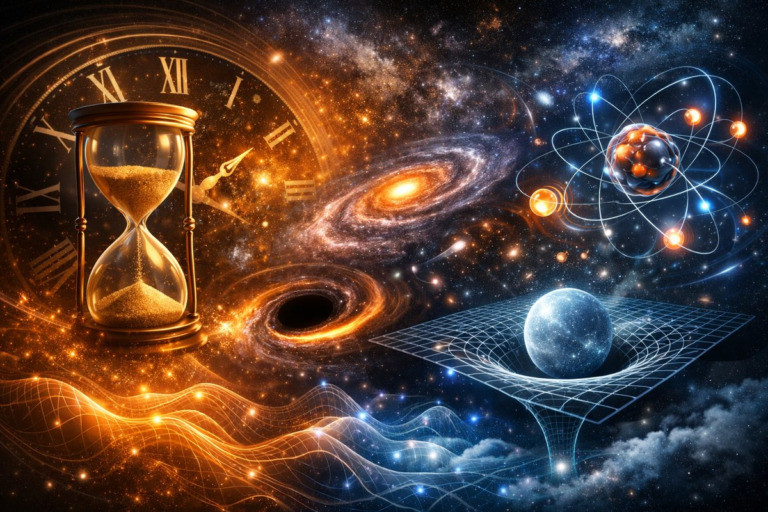
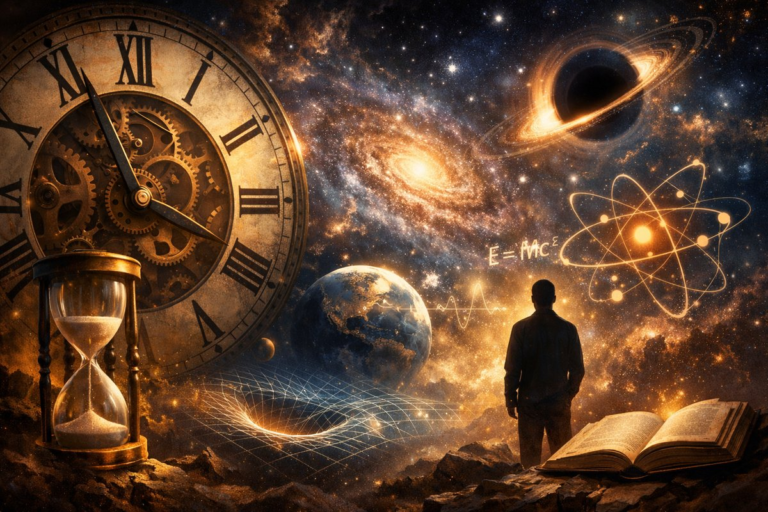
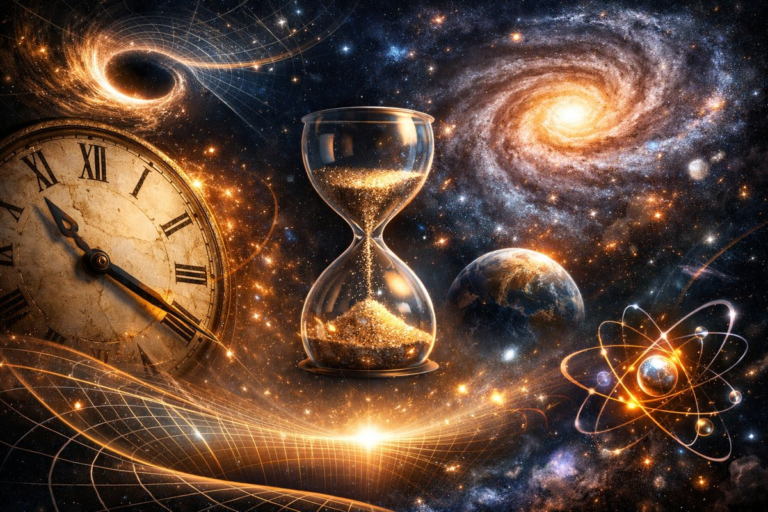
In the vast theater of the cosmos, time ticks differently in every corner. Recent observations from gravitational wave detectors have given us a front-row seat to cosmic collisions that happened billions of years ago, yet reach our instruments in the present. Each ripple in spacetime carries encoded stories of black holes and neutron stars merging, transforming matter into pure energy and forging elements heavier than iron. Meanwhile, precision clocks stationed on satellites remind us that even a few miles of altitude can stretch or shrink our perception of a second. Together, these breakthroughs set the stage for a deeper narrative-one where time, matter, and mystery entwine in a cosmic dance.
Time, once thought of as a universal metronome ticking steadily, now reveals itself as a dynamic player. Relativity teaches us that motion and gravity weave together to bend the timeline, causing clocks in fast jets or high orbits to tick at different rates than those on Earth’s surface. In a recent experiment, scientists compared atomic clocks separated by just a foot of elevation and observed measurable differences in their oscillations. This demonstration of gravitational time dilation, once relegated to theoretical textbooks, now stands as a practical concern for global positioning systems and space missions. As our instruments become ever more precise, the frontier of temporal measurement advances, hinting at hidden layers where quantum fluctuations and spacetime curvature might coalesce.
Meanwhile, matter itself refuses to remain a passive stage. In underground laboratories shielded from cosmic rays, detectors search for whispers of dark matter particles that could account for the missing mass of galaxies. Simultaneously, high-energy collisions at particle accelerators probe the quantum vacuum, producing ephemeral particles that flicker into and out of existence. Each collision paints a fleeting portrait of the subatomic world, revealing symmetries and anomalies that guide our theories. Recent results have revived debates about unexpected magnetic moments and rare decay channels, suggesting that our current framework may be incomplete. As antimatter experiments refine their techniques, the cosmic imbalance between matter and its mirror twin grows ever more mysterious.
At the intersection of time and matter lies the paradox of entanglement, a phenomenon where two particles share a connection that transcends distance-and possibly time. Researchers have extended entanglement experiments to include time-separated events, effectively linking photons created at different instants. These time-twisted entanglement tests challenge classical intuitions about cause and effect, raising profound questions about the flow of information in the quantum realm. Could future measurements influence past outcomes? While the consensus remains that no usable information travels backward in time, these experiments push the envelope of our understanding and hint at deeper principles waiting to be uncovered.
Yet for every question we answer, new mysteries emerge. Dark energy, the enigmatic force driving the accelerating expansion of the universe, remains wholly inscrutable. Sky surveys catalog hundreds of thousands of supernovae and distant galaxies, tracing the expansion history with ever-finer detail. Despite these efforts, the origin and nature of dark energy evade explanation. Is it a vacuum property, a new field, or an illusion born of our incomplete theories? The answers will require not only better telescopes and detectors, but bold leaps of imagination.
Even here on Earth, the human scale of time and matter invites wonder. Our brains perceive time as a steady march, yet neurological studies show that emotion and attention can stretch or contract our inner sense of duration. Matter, too, is woven into our everyday lives: from the silicon in our electronics to the carbon-based molecules that comprise our bodies. By tracing these fundamental threads, science reveals the continuity between cosmic processes and the molecules in our veins. The same forces that sculpt galaxies also govern chemical reactions in cells, forging an intimate connection between the universe at large and our personal experience.
Looking ahead, the next generation of observatories and experiments promises to deepen the narrative. Upcoming infrared space telescopes will peer through cosmic dust to witness star formation in distant galaxies. Upgraded gravitational wave facilities will detect events at unprecedented distances, mapping the chorus of merging black holes across cosmic time. Quantum sensors placed in deep caverns or aboard high-altitude balloons may catch glimpses of dark matter interactions that have eluded detection so far. Each new tool extends our senses, allowing us to read chapters of the universe that were once invisible and silent.
In this age of discovery, the story of time and matter is still being written. The mysteries we wrestle with today will fuel the explorations of tomorrow, guiding us toward ever more nuanced understandings of reality. Whether we glimpse answers in the flicker of a detector or the shimmer of a distant galaxy, one truth remains clear: the cosmos invites us to keep asking questions, to remain curious, and to celebrate the profound connections that bind us to the fabric of space, time, and matter.