Location
Mount Vernon, WA 98274

Location
Mount Vernon, WA 98274
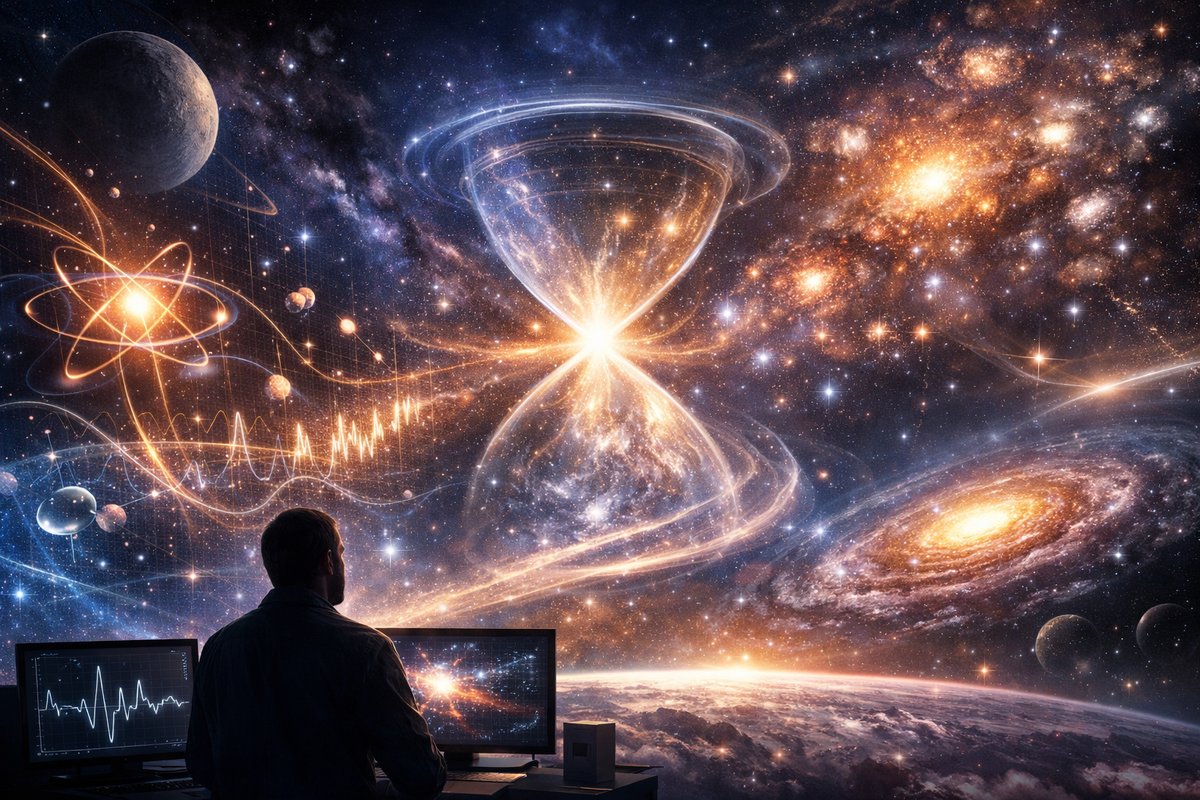
From the heartbeat of quantum fluctuations to the deep pulse of galactic clusters, a new wave of discoveries is weaving an extraordinary narrative. Scientists are piecing together how time and matter intertwine, and what mysteries still await beneath the cosmic veil.
In a cavernous laboratory buried beneath layers of granite, a team of physicists gathers around an array of sensors humming with anticipation. These instruments are tuned to catch the faintest ripples in spacetime-signals from colliding black holes half a universe away. Meanwhile, high above Earth’s atmosphere, a powerful space telescope sweeps its mirror across distant galaxies, charting the distribution of dark matter that holds cosmic structures together. Each data point is a thread in an unfolding tapestry, revealing how time and matter dance a mysterious waltz that shapes everything from the smallest particle to the grandest galactic web.
Scientists have long known that matter and time are inseparable partners. Classical physics once treated time as a steady river, flowing uniformly for all observers. Matter was simply the bits and pieces carried along its current. But in the era of relativity, we discovered that time itself stretches and contracts under the influence of gravity and speed. A clock orbiting Earth ticks more slowly than one on the ground. A particle hurled near light speed ages more slowly than its stationary twin. Yet a deeper question lingers: is time merely a dimension in which matter moves, or is it born from the fundamental interactions of matter and energy?
Recent breakthroughs are challenging our understanding in unprecedented ways. Experiments in condensed matter physics have demonstrated so-called “time crystals”-structures that exhibit perpetual motion in their lowest energy state. These peculiar phases of matter break the symmetry of time, oscillating indefinitely without input of energy. Far from being science fiction, they offer clues to the hidden layers of temporal symmetry in the quantum realm.
In parallel, gravitational-wave observatories continue to deliver astonishing news. The latest detection involved not black holes, but neutron star collisions-dense stellar remnants smashing together in a burst of gravitational and electromagnetic signals. By comparing the arrival times of ripples in spacetime with the flash of gamma rays, researchers refined the speed of gravity to remarkable precision. Each measurement serves as a probe of how time and gravity are linked and whether the laws that govern them hold true across cosmic distances.
Dark matter and dark energy add further intrigue. They remain invisible, detectable only through their gravitational effects. Yet they account for about 95 percent of the universe’s mass-energy budget. In sprawling surveys of galaxy clusters, astronomers map the lensing of background starlight by massive halos of dark matter. At the same time, supernova observations reveal that the cosmic expansion is accelerating, hinting at a mysterious pressure-the so-called dark energy-that pushes galaxies apart. Does this accelerated expansion reshape the flow of time on a cosmic scale? Some theorists propose that time itself may emerge from quantum entanglement woven among fundamental particles, a bold idea that places matter and information at the cradle of temporal experience.
Closer to home, researchers are probing time and entropy in tabletop experiments. By cooling atomic gases to near absolute zero and arranging them in optical lattices, physicists simulate conditions that mimic early-universe plasmas. They watch how quantum fluctuations freeze into patterns, analogues of the cosmic microwave background ripples. Every experiment becomes a miniature cosmos, letting us glimpse the infancy of space and time.
But beyond the sterile halls of research institutions, these revelations resonate with human curiosity. In classrooms, students build simple photon entanglement setups to witness spooky action at a distance. Hobbyists assemble do-it-yourself neutrino detectors to catch ghostlike particles streaming through Earth from the sun. Desktop hourglasses, once simple ornaments, now symbolize our quest to measure and master time. Home planetariums project stars onto ceilings, reminding us of our place in the vast tapestry.
As knowledge proliferates, so does the narrative. Writers and filmmakers draw on the interplay of time and matter to craft tales of alternate realities, time loops, and cosmic destinies. Virtual-reality experiences let users float inside a black hole’s glow, witnessing time dilation firsthand. Artists sculpt shifting light installations that pulse in rhythms echoing quantum vibrations. The boundary between science and story blurs, reflecting the same fundamental mystery: how do we define reality when time and matter interlace in ways we can barely fathom?
Yet mysteries remain. What is the ultimate fate of the universe-continued expansion into a cold, dark emptiness, or a reversal back toward a fiery rebirth? Could gravity leak into hidden dimensions and alter the flow of time at microscopic scales? Do black holes preserve or destroy information, and how does that impact the arrow of time? Each question drives new experiments, new missions, and fresh theoretical insights.
A next-generation gravitational-wave observatory, with detectors on separate continents and in space, is on the drawing board. Its aim: to catch primordial waves spawned moments after the Big Bang. A planned deep-space probe will venture beyond the heliosphere, measuring time dilation effects as it skirts the sun’s gravitational well. Meanwhile, quantum computing platforms scaled to hundreds of qubits promise to simulate the entanglement structure of spacetime itself.
In labs worldwide, collaborations bridge particle physics, cosmology, and quantum information. Physicists, mathematicians, engineers, and even philosophers debate what time truly is. Language evolves to capture these ideas-talk of emergent dimensions, holographic universes, and timeless quantum cores. The very notion of “now” is under scrutiny: is the present universal, or is it a patchwork of local moments stitched together by light signals and entangled correlations?
As we trace each thread, from subatomic vibrations to the heartbeat of galaxies, we realize that the story of time and matter is also our story. Our lives unfold in moments measured by watches, calendars, and memories-tools that translate cosmic rhythms into human scales. We age, we remember, we anticipate, all within the flow shaped by the universe’s hidden rules.
Today’s discoveries are chapters in a greater saga. We stand at a crossroads where experiments and narratives converge, where data drives imagination and stories inspire new hypotheses. In that interplay lies the true mystery: how a universe of particles, forces, and fields gives rise to consciousness pondering its own origin.
And so the search continues. Beneath laboratory floors and beyond interstellar space, the threads of reality await our touch. Each insight casts new light on the enigma of time and matter, offering glimpses of a cosmos far richer than we ever dreamed. In unraveling these threads, we also weave our own destiny-seeker and storyteller in an unfolding epic that spans from quantum flickers to cosmic dawns.