Location
Mount Vernon, WA 98274

Location
Mount Vernon, WA 98274
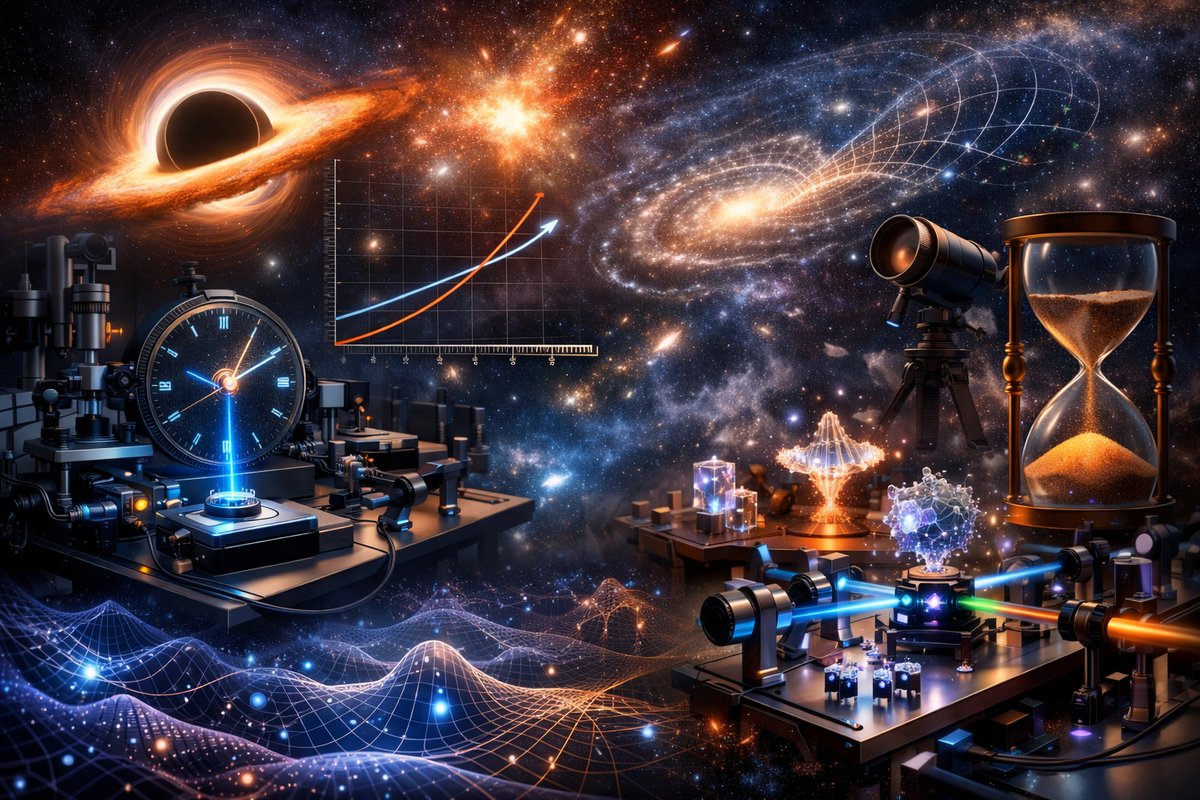
Cutting-edge experiments are bringing time's flow and matter's hidden patterns into sharper focus-from tabletop clocks detecting minute gravitational effects to laboratory systems mimicking properties of exotic phases. Meanwhile, astronomers grapple with a widening gulf in measurements of cosmic expansion. These breakthroughs reveal a universe brimming with fresh puzzles that bridge the infinitesimal and the infinite.
In laboratories around the world, researchers are racing to measure time and matter with unprecedented precision while astronomers wrestle with anomalies in the cosmic ledger. Earlier this month, a team of physicists reported success using an array of optical lattice clocks to detect gravitational time dilation across a mere ten centimeters of elevation difference. These clocks, which trap thousands of atoms in a grid of laser light, tick so steadily that the weight of a finger pressing down on one side of the table changes the rate at which time flows inside it. This tiny warping of temporal rhythm confirms general relativity’s predictions while opening the door to portable gravity sensors and geological surveying tools that rely on time rather than seismometers.
In a separate advance in controlled-matter research, scientists engineered a new form of quantum phase in ultracold trapped ions-phenomena sometimes dubbed “time crystals.” Unlike ordinary crystals that repeat in space, a time crystal’s structure repeats in time, oscillating indefinitely when driven by an external field. This exotic state of matter challenges long-held thermodynamic assumptions about equilibrium and energy dissipation. By observing a system that cycles through states in perfect synchronization, researchers hope to uncover new strategies for error-resistant quantum computing and novel materials that exploit temporal order rather than just spatial order.
While laboratory clocks and quantum simulators explore local scales down to the femtosecond and below, cosmologists are focusing on the largest stage of all: the universe itself. Recent measurements of the universe’s expansion rate yield conflicting results depending on the method. Observations of the cosmic microwave background-relic radiation left over from an infant cosmos-point to one value, while surveys of supernovae and Cepheid variable stars in nearby galaxies deliver a faster rate. This discrepancy, known as the “Hubble tension,” has grown to a level that statistical flukes no longer suffice as explanations. The mismatch could hint at a new form of dark energy that evolves over time, an extra species of light particle we’ve yet to detect, or even subtle interactions between matter and radiation that only manifest on cosmic scales.
These cosmic irregularities mirror the kind of surprises emerging in the lab. For example, researchers exploring strongly interacting matter at ultrahigh densities and temperatures-conditions akin to the first microseconds after the Big Bang-have uncovered signals of unanticipated collective behavior. Particle collisions in accelerator facilities recreate a quark-gluon plasma, a soup of elementary constituents that normally forms only within colliding neutron stars or the early universe itself. Recent data hint at vortices and magnetic domains within this plasma that defy simple modeling, suggesting that even familiar building blocks of matter can exhibit mysterious collective phenomena when pushed to extremes.
The convergence of precision metrology, quantum simulation, and cosmology underscores a deeper theme: time and matter are not passive backdrops but active participants in the unfolding drama of reality. Clocks have become inertial sensors that reveal underlying gravitational ripples, quantum simulators act as miniature universes with their own emergent laws, and the cosmos at large seems to carry signatures of unknown processes encoded in its expansion history and primordial glow. In each domain, mystery breeds opportunity.
Beyond the technical milestones, these developments carry philosophical weight. The fact that a shift of a few atomic layers in a clock’s height can alter its tempo reminds us that time is locally malleable. Exotic matter phases challenge the idea that disorder inevitably increases, confronting pre-Newtonian intuitions about irreversibility. And the tension between competing measures of cosmic expansion encourages humility in our understanding of the universe’s past and future. Each new anomaly invites creative solutions and fresh experimental designs that could reshape our grasp of fundamentals.
Future directions span far and wide. Metrology labs are designing fiber-linked clock networks across continents, enabling geodesy with millimeter precision and mapping subterranean structures by time differences alone. Quantum platforms are scaling up from tens to hundreds of qubits, exploring topological phases that may host quasiparticles immune to decoherence. Space missions set to launch high-precision instruments into orbit will test relativity in new gravitational potentials and search for changes in fundamental constants over cosmic time.
Meanwhile, astronomers are deploying next-generation telescopes to peer deeper into the cosmic microwave background’s polarization patterns and to catalog hundreds of millions of galaxies to track the imprint of subtle forces. Combined with laboratory breakthroughs, these efforts promise to weave a cohesive narrative from the Planck scale to intergalactic voids.
In the interplay of time, matter, and mystery, science writers and storytellers find fertile ground. The leaps in measurement and modeling redefine our sense of scale and chronology, from the ticking of atomic ensembles to the expansion of all space. They spotlight the synergy between theory and experiment, between careful calibration of clocks and wide-angle surveys of the skies. And they underscore a powerful message: the universe remains full of surprises, waiting for the curious mind equipped with a precise clock, a cold ion trap, or a deep-space observatory to turn anomaly into insight.
As these lines of inquiry unfold, researchers and enthusiasts alike can trace the contours of a yet-unwritten chapter of cosmic exploration. Whether gauging the flow of time in a university lab or mapping giant clusters of galaxies, every measurement, every anomaly, carries the promise of transforming mystery into mastery. The emerging picture is not one of tidy certainties but of dynamic landscapes where time and matter dance in novel steps, inviting us to learn new moves for the next act of discovery.