Location
Mount Vernon, WA 98274

Location
Mount Vernon, WA 98274
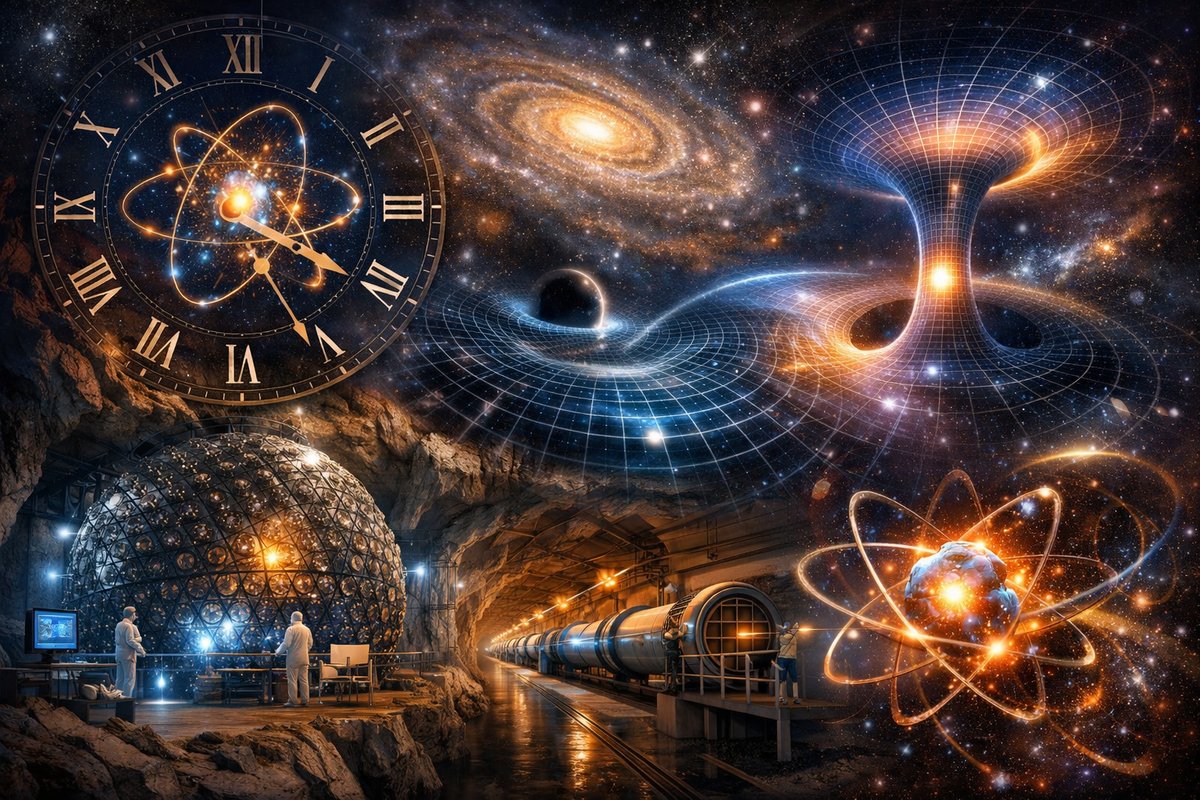
Researchers are deploying novel precision tools-from quantum timekeepers to subterranean particle detectors-to chart the hidden rhythms of the cosmos. Blending cutting-edge experiments with age-old questions about origin and impermanence, these efforts reveal how the flow of time and the fabric of matter entwine in a grand cosmic tapestry.
In an isolated mountain valley, a cluster of steel-encased chambers hums quietly as lasers flash inside. Deep below the surface, in a cavern carved from ancient granite, detectors record fleeting traces of particles that traversed Earth’s crust. Far above, suspended in a vacuum chamber, an ensemble of trapped ions ticks with such regularity that scientists describe it as the most reliable timekeeper ever built. Across these disparate labs, a single quest unites diverse research teams: to understand how time and matter weave together, and what mysteries lie hidden within their interplay.
The heartbeat of this scientific odyssey is precision. Atomic clocks, once bulky assemblies of mirrors and beam tubes, have slimmed down to chip-scale instruments that fit on a desktop. By cooling ions to a fraction of a degree above absolute zero and probing them with ultrastable laser light, researchers achieve time measurements accurate to parts in 10^18. Translated to everyday scales, these clocks would deviate by less than a second over the entire age of the universe. Such fidelity enables tests of general relativity on tabletop scales-detecting minute shifts in time dilation when the clock moves just a few centimeters above Earth’s surface.
Beyond pure chronometry, these devices unlock new windows into dark phenomena. Tiny discrepancies between two clocks separated by altitude or gravitational potential offer clues about how matter and energy shape spacetime. If an unknown field or particle exerts even a vanishingly small influence, it could manifest as a drift in one clock relative to another. Experiments in shielded labs now search for hints of hypothetical ultralight particles that might account for dark matter, using time itself as a detector.
Meanwhile, deep-earth observatories pursue a complementary line of inquiry. In the bowels of decommissioned mines, arrays of scintillation detectors lie ensconced in water tanks shielded from cosmic rays. Here, physicists track neutrinos and other ghostly particles produced by natural radioactive decay and cosmic interactions. These subterranean experiments probe how matter hides subtle quantum effects in bulk samples, and how those effects ripple outward to influence geophysical processes.
One particularly ambitious project uses a network of borehole-deployed sensors to monitor seismic vibrations and rare particle interactions simultaneously. By correlating mechanical tremors with particle detection events, researchers hope to disentangle geological noise from cosmological signals. The ultimate aspiration is to detect traces of ancient supernovae imprinted in deep-earth matter, or to glimpse the slow decay of proton-like structures predicted by grand unified theories.
At the crossroads of these subterranean and chronometric efforts lies quantum metrology-an interdisciplinary field where matter waves, entangled particles, and squeezed light converge to push measurement boundaries. In a laboratory lit by blue laser diodes, an ensemble of ultracold atoms floats in an optical lattice, each atom held at a precise point by an interference pattern. When these atoms are probed collectively, their quantum correlations enhance the sensitivity of timing and field measurements beyond classical limits. This quantum advantage allows researchers to detect feeble electromagnetic fluctuations or gravitational perturbations that would otherwise be buried beneath thermal noise.
Yet, perhaps the most profound revelations emerge when time and matter are considered philosophically rather than just technically. A growing cadre of theorists contends that time might not be a fundamental entity but an emergent property arising from entangled quantum states. In this view, the flow of time emerges from the web of correlations among particles in a closed system. Gravity, spacetime curvature, and inertial motion would then all be facets of an underlying quantum information structure. To probe these ideas experimentally, interdisciplinary teams are designing tabletop tests that mimic cosmological conditions using superconducting circuits or photonic networks.
One challenge in mapping these exotic regimes is isolating systems from environmental disturbances. Even the faintest electromagnetic fields or thermal gradients can drown out the delicate quantum signals. In response, some labs have adopted sustainable practices to minimize interference. Active cooling systems powered by renewable sources, low-emissivity materials for shielding, and vibration-damping mounts crafted from recycled composites all contribute to an experiment’s fidelity. By reducing external noise and environmental impact, scientists ensure both scientific rigor and ecological responsibility.
In parallel with these laboratory pursuits, field experiments are unfolding in extreme environments where nature itself tests the limits of time and matter. High-altitude balloons carrying atomic clocks into the stratosphere measure time dilation under changing gravity gradients. Antarctic research stations deploy bare optical cavities above the snow to capture atmospheric effects on laser stabilization, offering insights into both climate science and fundamental physics. Even aboard zero-gravity flights, handheld quantum gravimeters map tiny variations in Earth’s gravitational field, with implications for mineral exploration and geodesy.
The insights gleaned from these endeavors ripple outward into other domains. Engineers designing navigation systems for deep-space probes must account for minute relativistic corrections over interplanetary journeys. Materials scientists exploit atomic-scale understanding to develop resilient alloys and superconductors. Medical imaging techniques such as magnetic resonance rely on principles born of quantum metrology. Each advance in timekeeping and particle detection extends a tendril into unexpected territories-bridging the abstract with the tangible.
Beyond purely scientific gains, the pursuit of time and matter carries an emotional resonance. It echoes humanity’s ancient longing to chart the heavens, to decode the language of nature, and to transcend the constraints of our fleeting existence. When a clock measures an infinitesimal tick, or a detector registers a lone neutrino, we glimpse the universe’s silent dialogue-a conversation that has persisted for billions of years.
In classrooms and public forums, outreach initiatives bring these concepts to wider audiences. Portable cloud chambers produce ephemeral tracks of subatomic particles, captivating students with the visible footprints of cosmic visitors. Interactive exhibits allow visitors to slow down virtual time in a gravitational field or to trigger quantum entanglement experiments on touchscreen devices. These immersive experiences foster curiosity, demystify advanced research, and inspire the next generation of explorers.
Yet challenges remain. As instruments grow ever more sensitive, safeguarding data privacy and integrity becomes crucial. Secure time-stamp protocols must ensure that collected measurements remain tamper-proof, especially when used for navigation or communication systems. Collaborative networks sharing data from globally distributed clocks and detectors require encryption and robust authentication to prevent interference or malicious manipulation.
Looking ahead, the next decade promises even bolder initiatives. Space-based interferometers may directly measure gravitational waves at low frequencies, mapping the mergers of supermassive black holes. Ultra-cold atom interferometers could probe the quantum nature of gravity. Terrestrial networks of atomic clocks might form a synchronized grid, enabling real-time monitoring of tectonic shifts or volcanic activity. Meanwhile, hybrid platforms combining mechanical resonators, photonic circuits, and trapped ions could implement prototype quantum simulators of cosmological evolution.
In the interplay of time, matter, and mystery, every experimental breakthrough reframes our place in the cosmos. Each precision tick or particle trace draws back the veil on questions as old as humanity’s first stargazing gaze. While the ultimate answers may elude us for generations, the journey itself enriches our collective narrative-one of curiosity, creativity, and the enduring quest to know the unfathomable.
As probes hum in valleys, clocks glimmer in labs, and detectors listen deep underground, we stand at the threshold of revelations that promise to reshape our understanding of reality. In that moment of anticipation-when theory and experiment converge-we witness science transforming mystery into story, and story into a deeper grasp of existence.