Location
Mount Vernon, WA 98274

Location
Mount Vernon, WA 98274
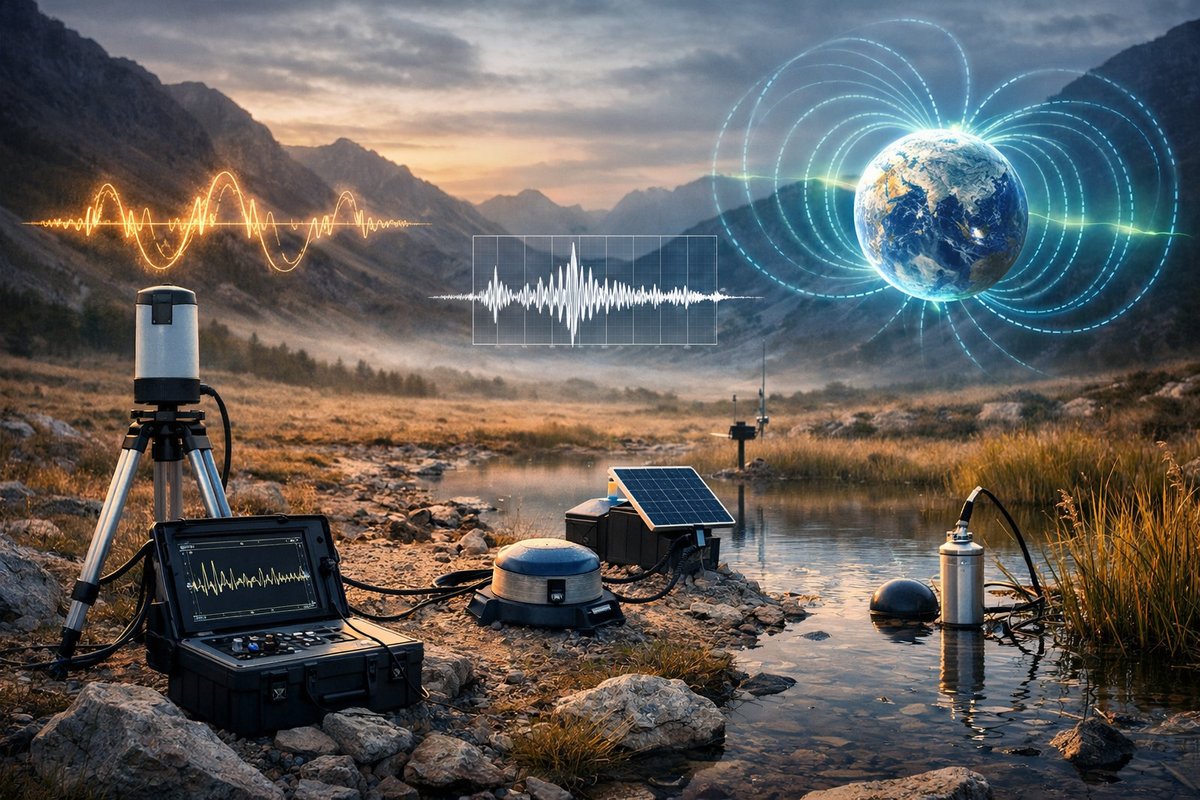
In a remote basin, geoscientists have deployed a novel array of magnetometers, microseismic sensors, and water-level loggers to capture hidden interactions between groundwater flows and magnetic fluctuations. Their early data hint at rhythmic couplings that could reshape water management, earthquake forecasting, and our sense of the planet as a living, dynamic system.
Far from the buzz of urban centers, a team of geophysicists and hydrologists has turned an arid desert basin into a living laboratory. With sensors anchored in dry washes and boreholes, they are eavesdropping on Earth’s faintest murmurs, seeking the subtle choreography of forces beneath our feet. What began as a proof-of-concept for measuring groundwater movement has blossomed into an integrated investigation of how fluid flow, rock stress, and magnetic fields converse in silent harmony.
Traditional monitoring methods treat each phenomenon in isolation: groundwater wells log water levels, seismographs record tremors, and magnetometers track field variations. In this experiment, researchers have co-located all three sensors at multiple sites, connecting them through a low-power wireless network. The goal is to detect spatiotemporal patterns-diurnal or seasonal cycles, storm-driven pulses, even cosmic influences-that only emerge when data streams merge.
At each monitoring node, a portable magnetometer measures fluctuations in the local magnetic field down to fractions of a nanotesla, while a microseismic sensor records ground vibrations at frequencies barely perceptible to the human ear. Buried pressure transducers log changes in groundwater depth every few minutes. All devices feed data to a nearby LoRaWAN gateway, which relays compressed packets to a central server powered by solar panels and battery packs.
This modular, open-source design leverages off-the-shelf electronics wherever possible. Fiber-optic cables donated by a collaborating university link deeper wells, enabling distributed acoustic sensing (DAS). Lightweight data loggers, built from energy-efficient microcontrollers, keep power consumption under 100 milliwatts. Over months of operation, researchers fine-tuned sample rates and synchronization to ensure magnetic pulses and seismic hums could be aligned with fluid level shifts to within a second.
Early analyses have already yielded surprises. Diurnal recharge from overnight cooling winds triggers subtle pore-pressure changes that propagate through the shallow aquifer. These pulses, in turn, induce minute elastic strains in surrounding rock, which slightly perturb the ambient magnetic field. The result is a regular cycle: groundwater rises, rock flexes, magnetometers tickle higher readings-and then everything resets at dawn.
Beyond Earth’s own forces, the team detected faint signatures of cosmic-ray modulation. During brief storms of charged particles from solar activity, magnetometer baselines waver. These external influences appear to amplify or dampen the local strain-induced magnetic response, suggesting an unexpected bridge between space weather and subsurface hydrogeology.
To untangle these overlapping signals, researchers have turned to machine learning. Algorithms trained on synthetic datasets flag recurring patterns, classify anomalies, and even suggest causal links among variables. An emergent property of this cross-disciplinary approach is the realization that the desert basin behaves as a complex adaptive system, where small inputs can cascade into larger-scale responses.
Practical benefits ripple outward from these discoveries. By correlating groundwater levels with microseismic and magnetic indicators, local water managers hope to refine recharge estimates for sensitive aquifers. In regions prone to low-magnitude tremors, the same network could offer early warning signs of shifting stresses. Even in agricultural zones, insights into subsurface fluid dynamics could inform irrigation schedules and conservation strategies.
Citizen scientists are joining the effort too. A smartphone app turns built-in magnetometers into crowd-sourced data collectors. Enthusiasts upload time-stamped field measurements, expanding the network’s footprint beyond official stations. While these readings lack the precision of lab-grade instruments, they help map broad trends and test hypotheses at scale.
Ethical considerations and sustainability guide every step. Solar-powered gateways minimize fossil-fuel reliance, and low-energy sensors reduce environmental impact. Data governance policies protect sensitive location information, ensuring that both private landowners and public stakeholders can trust the network’s deployment.
Building on the desert pilot, the team plans to link their ground stations with satellite observations of soil moisture and gravity anomalies. By merging orbital and in-situ data, researchers aim to create a planetary-scale view of fluid flows, tectonic pulses, and magnetic whispers.
“Nature doesn’t segment itself into disciplines,” reflects the project lead. “By listening to multiple voices at once, we begin to hear harmonies that were invisible before. It’s not just about cataloging data-it’s about cultivating wonder at the processes that sustain our world.”
Challenges remain: refining sensor calibration, enhancing network resilience under extreme weather, and scaling analysis pipelines to handle terabytes of continuous recordings. Yet each obstacle reveals an opportunity for innovation-whether through advanced materials, decentralized data protocols, or collaborative design sprints that span continents.
As this desert experiment matures, its ripple effects promise to reach far beyond one basin. The vision is a global mesh of listening posts, each tuned to nature’s silent rhythms, weaving a tapestry of real-time insights into groundwater stewardship, seismic resilience, and the planetary forces that shape our environment. In doing so, we gain more than data-we rediscover our capacity to marvel at Earth’s hidden symphony.