Location
Mount Vernon, WA 98274

Location
Mount Vernon, WA 98274
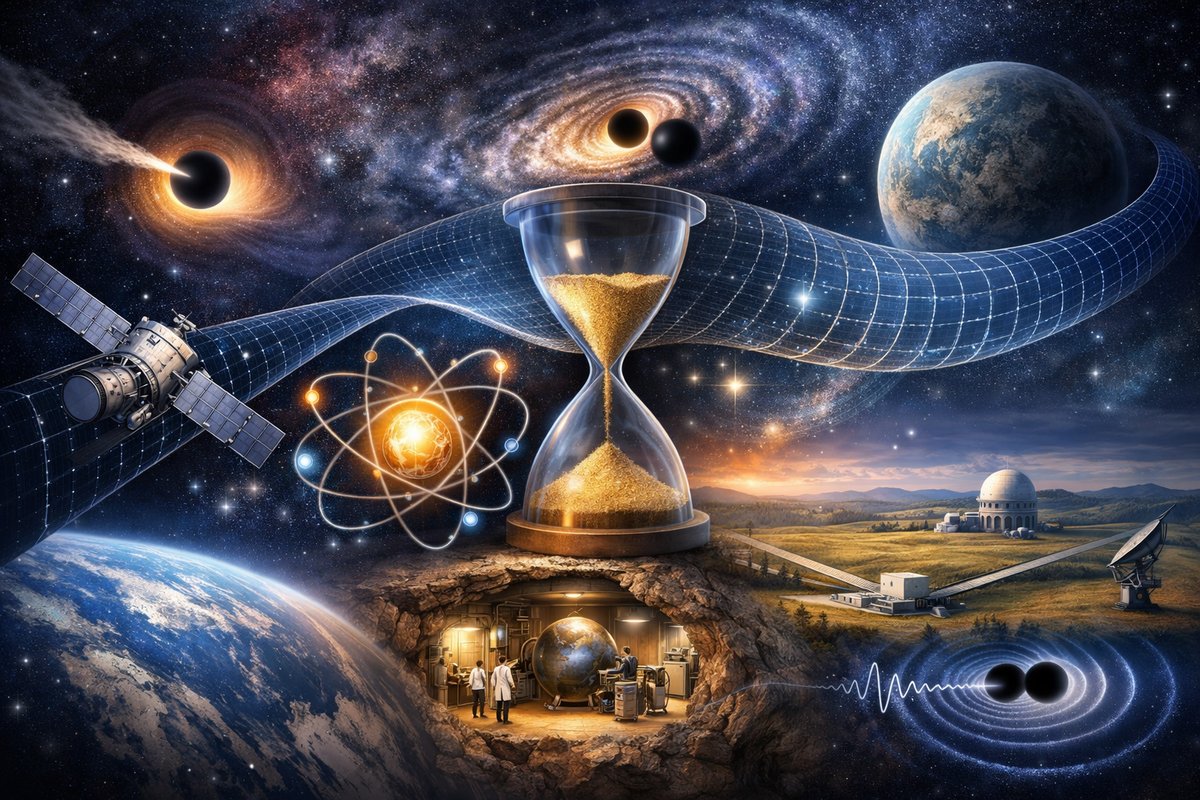
A wave of recent breakthroughs is revealing time and matter as two sides of the same cosmic coin. From space-borne atomic clocks to underground dark-matter labs and gravitational-wave observatories, scientists are assembling an unprecedented tapestry of reality that reshapes both fundamental physics and practical technology.
Scientists stand at a remarkable crossroads where the most precise timekeepers, the darkest realms of matter, and the faintest cosmic whispers converge to reshape our understanding of reality. In laboratories buried beneath mountains, in observatories scattered across continents, and in satellites orbiting Earth, a variety of experiments are teasing apart the interplay between time, mass, and the deep mysteries that bind them. These efforts not only illuminate the inner workings of the universe but also promise transformative advances in navigation, communication, and environmental monitoring.
One of the most striking developments comes from space-based atomic clocks. Aboard a recent mission, ultra-stable optical clocks were installed on a low-Earth orbit platform to test Einstein’s predictions with previously unattainable precision. As these clocks whir against their ground counterparts, minute differences in their tick rates-driven by variations in gravity and velocity-are mapped in real time. This isn’t purely academic. By charting the subtle warping of time caused by Earth’s uneven mass distribution, researchers are developing a global timekeeping network that doubles as a geodetic sensor, capable of detecting shifts in sea level, ice mass, and even underground water reserves.
Meanwhile, back on the ground, optical lattice clocks housed in climate-controlled vaults are engaging in their own high-stakes duel. Two labs separated by mere meters in elevation are comparing ticks with a fractional uncertainty approaching one part in 10^19. That level of precision means that a clock at sea level and its partner on a nearby hill can register a measurable time dilation in just hours. By combining data from dozens of such installations worldwide, scientists hope to produce a continuous map of Earth’s gravitational potential, effectively watching the planet’s matter move and evolve in near real time.
Out in the open, but shielded by kilometers of rock, gravitational-wave observatories are eavesdropping on spacetime itself. The latest observation run-the most sensitive yet-has cataloged dozens of mergers involving black holes and neutron stars. Each ripple carries a unique signature of mass, spin, and distance, offering a direct glimpse into how matter behaves under extreme conditions. Researchers are now experimenting with quantum squeezing techniques to push detector sensitivity even further, a move that might one day reveal the faint hum of primordial waves generated in the first instants after the Big Bang.
Deep beneath the Antarctic ice, an upgraded neutrino telescope is catching elusive cosmic messengers that have traversed billions of light-years. By measuring the tiny delays in neutrino arrival times relative to photons and gravitational signals, physicists are homing in on the neutrino’s minuscule mass, one of the last unknown quantities of the Standard Model. Those findings could have profound implications for the history of matter in the universe, informing theories about why galaxies hold together and how cosmic structures evolved.
Even darker corners of the cosmos are not left out. A suite of underground dark-matter detectors, shielded from cosmic rays, is relentlessly searching for weakly interacting massive particles (WIMPs). Each null result constrains theoretical models, tightening the net around the particle nature of dark matter. But the quest feels as much philosophical as technical: to find unseen matter that shapes galaxies and drives cosmic history, scientists must push both their instruments and their theories to the brink.
Observations of the cosmic microwave background (CMB) offer yet another vantage point on time and matter. New polarization measurements, performed by balloon-borne telescopes and high-altitude platforms, are refining our picture of the universe’s infancy. Tiny fluctuations in the temperature and polarization of the CMB trace the influence of quantum fluctuations and gravity during the epoch of recombination. These data form a bridge between the quantum world of particles and the cosmic scaffold of galaxies, revealing how the universe’s earliest matter distributions evolved into the web we observe today.
Taken together, these diverse efforts are weaving a tapestry in which time and matter are inseparable threads. The interplay of clocks and gravimeters maps the flow of time against shifting mass. Gravitational waves and neutrino bursts trace moments of extreme matter interactions in spacetime. Dark-matter hunts and CMB surveys chart the skeleton of invisible matter that underlies all cosmic history. By synthesizing insights across these platforms, researchers seek a unified narrative that honors both quantum uncertainty and cosmic order.
The practical upshots of this research are already flowing into everyday life. More accurate timekeeping enhances global navigation systems, enabling autonomous vehicles to traverse challenging terrain and ships to navigate treacherous waters with greater safety. Gravity-based clocks promise early warnings for volcanic activity and groundwater depletion, boosting resilience in regions threatened by natural disasters. Quantum sensors derived from interferometry techniques are poised to revolutionize mineral exploration and archeology, detecting subtle subsurface features without invasive drilling.
Beyond technology, these experiments strike at the heart of our human impulse to tell stories about existence. Each measurement, each unexpected anomaly, becomes a chapter in a narrative that stretches from the moment of the Big Bang to the ticking of a watch on your wrist. In grappling with the mutual shaping of time and matter, we confront profound questions about causality, permanence, and the nature of change.
Looking ahead, the coming decade promises even more dramatic strides. Proposed space missions aim to place atomic clocks at Lagrange points, where the delicate balance of gravity and inertia can be harnessed for ultra-stable timebases. Next-generation gravitational-wave arrays will span multiple hemispheres, capturing a fuller symphony of spacetime vibrations. Deep-underground neutrino observatories will grow in scale, unlocking new windows onto the high-energy universe. Each initiative will add fresh twists to our evolving story of how time and matter dance together across scales.
In a world where every second is stamped by digital pulses and every particle carries the imprint of cosmic history, these scientific endeavors remind us that reality remains richer and more mysterious than any single narrative can capture. As clocks grow ever more precise and detectors ever more sensitive, the boundary between what we know and what we imagine continues to shift. Embracing that uncertainty is both a challenge and a gift: it keeps alive the curiosity that drives us to explore, to question, and to dream.
So the next time you glance at a clock or look up at the stars, remember that you are peering into a grand experiment billions of years in the making-a story still being written by the interplay of time, matter, and mystery.