Location
Mount Vernon, WA 98274

Location
Mount Vernon, WA 98274
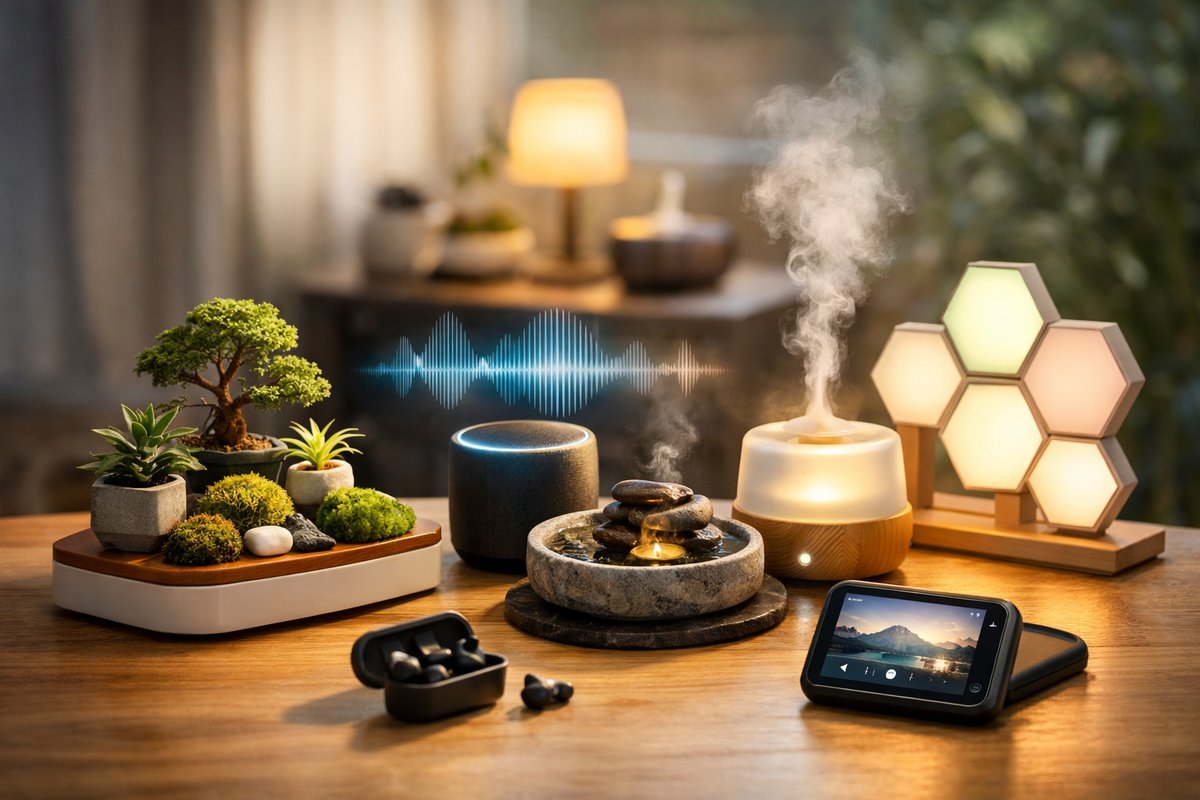
From pocket-sized plant clusters to curated ambient soundscapes, subtle shifts in daily life are converging into a broader movement of modular living. These emerging micro-worlds marry technology, sustainability, and emotional intelligence, revealing how tiny rituals are foreshadowing a new cultural pulse.
Every morning, Mia arranges a quartet of tiny succulents on the corner of her desk. Each planter is self-watering, tied together by a thin magnetic base that lets her reconfigure the display in seconds. She taps her phone, and a strip of programmable LED light behind her monitors pulses from dawn-like amber to mid-day white. On the right, a small white noise machine simulates distant rainfall. On the left, she flips open an eco-friendly journal and scribbles her first intention for the day.
These micro-rituals have become more than decorative flourishes. They form part of a quiet revolution in how we structure our homes, our screens, and our heads. Across living rooms and digital channels worldwide, people are calibrating tiny ecosystems-both analog and virtual-to foster calm, connection, and purpose in an era of fragmentation.
In the aftermath of rapid digital overload, niche communities are flourishing around the cultivation of micro-habits. On one online forum, aficionados swap tips for growing airborne moss “cloud gardens” in transparent orbs. In another, remote workers exchange recipes for single-cup cold brews. What binds them isn’t scale or notoriety, but intimacy: a shared satisfaction in fine-tuning the small parts of life.
These micro-worlds are often enabled, paradoxically, by modular tech. Plug-and-play controllers let users weave together bespoke home environments, whether that means syncing soft light to circadian rhythms or triggering a sparrow-song soundtrack whenever a calendar meeting ends. Instead of monolithic gadgets, the focus has shifted to interoperability-tools that can be as easily swapped out as plants in Mia’s magnetic planters.
Sustainability-minded makers are riffing on this trend with reconfigurable furnishing. Shelves that clamp onto adjustable rails become mini apothecaries for dried teas and foraged herbs. Desk organizers constructed from recycled plastics segment cables and notebooks by color, so that even the mundane act of plugging in a charger becomes an aesthetic statement. The modular ethos spills into clothing, too, with snaps and magnetic fasteners letting wearers adapt jackets and backpacks on the fly.
At the core of this phenomenon is a values-driven approach: less waste, more curiosity, and deeper emotional intelligence. By breaking down life into modular moments-morning journaling, micro-gardening, ambient listening-people are learning to notice friction points and fill them with intention. One woman uses a pocket-sized mindfulness timer to pause for ten seconds every hour, marking each break with a doodle in a recycled-paper notebook. Her habit tracker charts these pauses alongside steps walked, linking mental rest with physical movement.
These small shifts are already rippling outwards. Urban planners in several cities have piloted “micro-oasis” pockets-tiny plots reclaimed from parking spaces-where neighborhoods can adopt a single planter, complete with soil sensors and solar-powered drip irrigation. The pilot projects gather data on local heat reduction, air quality improvement, and social engagement, demonstrating how even one square meter of green can nudge entire blocks toward collective care.
In the digital sphere, apps designed around micro-goals are surging in popularity. Instead of ambitious to-do lists, they ask users to commit to five minutes of language practice, two minutes of deep breathing, or a single page of reading. Gamified feedback tracks these micro-wins and integrates them into broader progress reports, making sustained effort feel both achievable and rewarding.
Designers are exploring analogous experiments in public spaces. A new café in a European capital invites patrons to “build your own corner”-a modular partition system hosts user-submitted art, book swaps, and plant cuttings. Visitors are encouraged to rearrange the partitions throughout the day, turning the café into an evolving tapestry of local tastes. The project underscores how small acts of co-creation can foster a sense of ownership and playful discovery.
Brands and manufacturers, recognizing the appeal of modular simplicity, are rethinking product lifecycles. Rather than dumping old gadgets into landfills, some are offering component exchange programs: customers mail in a worn-out light panel or a depleted planter cartridge and receive a replenished module in return. The model reduces waste and invites users to see each purchase as part of a fluid ecosystem, rather than a disposable object.
Educational institutions are also tapping into micro-learning trends. Workshops on single-topic crafts-like weaving a straw coaster or casting a tiny concrete vase-grant students immediate, tactile rewards. By celebrating the manageable scale of these projects, educators are fostering confidence and curiosity, countering the intimidation of larger artistic or technical endeavors.
Perhaps most intriguingly, these micro-movements are seeding macro-change. When people discover the value of small successes, they often carry that mindset into civic life. A neighborly initiative to install a dozen smart planters in an alley can blossom into a full-block community garden. A daily five-minute gratitude note shared on a social feed can galvanize a network of mutual support. The cumulative effect hints at a future where large-scale change begins at the level of personal habit.
Of course, fragmentation remains an undercurrent: without mindfulness, modularity can fracture into mere novelty. But when combined with clear values-sustainability, inclusivity, and emotional awareness-these micro-worlds can anchor us. They remind us that progress often isn’t a grand sweep, but a series of intentional tweaks, reconfigurations, and small offerings.
Back at Mia’s desk, the succulents glow under shifting light. Her journal lies open, half-filled with dreams for the week ahead. With each modular module-planter, light strip, journal prompt, ambient sound-she’s forging a personal ecosystem that resonates far beyond her small workspace. In stitching these micro-worlds together, she’s not just crafting her own day; she’s weaving the first threads of a broader cultural tapestry-and illuminating where we might all be headed next.