Location
Mount Vernon, WA 98274

Location
Mount Vernon, WA 98274
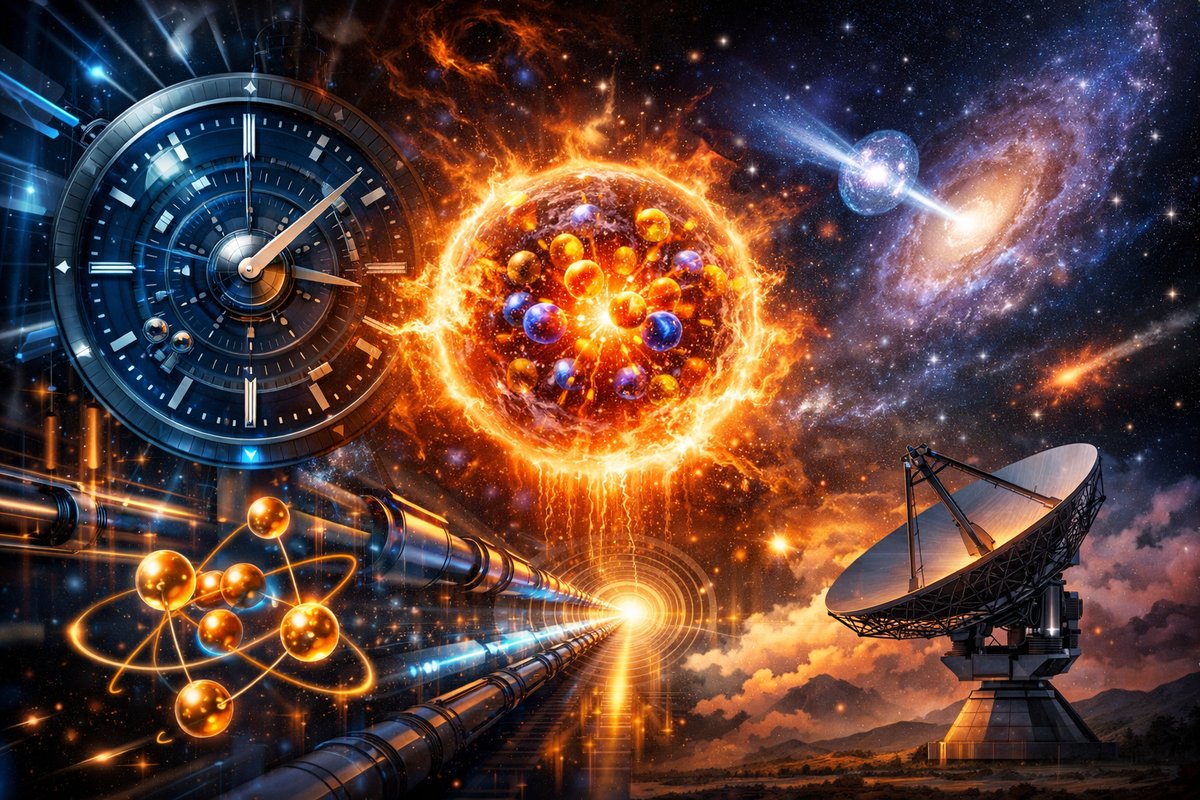
A wave of groundbreaking experiments is reshaping our understanding of time's flow, the behavior of exotic forms of matter, and the lingering enigmas of the cosmos. From ever-more-precise atomic clocks to laboratory-created quark-gluon plasma and unexplained cosmic signals, researchers are piecing together a narrative that spans the subatomic realm to intergalactic scales.
For centuries, time, matter, and mystery have been the pillars around which our scientific stories take shape. In recent months, a series of high-precision measurements and bold laboratory recreations have converged to reveal hidden contours in the fabric of reality. Atomic clocks operating on research aircraft have directly measured time dilation across altitudes. In subterranean detector halls, scientists have glimpsed fleeting forms of exotic matter that existed only microseconds after the Big Bang. And beyond our planet, mysterious bursts of energy continue to challenge existing theories.
One of the most vivid confirmations of Einstein’s century-old insight comes courtesy of a mobile atomic clock network. Researchers from a leading standards institute have placed next-generation optical atomic clocks on board high-altitude jets, observing that clocks aboard the aircraft tick ever so slightly faster than identical devices on the ground. By comparing time stamps accurate to better than one part in 10^18, teams have measured gravitational time dilation with unprecedented clarity. These results not only refine navigation systems and global positioning networks-they also underscore how intimately time is woven into the geometry of spacetime.
Deep beneath the earth’s surface, in shielded experimental caverns, physicists are recreating conditions normally reserved for the heart of stars and the first instants of the universe. In heavy-ion collision facilities, beams of atomic nuclei slam together at velocities approaching the speed of light, melting ordinary protons and neutrons into a seething quark-gluon plasma. For mere fractions of a second, this exotic matter exists at trillions of degrees, behaving more like a perfect fluid than a gas. Today’s detectors register subtle flows and correlations among the liberated quarks, offering insights into how the early universe cooled into the building blocks of atoms.
While lab-made quark soup answers fundamental questions, the universe itself continues to pose new mysteries. Fast radio bursts-intense, millisecond-long flashes of radio waves from distant galaxies-have become a frontier of inquiry. Though telescopes have pinpointed dozens of these enigmatic pulses, their origin remains elusive. Some models propose magnetized neutron stars or colliding black holes; others envision interactions with hypothetical dark matter particles. Each new detection sends ripples through theory circles, prompting fresh simulations and high-energy particle searches aimed at capturing the fingerprints of exotic fields or undiscovered forces.
Closer to home, instruments tuned to spacetime’s faintest tremors have started harvesting a trove of data on gravitational waves. Since the first landmark detections, observatories on separate continents have recorded tens of collisions between black holes and neutron stars. These ripples in the cosmic tapestry not only confirm general relativity in extreme regimes but also reveal the astrophysical demographics of dark, compact objects. Recently, researchers detected a merger that emitted both gravitational waves and a burst of light, offering a dual view of cataclysmic stellar death throes. In combining electromagnetic and gravitational signatures, scientists are mapping uncharted territories where matter, energy, and gravity intertwine.
Beyond data points and detector readouts, these breakthroughs ripple into our human narrative. Time dilation reshapes how we reckon age and simultaneity; exotic matter experiments hint at technologies yet to come, from next-generation materials to quantum information platforms. The cosmic signals we chase remind us of our place in an expanding universe, one that still holds secrets beyond our current theories. Each measurement, each flash of data, builds a collective story that we all inhabit-one of curiosity, ingenuity, and wonder.
Looking ahead, the synergy between tabletop experiments and sky-spanning observatories promises even deeper revelations. Quantum entanglement might someday be harnessed to build clocks so precise that they detect vertical motion across a single human height. Particle colliders could explore new energy regimes, probing whether additional dimensions or unknown symmetries lurk beneath the Standard Model. Large arrays of detectors-on land, in space, and under the sea-will listen to subtler vibrations of spacetime, potentially eavesdropping on the echoes of black hole formation or the whisper of primordial gravitational waves from an inflationary burst.
In the end, exploring time, matter, and mystery is more than esoteric inquiry-it’s an act of meaning-making. We map the contours of reality to better understand our own narratives: the fleeting moments we live, the substance we are made of, and the unknowable horizons that beckon. As new experiments unveil ever-finer threads in the cosmic weave, each discovery invites us to reimagine our relationship with the universe. In that ongoing tale, every measurement is both an ending and a beginning-a reminder that the story of reality is still being written, one precise tick and one fleeting particle at a time.