Location
Mount Vernon, WA 98274

Location
Mount Vernon, WA 98274
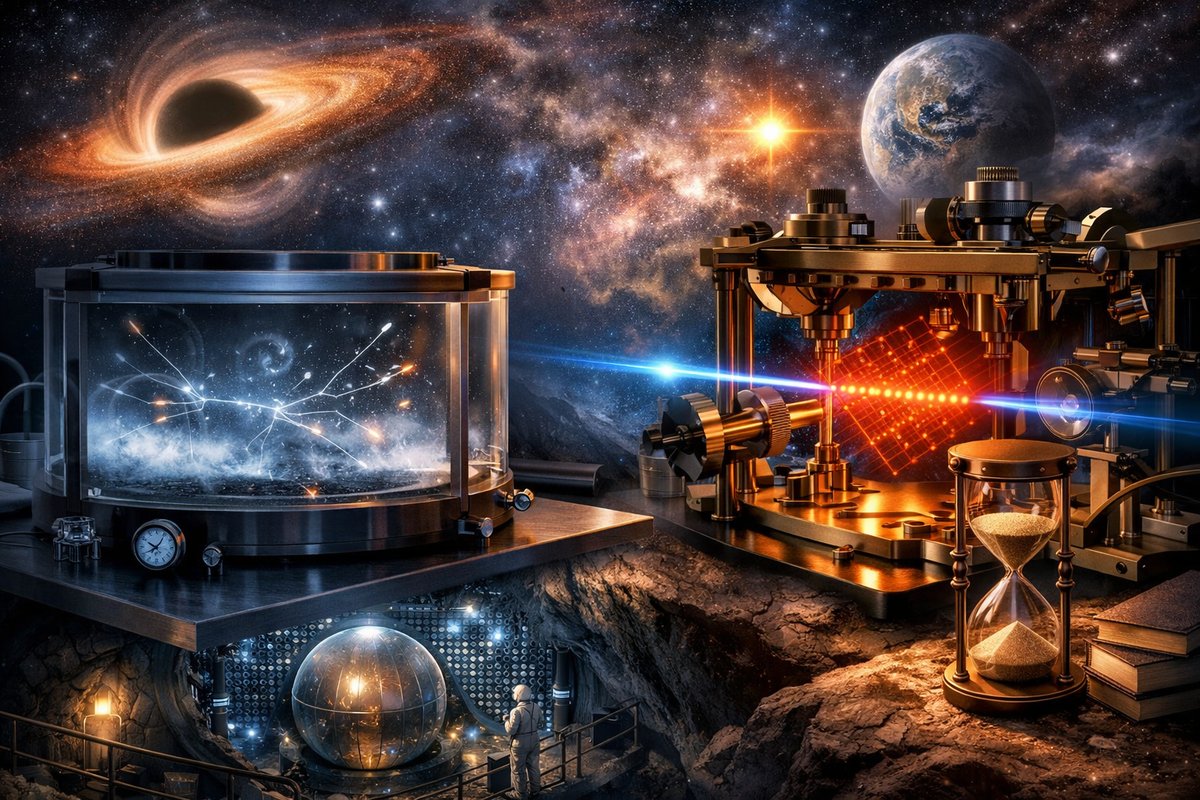
From tabletop cloud chambers to ultra-precise optical lattice clocks, researchers are tearing open the veil of reality to glimpse the interplay of time, matter, and entropy. These breakthroughs, ranging from home-based particle detectors to underground observatories, are redefining how we experience the cosmos.
In a quiet laboratory tucked beneath a suburban basement, pale streaks of light trace ghostly arcs across a small glass chamber. Meanwhile, half a world away in a temperature-controlled vault, a lattice of laser-cooled atoms ticks at a rate so steady it would only drift by a second over the age of the universe. These two scenes might seem worlds apart, yet both are part of a sweeping scientific movement: to unravel time, matter, and the subtle complexity that binds them.
The last decade has seen a dramatic convergence of precision engineering and humble curiosity. Ultra-stable optical lattice clocks, once confined to national metrology institutes, have become more compact and user-friendly. By trapping strontium atoms in a standing-wave of laser light, researchers have achieved fractional uncertainties below 10^-18, sensitive enough to detect the tug of Earth’s gravity over a few centimeters of elevation. This isn’t just a demonstration of engineering prowess; it represents a new lens on fundamental physics. Variations in clock rate can test whether fundamental constants shift under cosmic influences, probe exotic dark matter fields, or even search for hints of quantum gravity at low energies.
Yet the story of timekeeping isn’t restricted to large institutions. Modern high-precision digital stopwatches, accurate to microseconds, have given educators and enthusiasts the tools to perform real-world tests of relativity in classrooms and garages. By timing light pulses over measured distances or comparing two synchronized stopwatches as one ascends in a drone, hobbyists can witness time dilation in action. Paired with single-board computer kits and open-source synchronization software, these simple setups become windows on Einstein’s century-old predictions.
While optical clocks govern the cutting edge of temporal resolution, particle fog chambers echo the dawn of subatomic exploration. Historically, these devices used supersaturated alcohol vapor to reveal the passage of cosmic rays and nuclear decay products. Today’s DIY cloud chamber kits ship with LED illumination and clear safety guidelines, allowing anyone to record alpha particles leaving straight filaments or muons carving faint arcs. When coupled with time-lapse cameras, these home setups transform everyday cosmic bombardment into captivating slow-motion sequences. Observers are reminded that even the air around us carries whispers of high-energy processes playing out in distant corners of the galaxy.
But raw observation is only the start. To truly engage with the mystery of matter, modern citizen scientists combine their chambers with portable Geiger counter radiation detectors. These handheld sensors measure ionizing events in real time, quantifying flux from natural radon in basements or elevated cosmic-ray counts at high altitude. By logging data on microcomputer arrays, users can map fluctuations with local weather conditions or solar activity, discovering the hidden variables that shape our radioactive environment.
It is in the realm of entropy, however, where the narrative threads of time and matter twist most intriguingly. The second law of thermodynamics describes an ever-increasing disorder, yet local systems can momentarily defy that trend. Laser diffraction grating sets, for example, let students scatter a coherent beam into colorful interference patterns, illustrating wave-particle duality and energy redistribution. Paired with a simple analog sundial or mechanical desk clock, these optical experiments become metaphors for entropy’s flow-light waves spreading into space as the hands of time sweep forward.
On a larger scale, entropy underpins research into black hole thermodynamics and information paradoxes. While these topics might seem far removed from cloud-chamber tracks, they share a deep connection: both hinge on how microscopic degrees of freedom coalesce into macroscopic phenomena. In surprisingly affordable electronics labs, enthusiasts can simulate spin systems or random-walk models on single-board computers. By visualizing how orderly arrangements dissolve into chaos, users can build intuition for why the arrow of time points irrevocably forward, even as fundamental laws remain reversible.
The practical implications of these explorations are far from abstract. Precise timing underlies next-generation navigation networks, secure communications, and distributed sensor arrays. Particle detectors can diagnose radiation leaks in medical or industrial settings, while entropy-inspired algorithms optimize data compression and machine learning. Even artistic installations have begun to harness these principles: time-lapse projections of cloud-chamber footage set to sonified clock ticks, or interactive museum exhibits that let visitors scatter virtual particles and watch the resulting diffusion in real time.
Bridging professional and kitchen-table science has always carried an emotional charge. There is something profoundly human about marking the passage of seconds, tracking the invisible flurry of subatomic debris, and contemplating the inexorable rise of entropy. These activities blend intellectual rigor with a childlike sense of wonder. They invite us to hold a stopwatch in one hand and peer into a cloud chamber with the other, making the cosmic feel intimate and the everyday feel extraordinary.
As the boundaries blur between major research centers and local makerspaces, the next wave of discoveries may emerge from unexpected quarters. A student team might use a time-lapse camera and diffraction grating to test novel light-scattering materials. A high school science club could repurpose an old stopwatch to explore synchronization networks. A backyard astronomer may synchronize an atomic clock module with telescope time stamps to refine measurements of variable stars. Each of these efforts contributes to a larger tapestry, weaving new threads into our evolving understanding of time and matter.
In the end, the pursuit of cosmic mysteries is not just a quest for equations or devices. It is a story about human curiosity, collaboration, and the willingness to engage with phenomena that stretch from the infinitesimal to the infinite. Every cloud-chamber streak, every jitter-free clock tick, and every flicker of an interference fringe is a reminder that the universe remains an open invitation to inquire and explore. By blending professional ingenuity with accessible tools, we all become part of the grand experiment to map the contours of reality itself.