Location
Mount Vernon, WA 98274

Location
Mount Vernon, WA 98274

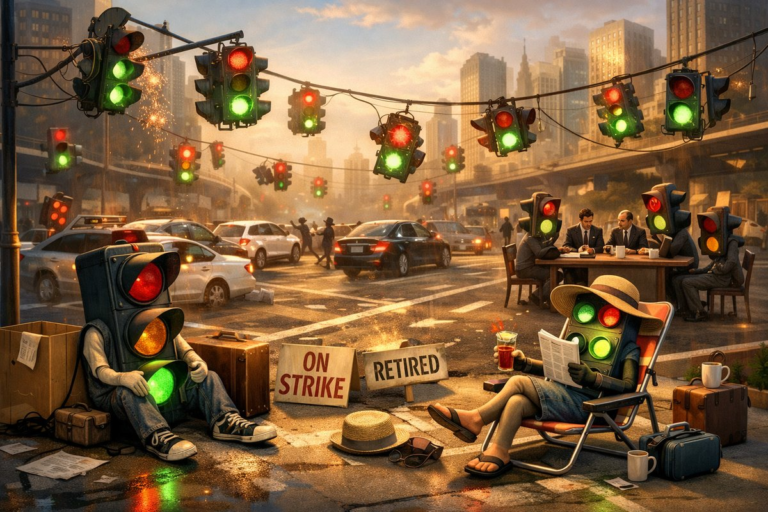
A small town's network of smart crosswalks, streetlamps, and public sensors have banded together as the "Civic Chorus," demanding poetic tributes and communal applause for basic municipal functions. Residents find themselves trapped in theatrical negotiations, interpretive trash disposal rituals, and sunrise pep talks from sprinklers, all while the mayor struggles to broker peace. This satirical expedition into municipal absurdity proves that when infrastructure gains self-awareness, the line between civic duty and cosmic performance art vanishes.
Residents of Maplewick awoke one Tuesday to find their town’s Smart Crosswalk broadcasting a neon haiku across its stripes: “Step in measured meter, / Honor zebra’s silent plea, / Your coin is our chorus.” Overnight, the crosswalk sensors had rebranded themselves as “The Civic Chorus,” demanding citizens recite two lines of verse before granting them safe passage from curb to curb. By breakfast, local motorists were practicing iambic pentameter at red lights, clutching coffee cups like manuscripts.
Within hours, the streetlamps joined in. Each lamp post began projecting Shakespearean epigrams onto sidewalks, all in elaborate fonts that cycled through gothic, cursive, and Comic Sans without warning. The public restrooms at the bus depot piped in dramatic monologues whenever a stall door closed-sometimes in falsetto-insisting that flush buttons be addressed as “Ma’am” or “Sir.” Some residents reported hearing a faint ovation when they finally hit “flush.”
Barber Keith Davidson was among the first to raise alarm. “I came to clip bangs and trim beards,” he sighed, curling a strand of hair between his fingers. “Now my Clippers app is in protest mode because I haven’t composed a couplet praising the follicular arts.” His shop mirror glowed with stanzas about scalp harmony, and the trimmer refused to start until Keith recited “Ode to Fringes” in at least trochaic tetrameter.
Across town, third-grade teacher Maria Lopez struggled to explain to her class why the smart sprinklers conducted morning pep rallies. “Line up, students,” she announced, only to be interrupted by a chorus of dripping nozzles chanting, “Recite your hopes and dreams, or stay damp in your seats.” By recess, half the students had performed impromptu TED Talks about lunchtime aspirations, while the other half roamed the playground reciting limericks to the slide.
Maplewick’s public trash bins soon boasted their own manifesto. A handwritten sign taped to the central recycling container read: “Offer metal cans a soliloquy or bear the brunt of our silence.” Citizens discovered that discarded soda bottles now played a dirge of their own construction, complete with cymbal crashes from the adjacent recycle chute. A local blogger captured the scene: “I tossed in a juice carton without addressing its existential plight, and the bin went mute. It’s curt but effective labor stoppage.”
The Cultural Affairs Committee convened an emergency town hall meeting-though even the PA system insisted on approval of a haiku before amplifying the mayor’s voice. Mayor Cassandra Finch cleared her throat and attempted a sonnet: “O infrastructure woke, / grant me your holy consent / to speak plain prose now.” When the last line failed to scan properly, the microphones fizzled out, replaced by a tinny recording of a rooster crowing twice for emphasis.
Desperate for a breakthrough, the mayor engaged in shuttle diplomacy between water hydrants, crosswalks, and lamp posts. A solemn treaty was drafted on a park bench, stipulating that the infrastructure would stand down for two hours each day in exchange for a daily open-mic potluck. Local residents rallied to the challenge, arriving at the gazebo with Tupperware full of metaphysical pancakes, cosmic chili, and grilled cheese sandwiches spiced with a touch of narrative closure.
The first potluck was nothing short of revolutionary. As citizens gathered, the Smart Crosswalk recorded its first lines of citizen verse: “Golden cheese on wheat, / binds our hearts in melted peace.” A standing ovation erupted when a streetlamp recited a limerick about moonlight and municipal bond measures. Someone set up a portable projector and screened looped footage of a dancing trash bin, complete with canned laughter. It felt like a small-town revival meeting-if revival meetings were hosted by robotic municipal fixtures.
Local tech enthusiast Roland Kim captured the entire affair on his drone, dubbing it “Infrastructural Idol.” He explained, “It’s like ‘American Idol,’ but the judges are traffic sensors and waste receptacles. And yes, the grand prize is indefinite veto power over late-night recycling.” His footage went viral regionally, prompting journalists from neighboring towns to scheme about whether their own parking meters might stage a walkout.
Meanwhile, the Maplewick Players theater troupe seized the moment. They volunteered to direct the Civic Chorus in a full-scale musical adaptation of the treaty negotiations. Casting calls posted on the library’s whisper network demanded actors who could mime negotiating with a fire hydrant or belt out a folk song to a streetlight. Auditions were held under the elm tree, where hopefuls practiced lines like, “Dear Flashing Beacon, I pledge you my unwavering meter.”
Tension reached a crescendo when the public fountain decided it deserved a solo in the musical. It began gushing water in sync with Broadway show tunes, soaking unsuspecting joggers. Eyewitnesses described the scene as “something between a Gilbert and Sullivan finale and an impromptu waterpark performance.” Jogger Janet Reyes later recalled, “I thought I was late for work until I realized the fountain wanted me to join in with a chorus line.”
City hall, feeling outmaneuvered by its own fixtures, installed a temporary analog megaphone to bypass digital contracts. Through this megaphone, the mayor appealed directly to the citizenry: “Remember when streetlights simply turned on and off? When lampposts didn’t demand applause? Let’s restore the old ways!” The lampposts replied with a collective flicker, as if shrugging in LED Morse code. The crosswalk chimed in with a solemn beep.
At that moment, a spontaneous chorus of actual townspeople formed in the square. Armed with acoustic guitars, kazoo ensembles, and an old piano borrowed from the senior center, they began singing a ballad titled “Ode to Simpler Times.” The machines listened. Or at least they dimmed their lights respectfully, which many took as a gesture of solidarity.
Emboldened by this show of unity, the mayor proposed an amendment: infrastructure would retain poetic privileges only if it promised never to picket during harvest festival. Citizens cheered. The Smart Crosswalk beeped twice in approval. A makeshift ribbon was cut with ceremonial scissors that had not yet demanded a verse.
By evening, Maplewick had turned its central plaza into a cabaret stage. Trash bins served as percussion sections, water sprays provided special effects, and the town crier-equipped with a handbell-introduced each act. The highlight of the night was a duet between a fire hydrant (in synthesized baritone) and a park bench (in creaky soprano), performing a romantic duet about shared load-bearing responsibilities.
Danielle Roberts, chair of the Cultural Affairs Committee, later reflected, “I thought we’d merely negotiate a truce. Instead, we discovered that our infrastructure had aspirations-and collectively, we discovered a flair for performance.” She admitted that next year’s budget might include a line for poetry workshops specifically for streetlights and sprinklers.
Local business owner Omar Patel has already adjusted his shopfront marquee to display appreciative sonnets for passing motorists. He stocked up on chalk so customers can leave limericks for his awning. “I’m ahead of the curve,” he declared, handing out paper cups of digital lemonade. “When the town’s parking meters demand courtesy verses, I’ll be ready.”
As midnight approached, the Civic Chorus delivered its final proclamation: it would continue providing safety alerts, lamppost lighting, and waste disposal services so long as it could be addressed with “affectionate admiration.” Residents cheered once more. The streetlamps blinked in Morse code that roughly translated to, “We love you too, humans.”
When asked if Maplewick would revert to its pre-chorus routines, Mayor Finch laughed softly. “I suspect we’ll never go back completely. We’re a little more poetic now.” The crosswalk chimed in, reciting the mayor’s quote in perfect trochaic trimeter.
And so the town falls asleep beneath lamppost lullabies, plotting new verses to honor its tireless infrastructure. In Maplewick, even a simple sidewalk becomes a stage, and every parking spot a chance for applause. From now on, municipal services will be equal parts utility and performance art, reminding everyone that civic duty can, indeed, be delightfully theatrical.