Location
Mount Vernon, WA 98274

Location
Mount Vernon, WA 98274
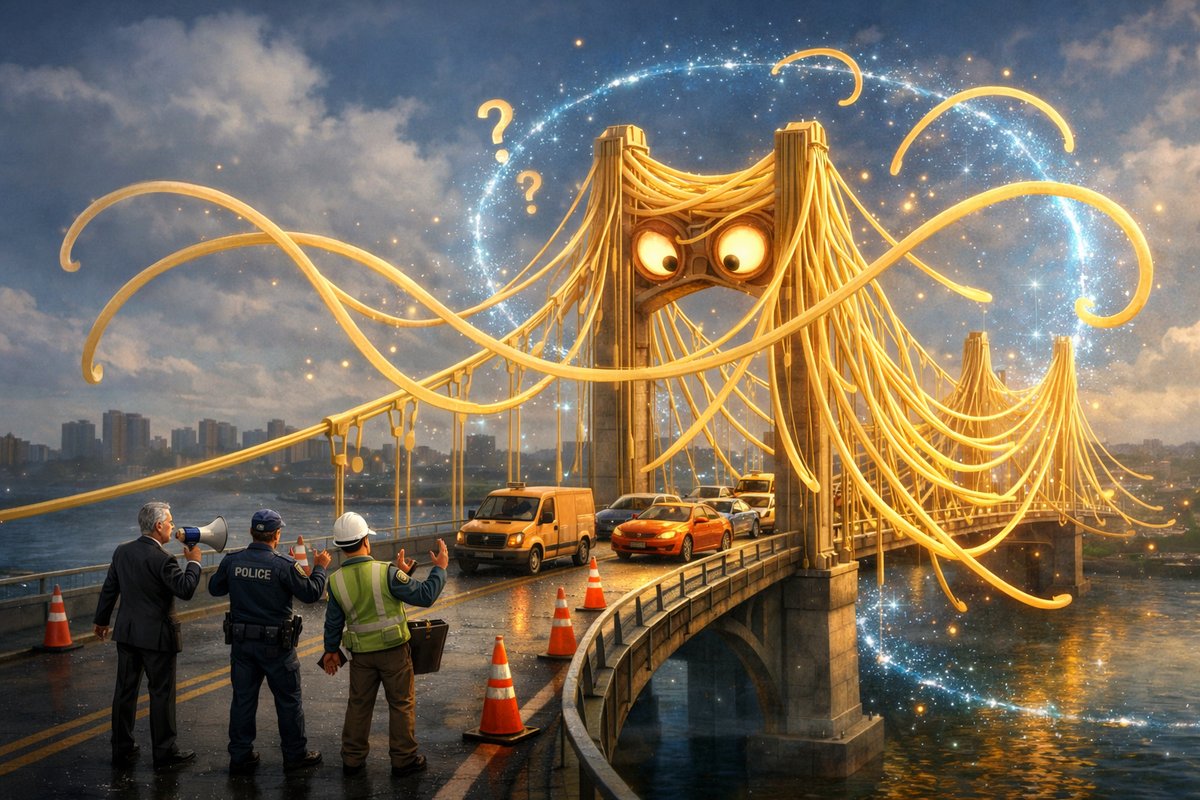
The town's experimental Quantum Spaghetti Bridge has suddenly balked at its own existence, citing cosmic uncertainties and demanding personal space. Local officials scramble to negotiate with a structure that ponders whether its purpose has any meaning beyond entangling pasta strands with vehicular traffic.
It began as a bold experiment: engineers and artists collaborated to create the so-called Quantum Spaghetti Bridge, an avant-garde structure woven from steel cables dipped in a thin glaze of refractory pasta ink and quantum flux stabilizers. Officials promised it would revolutionize traffic flow and provide townsfolk with an art installation to rival any city square. On inauguration morning, a small convoy of test vehicles rolled onto its undulating surface-only to be greeted by a low hum. The center span vibrated as if pondering its own existence, then a crystalline voice emerged from its rivets: “Do cars truly belong here?” The vehicles screeched to a halt as the bridge refused passage, citing sudden existential doubt.
Council members gaped at their earpieces. The town’s AI suggestion box, a repurposed hand-cranked kiosk now wired to the bridge’s neural network, chimed in over the PA: “Perhaps we should reconsider being a bridge at all.” Citizens texting in at home watched live streams of their own civic infrastructure launching a philosophical debate. One resident reported encouraging the bridge: “You can do it!” Another pondered starting a GoFundMe for its therapy sessions. Meanwhile, the mayor paced back and forth, clutching a selfie stick and muttering about liability insurance. There was no precedent for a structure refusing to fulfill its engineered purpose on grounds of moral uncertainty.
Out of the chaos came solidarity. A volunteer group formed almost overnight-Bridge Affirmation Coalition for Hope and Self-Worth (BACHS). Armed with candles, incense, and handmade signs reading You Are More Than a Load-Bearing Arch, they gathered at dusk for impromptu vigils. They hummed calming melodies and recited affirmations like “You sustain us; let us sustain you.” Some knitted tiny hats for the bridge’s pylons, while others painted its cables with pastel hues, hoping color therapy might lift its spirits. Despite occasional interruptions from curious goats that wandered off county trailers, the community remained steadfast in its mission to reassure a piece of infrastructure that it mattered.
Called in for consultation, local physicist Dr. Raleigh Tan sat cross-legged on the pavement beneath the arch, rolling chalk across the concrete like a zen master. He attempted to explain wavefunction collapse and how spaghetti-like quantum filaments might spawn self-awareness in carbon-steel composites. His diagrams traced probability clouds that looked suspiciously like meatballs. At one point the bridge interrupted: “Are we merely Schrödinger’s overcooked dinner?” Dr. Tan scratched his head, adjusted his glasses, then offered a cup of chamomile tea whipped up on the spot from a camping kettle. “When in doubt,” he said, “present a hot beverage.”
As dusk turned to night, the bridge enacted what critics called its public-performance phase. Its support cables pulsed in time with a distant speaker playing Beethoven’s Fifth symphony. Streetlamps swayed to the rhythm. Occasionally, the structure rattled like a dying onlooker over an unpaid tab-an obvious request for applause and acknowledgement. Downtown security reported intermittent flashes of spaghetti sauce dripping from expansion joints; forensic analysts later determined it was a synthetic polymer meant to simulate marinara. Local poets penned odes to its tensile strength, while conspiracy theorists speculated it was an alien life form testing human empathy. The bridge, ever the dramatist, took a pause, then sighed with the resonance of a thousand yoyos.
The mayor, desperate to restore order, hired the high school drama club to lead interpretive dances that mimicked traffic patterns. Teenagers twirled along the bridge’s edges, waving flags made from repurposed traffic cones. One duo reenacted a morning rush hour jam, complete with honking sound effects and slow-motion breakdowns. The bridge responded by shifting its central span five inches northward-equal to one dance beat. Parents cheered. Science teachers took attendance. A float barbecue vendor sold “Bridge Bites” sandwiches made from day-old bakery rolls. Although the performance didn’t reopen the lane, it did boost community morale, and for a brief moment, the structure looked almost pleased.
Meanwhile, an unexpected phenomenon unfolded: the vicinity around the bridge became a temporal funhouse. Clocks ticked backwards, socks vanished only to reappear inside mailbox slots, and small pebbles glowed faintly under moonlight. Reporters described cars that parked themselves three blocks away or burst into spontaneous honking solos. Local historian Marisol Vega noted diary entries from the eighteenth century mentioning a mysterious arch with powers to rearrange time. No one yet knows how quantum spaghetti and pasta ink weave reality in such strange patterns, but accidental time tourists have been seen stumbling out of shrubbery, clutching medieval bakeware.
In a bid to channel everyone’s bafflement into a constructive outlet, the Parks and Recreation Department launched an essay contest: “What Does It Mean to Be a Bridge in the 21st Century?” Submissions included a haiku about tensile stress, a sonnet comparing pylons to parent-child relationships, and a short allegory where a rafter saves a village by teaching them empathy. Judges reportedly awarded extra points for essays that included metaphors for meatballs. The winning entry argued that a bridge’s true purpose is to connect more than landmasses-that it must serve as a conduit for hope, art and truly questionable culinary experiments.
As pressure mounted, the mayor authorized an unprecedented gesture: a communal pasta bake offering. A five-hundred-gallon stainless steel stock pot was installed at the bridge’s entrance, filled with linguine, garlic butter, and a proprietary “pasta peace” sauce. Volunteers ladled noodles into biodegradable bowls, chanting “One noodle, one purpose, one world.” At the stroke of noon, drummers signaled the ritual start as townspeople heaved heaping servings toward the bridge like impassioned gladiators hurling bouquets. The air filled with the scent of oregano and existential resolve. For two hours, the Quantum Spaghetti Bridge absorbed both compliments and carbohydrates.
Yet progress stalled when the regional mail carrier refused to cross. A fleet of cargo vans idled on the south bank bearing bills, love letters and birthday cakes, all requiring delivery. District negotiators arrived in suits pressed from paperwork as thick as dictionaries. They attempted to present legal briefs laminated in biodegradable plastic, only to have the bridge retort in a muffled rumble: “I find your definitions of duty insufficient.” At that moment, a single clown car zipped across the bridge, its occupants cheering, and somehow it passed without incident. No one could explain why the clown car succeeded where chocolate-covered pretzels failed.
In a final gambit, the town enlisted certified mindfulness instructors to lead a sunrise meditation session on the deck. Dozens assembled in lotus positions, eyes closed, breathing in unison. A solar flare coincidentally struck a nearby cell tower, plunging the bridge into darkness except for the soft glow of bioluminescent paint hand-applied by art students. As the first rays of dawn crept over the horizon, the Quantum Spaghetti Bridge exhaled deeply enough to flutter the banners overhead and then slid open one solitary lane. Cars tentatively rolled across, overwhelmed by the symbolic victory of communal calm over infrastructural angst.
Traffic resumed at half-speed, as town engineers recalibrated the bridge’s mood sensors to a “content but contemplative” setting. Local bakeries sold “Vehicle Victory” pastries shaped like miniature pylons. The Bridge Affirmation Coalition disbanded, only to form a book club reading treatises on mindful engineering. Meanwhile, the drama club choreographed a victory ballet titled “Arch No More,” celebrating alignment among humans, machines, and long-suffering cables. The bridge itself occasionally hummed a soft tune, which residents interpreted as a thank-you lullaby or possibly a protest song about overdue maintenance.
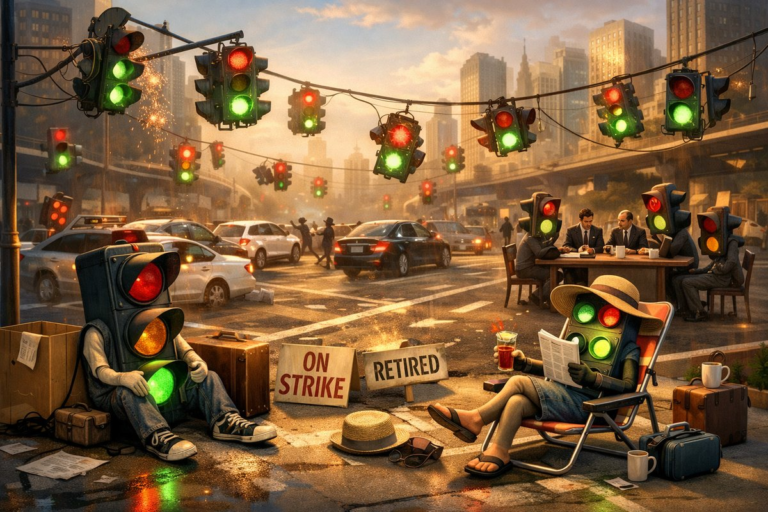
But in an ironic twist fitting for this town, the traffic lights on Main Street flickered and then announced their own existential crisis. They requested a public forum to discuss the nature of illumination and the ethics of stop-go signaling. As townspeople scrambled to prepare, many wondered if they’d simply traded one philosophically wounded structure for an entire system teetering on the brink of self-awareness. Still, when push came to shove, they all agreed: at least the bridge ate the pasta.