Location
Mount Vernon, WA 98274

Location
Mount Vernon, WA 98274
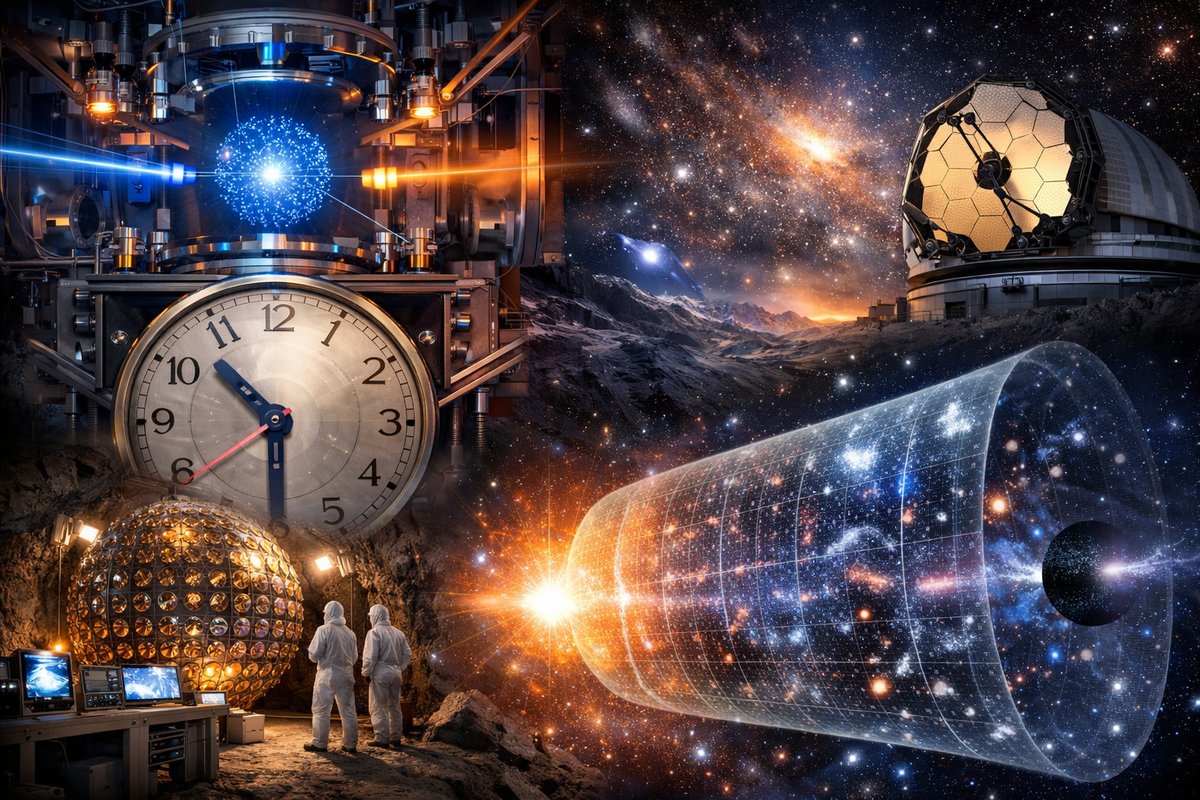
From ultrastable lab clocks measuring nanosecond warps to subterranean detectors hunting elusive dark matter, new research is weaving an intricate narrative of time and substance. Cutting-edge telescopes and quantum simulations now offer glimpses into the universe's infancy, reshaping our sense of cosmic tempo and material essence.
Humanity’s urge to chart the passage of time and unveil the secrets of matter has entered a bold new phase. In observatories perched high on rocky peaks, within underground chambers shielded from terrestrial noise, and inside quantum simulators chilled near absolute zero, researchers are forging novel pathways. No longer content with abstract equations, they are crafting experiments that pull back the veil on how the universe ticks and what it’s made of. This emerging convergence of cosmology, quantum mechanics, and thermodynamics is not just academic-its ripple effects may reshape precision navigation, materials science, and our own perception of existence.
A network of mid-sized optical and radio telescopes has recently completed its inaugural sky survey, tracing the faint glow of galaxies whose light was emitted when the universe was just a few hundred million years old. By comparing subtle shifts in spectral lines across dozens of these primordial structures, astronomers have unearthed evidence of irregular motions-tiny eddies of matter that challenge the smooth, uniform expansion posited by earlier models. These motions, likely seeded by quantum fluctuations in the earliest cosmic moments, are now imaged with enough clarity to test theories of how particles acquired mass in the aftermath of the big bang.
Back on Earth, optical lattice clocks are revealing another facet of cosmic time. Researchers have built devices so stable that two clocks sitting a meter apart exhibit a measurable time dilation purely due to Earth’s gravitational gradient. This breakthrough promises sub-nanosecond synchronization for global positioning systems and telecommunication networks. By extending this network of clocks into orbit on small satellites, scientists aim to map Earth’s geopotential field with unprecedented detail, turning time itself into a probe of planetary structure and dynamics.
While telescopes and clocks offer outward and temporal resolutions, gravitational wave detectors provide the ability to eavesdrop on spacetime’s most violent events. The latest upgrade to a subterranean interferometer has boosted its sensitivity to lower-frequency ripples, bringing binary mergers of intermediate-mass black holes within reach. In its first run, the detector registered a faint signal consistent with a cosmic collision over a billion light-years away. Each recorded waveform carries a signature of spacetime’s elasticity-data that may one day help reconcile general relativity with a quantum theory of gravity.
In parallel, teams operating deep-underground dark matter labs have implemented novel detection materials that promise higher sensitivity to low-mass candidate particles. By stacking ultra-pure crystalline wafers and monitoring minute bursts of heat or light, these setups are beginning to explore previously inaccessible regions of parameter space. Though no definitive dark matter interactions have been logged yet, every null result tightens the constraints on theories proposing hidden sectors or ultra-light particles influencing cosmic evolution.
Beyond direct searches, physicists are harnessing quantum simulators to emulate exotic phases of matter that once existed only in the early universe. Arrays of ultracold atoms trapped in light lattices can mimic the behavior of quark-gluon plasmas or topological solitons, offering a tabletop view of phenomena otherwise confined to particle accelerators. Such analog spacetime experiments also shed light on how information and entropy propagate in curved geometries, with implications for black hole thermodynamics and the arrow of time.
Speaking of entropy, materials scientists have devised granular assemblies that demonstrate irreversible transitions under cyclic compression. By tracking particle rearrangements with high-speed imaging, they can visualize how microscopic disorder accumulates into macroscopic friction and heat. These results echo cosmic principles: just as galaxies assembled and thermalized after the big bang, granular media evolve irreversibly toward higher entropy states, reinforcing the deep link between universal expansion and the thermodynamic arrow.
These breakthroughs are not confined to elite laboratories. Interactive planetarium programs now integrate real-time data streams from observatories, illustrating how distant cosmic events warp the very fabric of spacetime. Portable cloud chambers are making appearances in high school physics classes, allowing students to see tracks of cosmic rays that have journeyed across the galaxy. Such hands-on engagement fosters a sense of immediacy-time and matter are not abstract concepts but tangible realities to be observed and questioned.
Amid these technical advances, philosophers and storytellers are weighing in on the human dimension. If time and matter are woven together in a cosmic tapestry, what does that imply for memory, identity, and the flow of consciousness? Some experimental artists are creating immersive installations where visitors walk through laser grids that shift according to atomic clock readings, evoking the sensation of drifting through time at variable speeds. Others compose soundscapes derived from gravitational wave data, translating spacetime tremors into musical motifs that resonate with our emotional core.
Sustainability has also become part of the conversation. Researchers are exploring eco-friendly materials for detector components and cryogenic systems, aiming to minimize the carbon footprint of large-scale facilities. Solar- and wind-powered micro-grids are being piloted at remote observatories, ensuring that the quest to understand the cosmos does not compromise Earth’s own ecological balance. The marriage of green engineering with frontier science underscores a broader ethos: the curiosity that drives us outward must be tempered by responsibility toward our home planet.
At its heart, the interplay between time and matter invites a deeper emotional intelligence. When we measure a nanosecond drift or detect a fragment of a meteorite that fell millions of years ago, we connect with stories far older than human history. Such encounters can foster humility, resilience, and wonder-qualities that resonate in personal lives as much as in scholarly journals. In a world often divided by competing narratives, the cosmic quest provides a unifying perspective: all matter and all moments belong to the same unfolding universe.
Looking ahead, the next decade promises even more audacious experiments. Networks of quantum clocks on multiple satellites could map temporal warps around other planets. Neutrino detectors embedded under polar ice may capture ghostly particles from supernovae in real time. And hybrid facilities will combine optical, gravitational, and particle observatories in a single site, enabling instantaneous multi-messenger alerts for cataclysmic events.
Despite this rapid progress, fundamental mysteries remain. What is the ultimate fate of time in a universe dominated by dark energy? How did matter obtain its precise properties after the big bang? And can entangled quantum systems reveal a hidden layer of spacetime geometry? These questions serve as both challenge and inspiration. In the coming years, as new instruments come online and theoretical frameworks evolve, each answer will likely open fresh puzzles, ensuring that the story of time, matter, and mystery continues to unfold.
In the end, whether we peer through a telescope, synchronize a network of clocks, or trace particle tracks in a cloud chamber, we are participants in an epic narrative. It is a tale that spans the smallest quanta to the grandest galaxies, a reminder that our quest for understanding is as much about the external universe as it is about our inner horizons. The threads of reality are intricate and interwoven, but with each discovery we gain another glimpse of the vast, resonant tapestry we inhabit.